Photographs
what it really looks like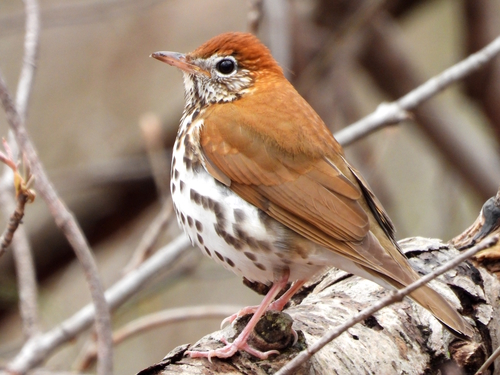
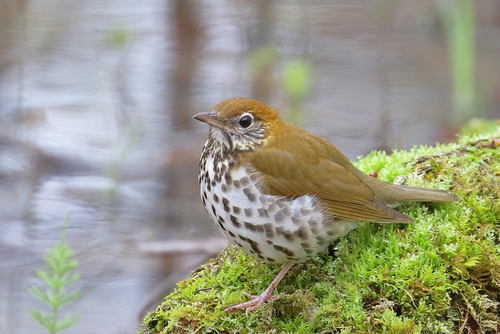
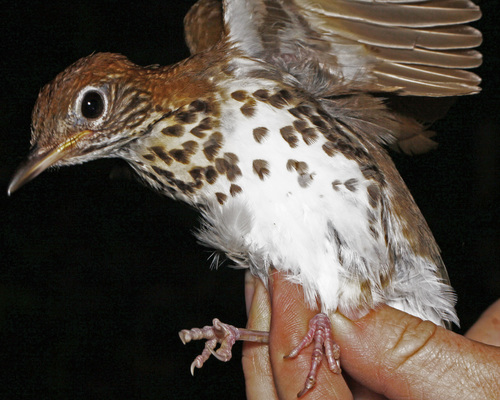
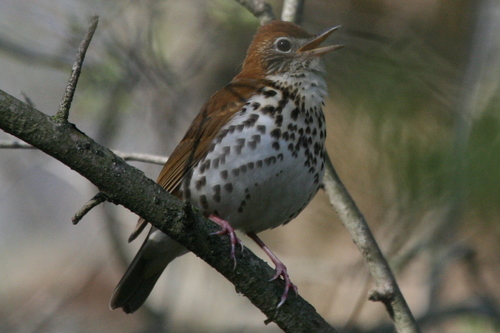
Photographs from iNaturalist · photographer credits
About from Wikipedia
Description
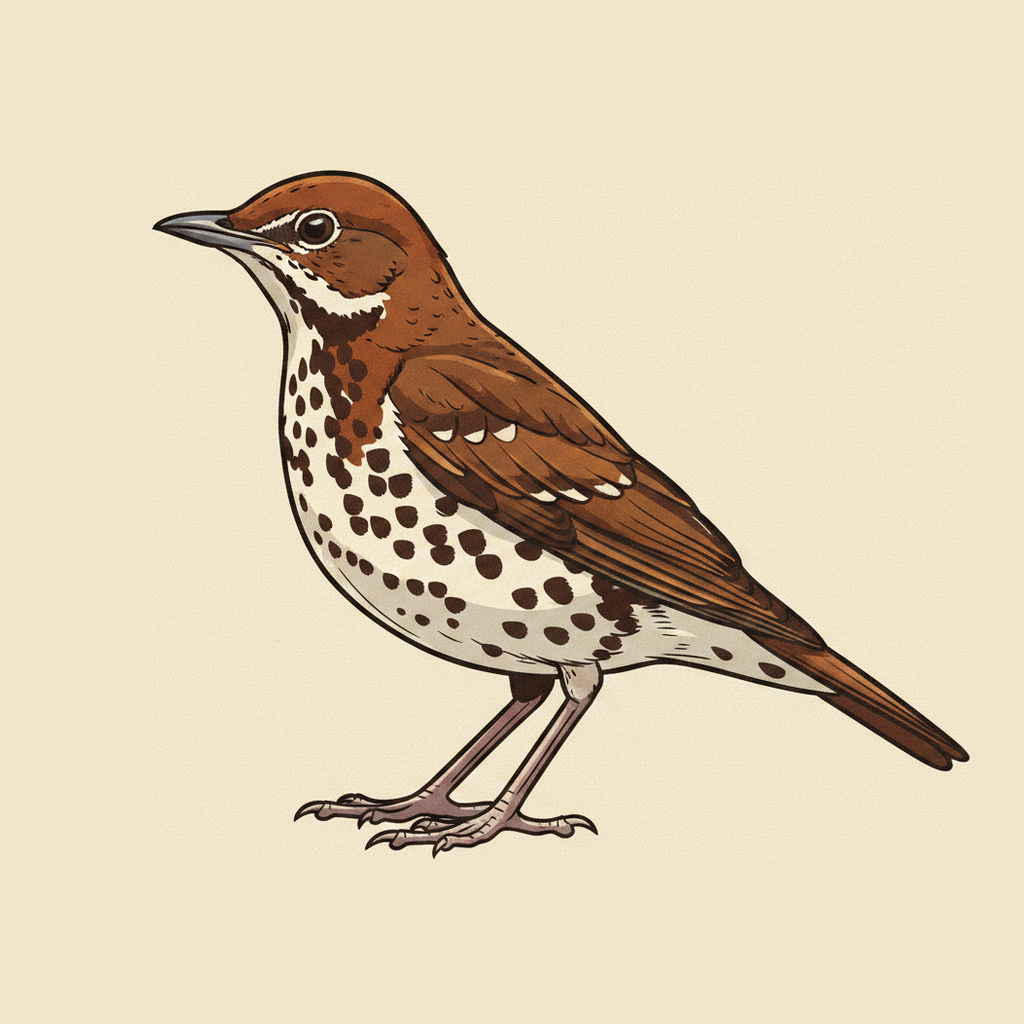
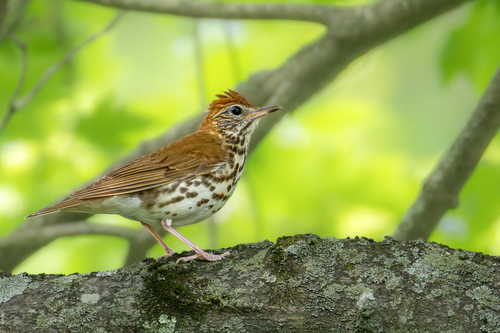
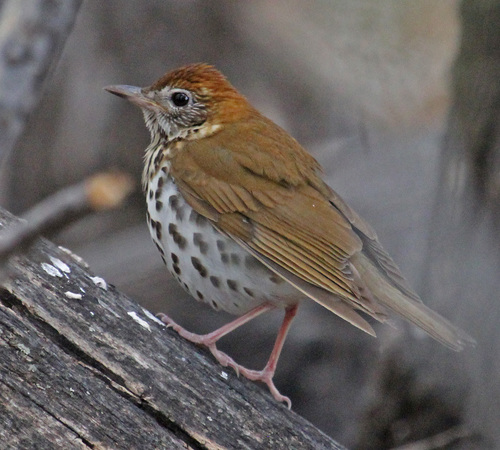
The adult wood thrush is 18 to 21.5 cm (7.1 to 8.5 in) long, with a wingspan of 30 to 40 cm (12 to 16 in) and a body mass of 48 to 72 g (1.7 to 2.5 oz). Among standard measurements, the wing chord is 9.6 to 11.6 cm (3.8 to 4.6 in), the bill is 1.6 to 2 cm (0.63 to 0.79 in) and the tarsus is 2.8 to 3.3 cm (1.1 to 1.3 in). It is distinctly larger than the Catharus thrushes with which the species is often sympatric but slightly smaller than the common American robin. The longest known lifespan for a wood thrush in the wild is 8 years, 11 months. The crown, nape, and upper back are cinnamon-brown, while the back wings, and tail are a slightly duller brown. The breast and belly are white with large dark brown spots on the breast, sides, and flanks. It has white eye rings and pink legs. Other brownish thrushes have finer spotting on the breast. The juvenile looks similar to adults, but has additional spots on the back, neck, and wing coverts. The male and female are similar in size and plumage.
Range & habitat
The wood thrush's breeding range extends from Manitoba, Ontario and Nova Scotia in southern Canada to northern Florida and from the Atlantic coast to the Missouri River and the eastern Great Plains. It migrates to southern Mexico through to Panama in Central America in the winter, mostly in the lowlands along the Atlantic and Pacific coasts. It generally arrives on the U.S. Gulf Coast during the first week of April. Fall migration usually begins in mid-August and continues through mid-September. Migration takes place at night, allowing them to find their direction from the stars and orient themselves by detecting the Earth's magnetic field. The wood thrush prefers deciduous and mixed forests for breeding. It prefers late-successional, upland mesic forests with a moderately-dense shrub layer. It favors areas with running water, moist ground, and high understorey cover. The breeding habitat generally includes trees taller than 16 m (52 ft), a fairly open forest floor, moist soil, and leaf litter, with substrate moisture more important than either canopy cover or access to running water. The wood thrush can breed in habitat patches as small as 0.4 hectares (0.99 acres), but it runs the risk of higher predation and nest parasitism. The wood thrush's breeding range has expanded northward, displacing the veery and hermit thrush in some locations. In recent times, as a result of fragmentation of forests, it has been increasingly exposed to nest parasitism by brown-headed cowbirds, as well as loss of habitat in the winter range. A Costa Rica-based study found that wood thrushes prefer environments with high precipitation on their non-breeding grounds, possibly due to greater prey availability in those habitats.
Behaviour
The wood thrush is primarily solitary, but occasionally forms mixed-species flocks in the winter. Its breeding territory ranges from 800 to 8,000 m2 (960 to 9,570 sq yd) in size, and are used for nesting, gathering nest materials, and foraging. Some wood thrushes also defend a feeding territory in the winter. Territorial interactions are usually settled without physical contact, but in high-intensity encounters or nest defense, physical interactions with the feet or bill have been observed. Defense behaviors in response to nest predators include wing flicks, tail flicks, and raising the crest, sometimes escalating to dives and strikes. This species has also been observed displaying a behavior known as "anting." Anting occurs when a bird picks up a single ant or group of ants and rubs them on its feathers. The purpose of this behavior is unknown, but it is thought that the birds may be able to acquire defensive secretions from the ants possibly used for some medicinal purposes, or that it simply supplements the birds' own preen oil.
Adapted from Wood thrush on Wikipedia, used under CC BY-SA 4.0.