Photographs
what it really looks like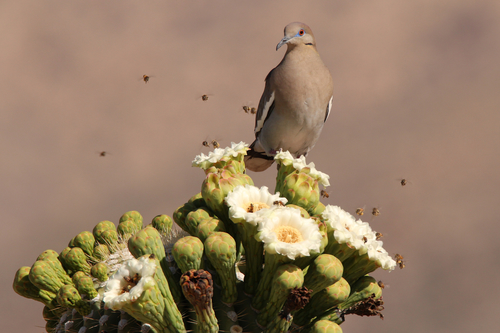



Photographs from iNaturalist · photographer credits
About from Wikipedia
Description
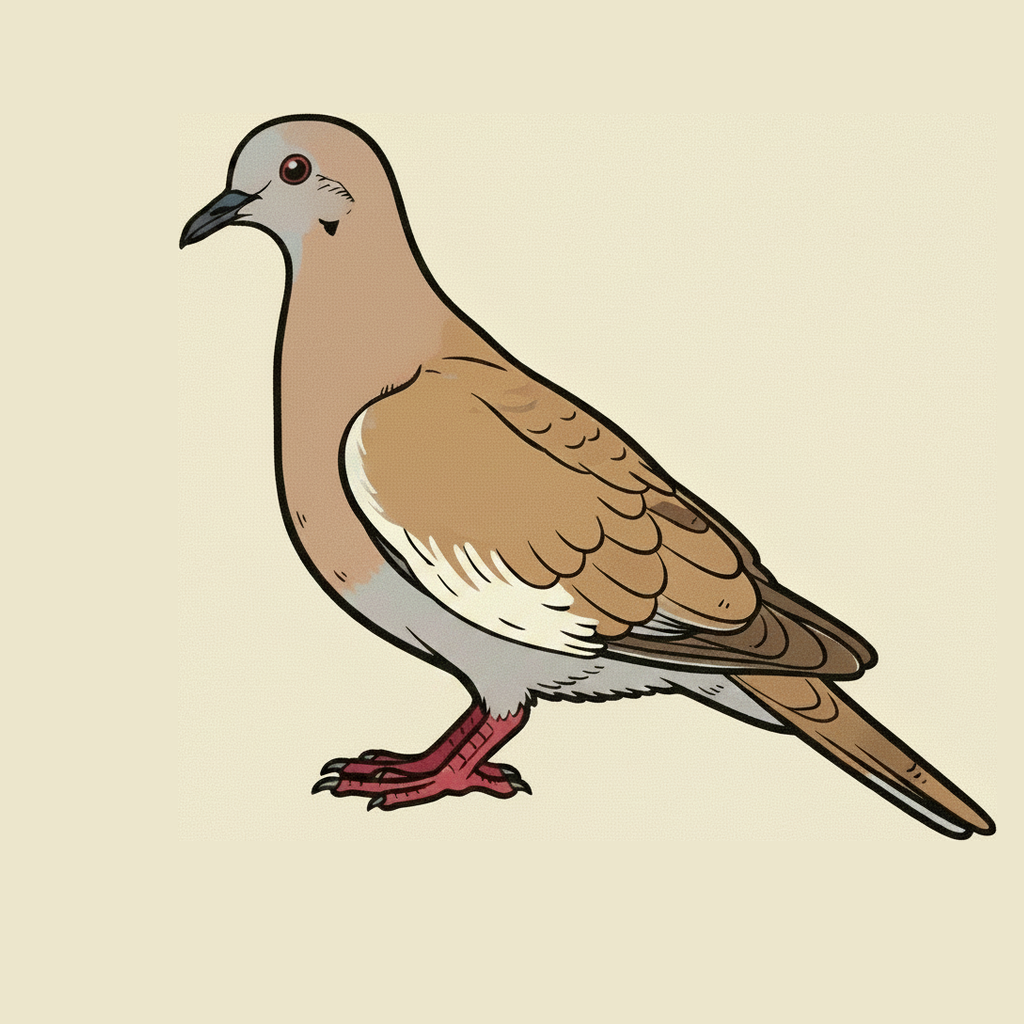
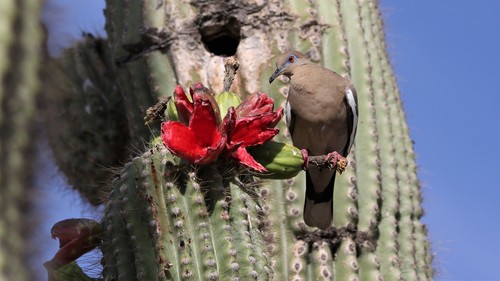
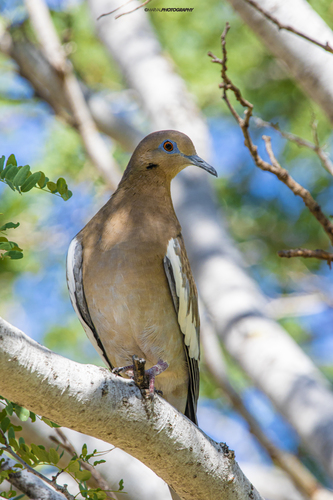
White-winged doves are a plump, medium-sized bird (large for a dove), at 29 cm (11 in) from tip to tail, and a weight of 150 g (5.3 oz). Wingspan ranges from 18.9 to 22.8 in (48–58 cm). They are brownish-gray above and gray below, with a bold white wing patch that appears as a brilliant white crescent in flight, and is also visible at rest. Adults have a ring of blue, featherless skin around each eye and a long, dark mark on the lower face. They have a blue eye ring, and their legs and feet are brighter pink/red. Their eyes are bright crimson, except for juveniles, who have brown eyes. Juveniles are duller and grayer than adults and lack iridescence. Juvenile plumage is usually found between March and October. Differentiating between sexes is difficult, and usually requires examination of the cloaca. Males do have a more iridescent purple color to the crown, neck, and nape, as well as a more distinctive ear spot, though the differences are slight. Males are usually heavier on average, but differences in daily weight due to feeding make this an inaccurate field tool. Thus, most observers cannot accurately differentiate between sexes based on external characteristics alone. The identifying hallmark is its namesake white-edged wing, which similar species lack. It appears similar to the mourning dove, with which it may be easily confused. Compared to the mourning dove, it is larger and heavier. It has a short, rounded tail, whereas the mourning dove has a long, tapered, triangular tail. The mourning dove has several black spots on the wing; the white-winged dove does not. Other similar species include the white-tipped dove, but the lack of white wing edging is distinctive. The same goes for the invasive Eurasian collared dove, which is further differentiated by grayish overall color and black neck band. Their molt is similar to that of the mourning dove. Molting runs from June through November and occurs in the summer breeding grounds unless interrupted by migration.
Range & habitat
Some populations of white-winged doves are migratory, wintering in Mexico, Central America, and the Caribbean. They are year-round inhabitants in Texas. San Antonio, Texas, had a year-round population of over a million doves in 2001. The white-winged dove inhabits scrub, woodlands, desert, urban, and cultivated areas. They are found increasingly farther north, now being visitors to most of the United States, and small parts of southern Canada. In recent years with increasing urbanization and backyard feeding, it has expanded throughout Texas, into Oklahoma, Louisiana, and coastal Mississippi. It has also been introduced to Florida. The white-winged dove is expanding outside its historic range into Kansas, Arkansas, Oklahoma, and northern New Mexico. It has been increasingly reported as far north as Canada and Alaska. Within Arizona, populations are effectively divided between agricultural and desert groups. It shares its habitat with that of the mourning dove, but the white winged dove will fly higher. They generally nest at low densities in the desert, but are found in high concentrations near riparian areas. Nesting in riparian zones is referred to as colonial, as opposed to noncolonial behavior in harsher environments. Such colonies are quite variable, but may be very large. Colony size varies from 5 hectares (0.019 mi2) to well over a 1,000 hectares (3.9 mi2). Outside of colonies, nests have a density of less than 10 per hectare, but within colonies, 500–1,000 nests are found per hectare. Before the advent of widespread agriculture, they may not have been widely present in what is now the United States, as evidenced by a lack of fossil remains and absence from the journals of early European explorers. Their presence in California is likely recent, as a result of the manmade filling of the Salton Sea at the turn of the 20th century. The historical range of the dove closely mirrors that of the saguaro cactus, on which it relies heavily for nectar and fruit where it is found. Modern agriculture has greatly expanded its range by providing a reliable source of forage. The urban heat island effect may also enable them to live further north than they otherwise could. White-winged doves typically migrate into Arizona beginning in March. In California, birds arrive in April and depart by August. Texas migrations run from April through June, peaking in May, and departures run from September to October. Migratory groups may include as many as 4,000 individuals, though typically less than 50. A combination of weather, food availability, and hunting pressure can affect the timing of migration. As populations expand in Texas they are becoming less migratory; about 1/3 of birds now overwinter in Texas. Migrations are tracked via traditional banding methods, but the isotope composition of hydrogen and carbon in the feathers can also be used. A 2015 study showed that by tracking the amount of various isotopes, researchers could accurately identify a white-winged dove's migration origin. They could also identify if it had been eating from saguaros because of the unique carbon signature that cactus photosynthesis produces.
Behaviour
Normally, up to 4000 birds are seen migrating, but in Texas, a flock of up to a million birds was recorded. Z. asiatica may fly 25 or more miles to find water, though they can be sustained solely by the water in saguaro cactus fruit.
Adapted from White-winged dove on Wikipedia, used under CC BY-SA 4.0.