Photographs
what it really looks like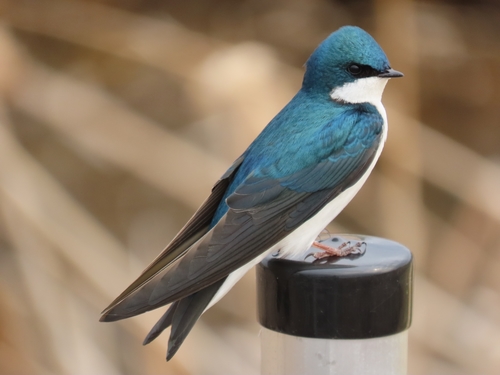
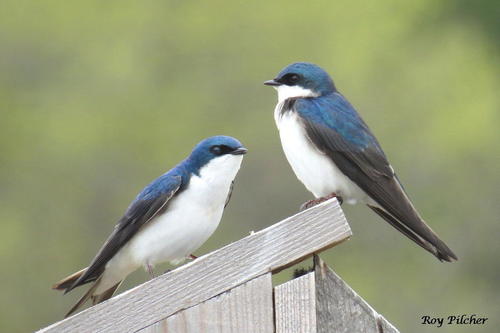
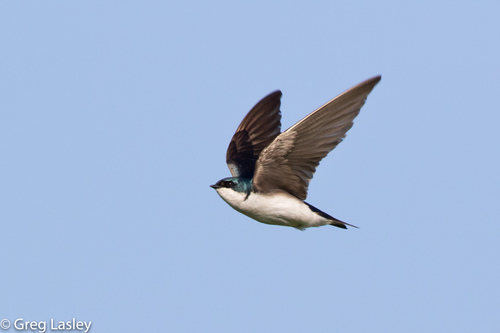
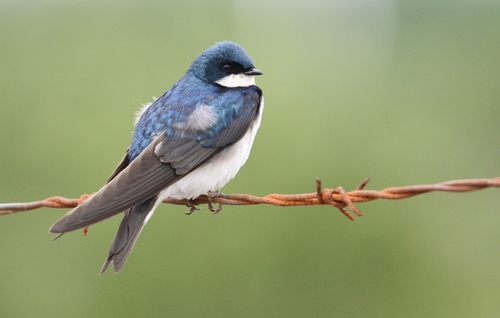
Photographs from iNaturalist · photographer credits
About from Wikipedia
Description
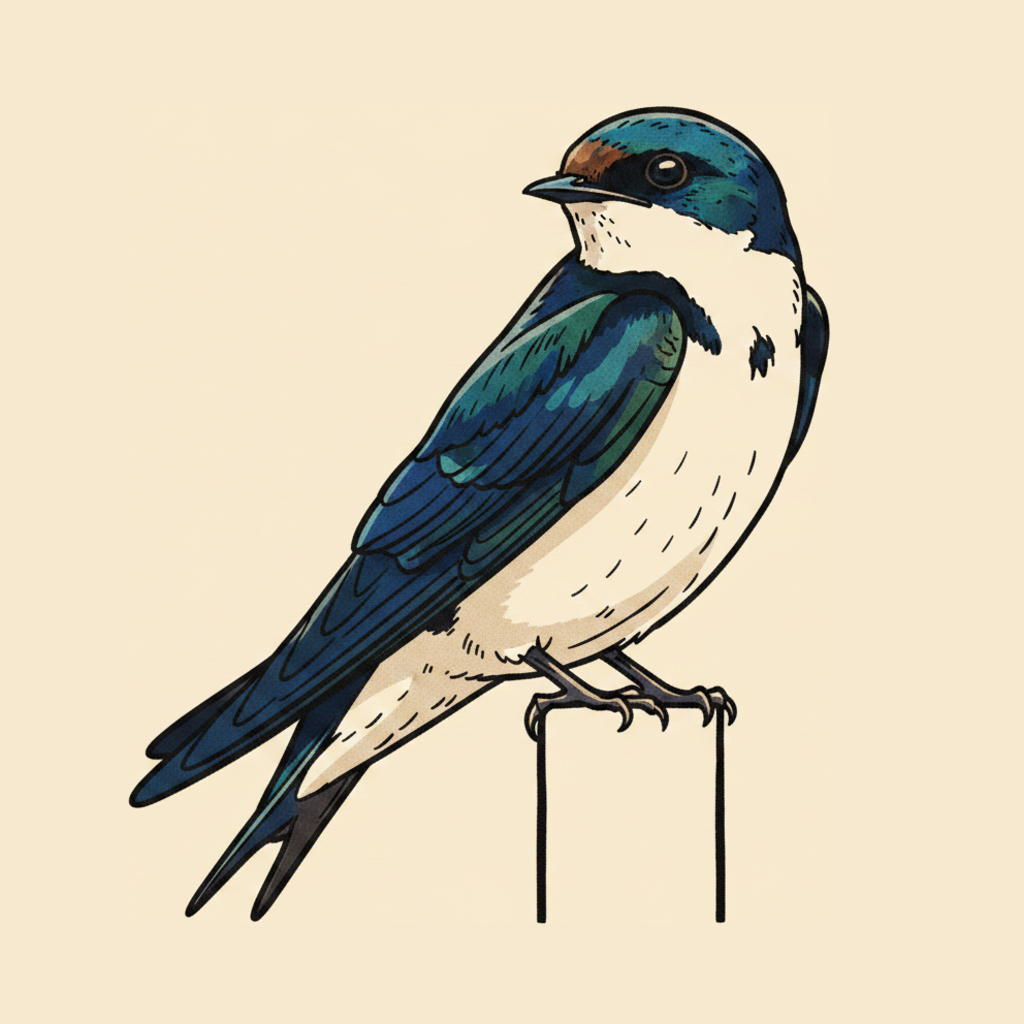
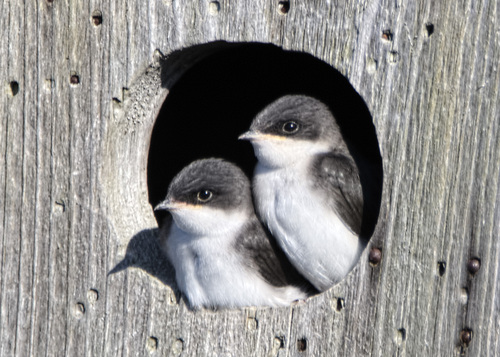
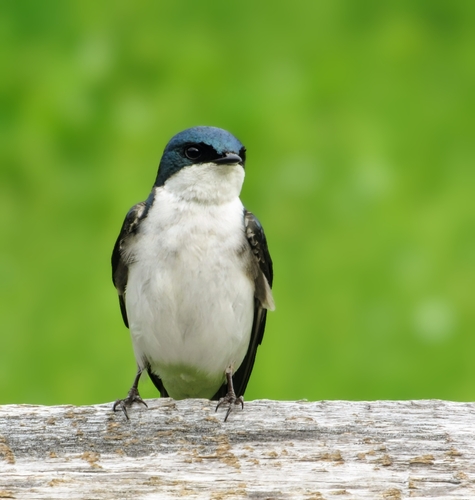
The tree swallow has a length between about 12 and 14 cm (4.7 and 5.5 in) and a weight of approximately 17 to 25.5 g (0.60 to 0.90 oz). Wingspan ranges from 30 to 35 cm (12 to 14 in). The male has mostly glossy blue-green upperparts, the wings and tail being blackish. The underparts and the cheek patch are white, although the underwing coverts are gray-brown. The bill is black, the eyes dark brown, and the legs and feet pale brown. The female is duller in color than the male, and sometimes has a brown forehead. The second-year female also has brown upperparts, with a variable number of blue feathers; some third-year females also retain a portion of this subadult plumage. According to a 1987 study, this likely allows a younger female to explore nest sites, as the resident male is usually less aggressive to a subadult female. A 2013 study found that the resident female was less aggressive towards second-year female models when they were presented separately from older models. Why the female eventually replaces its subadult plumage is unknown; it may allow males to assess female quality, as pairs mate assortatively based on plumage brightness. The juvenile tree swallow can be distinguished by its brown upperparts and gray-brown-washed breast.
Range & habitat
The tree swallow breeds in North America. Its range extends to north-central Alaska and up to the tree line in Canada. It is found as far south as Tennessee in the eastern part of its range, California and New Mexico in the west, and Kansas in the center. It occasionally breeds further south in the US, and vagrants are sometimes found in the Arctic Circle, the northern Pacific, Greenland, and Europe. The wintering range is from California and southwestern Arizona in the west and southeastern Virginia in the east south along the Gulf Coast to the West Indies, Panama, and the northwestern South American coast. While migrating, this swallow often uses stop-over sites, spending an average of 57 days at these areas during autumn. To get to its wintering range, it often uses one of three flyways: the Western flyway, west of the Rocky Mountains; the Central flyway, between the Rocky Mountains and the Great Lakes, stretching south into Eastern Mexico; and the Eastern flyway, from the Great Lakes east. When a swallow returns to nest, it usually does not change breeding sites. The breeding habitat of this bird is primarily in open and wooded areas, especially those near water. It roosts every night during the non-breeding season, preferring to rest in cane or reed beds over water, but it is also found over land and on trees and wires. Roosting sites are generally 100 to 150 kilometres (62 to 93 mi) apart.
Behaviour
Because of the large amount of research on the tree swallow and how it willingly breeds in nest boxes, biologist Jason Jones recommended that it be considered a model organism. Although it is aggressive during the breeding season, this swallow is sociable outside of it, forming flocks sometimes numbering thousands of birds.
Adapted from Tree swallow on Wikipedia, used under CC BY-SA 4.0.