Photographs
what it really looks like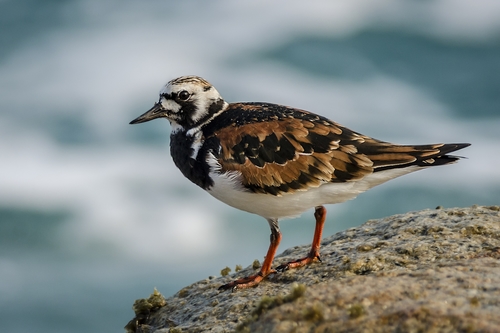


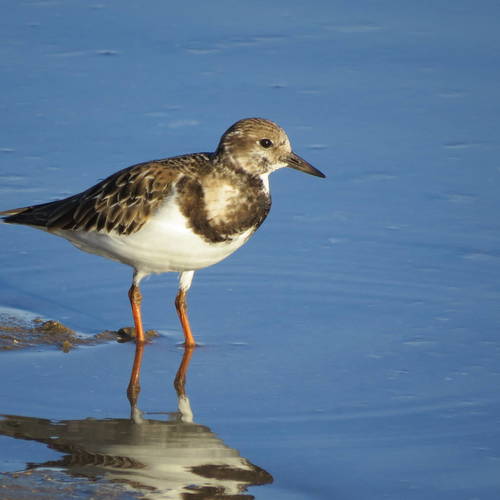
Photographs from iNaturalist · photographer credits
About from Wikipedia
Description
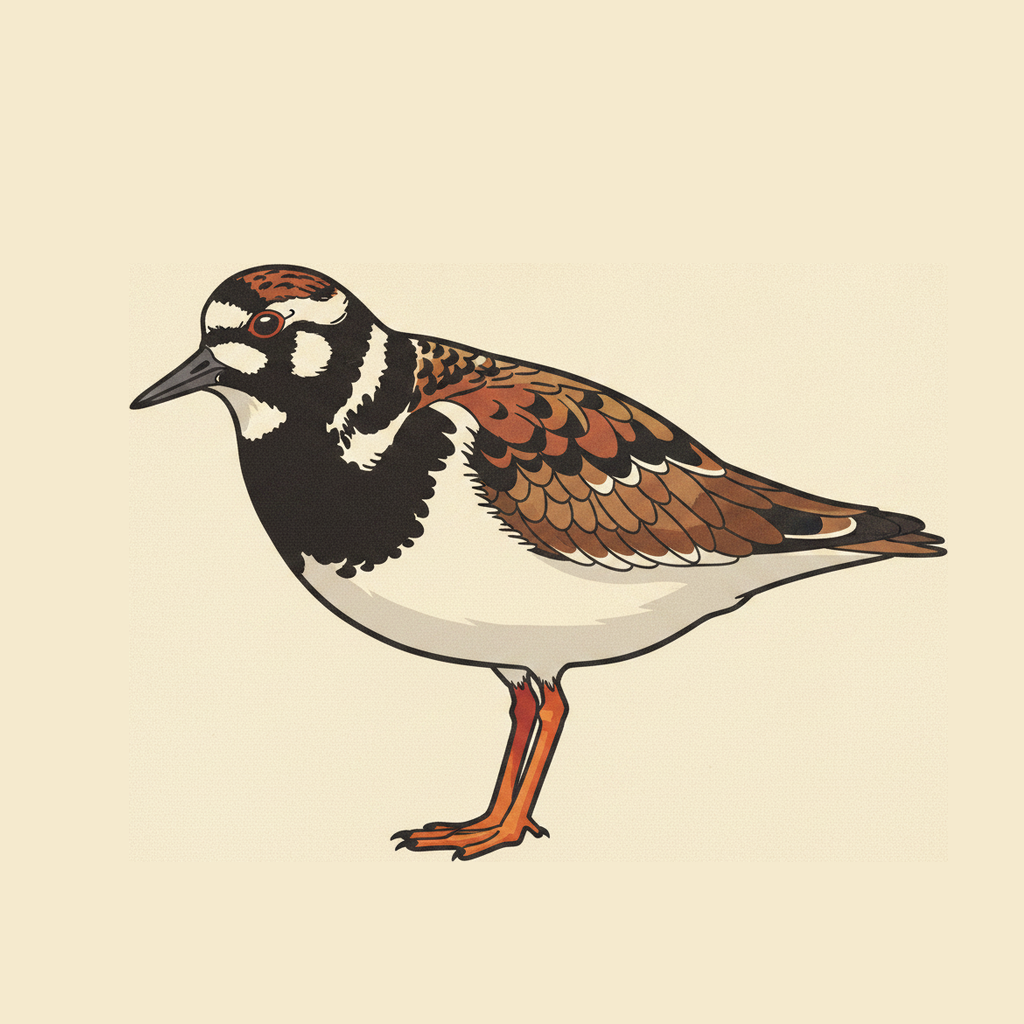
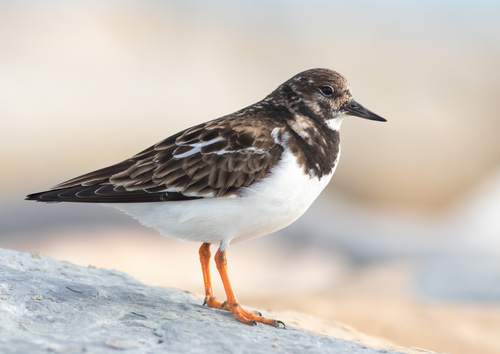
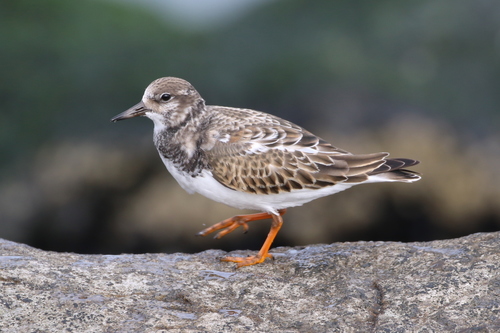
It is a fairly small and stocky bird, 22–24 cm (8.7–9.4 in) long with a wingspan of 50–57 cm (20–22 in) and a weight of 85–150 g (3.0–5.3 oz). The dark, wedge-shaped bill is 2–2.5 cm (0.79–0.98 in) long and slightly upturned. The legs are fairly short at 3.5 cm (1.4 in) and are bright orange. In all seasons, the plumage is dominated by a harlequin-like pattern of brown, black and white. Breeding birds have reddish-brown upper parts with black markings. The head is mainly white with black streaks on the crown and a black pattern on the face. The breast is mainly black apart from a white patch on the sides. The rest of the underparts are white. In flight it reveals a white wingbar, white patch near the base of the wing and white lower back, rump and tail with dark bands on the uppertail-coverts and near the tip of the tail. The female is slightly duller than the male and has a browner head with more streaking. Non-breeding adults are duller than breeding birds and have dark grey-brown upperparts with black mottling and a dark head with little white. Juvenile birds have a pale brown head and pale fringes to the upperpart feathers creating a scaly impression. Birds of the subspecies A. i. morinella are marginally smaller, with darker upperparts and less streaking on the crown. The ruddy turnstone has a staccato, rattling call and also a chattering alarm-call which is mainly given during the breeding season.
Range & habitat
The ruddy turnstone breeds in northern latitudes, usually no more than a few kilometres from the sea. The subspecies A. i. morinella occurs in northern Alaska and in Arctic Canada as far east as Baffin Island. A. i. interpres breeds in western Alaska, Ellesmere Island, Greenland, Norway, Denmark, Sweden, Finland, Estonia and northern Russia. It formerly bred on the Baltic coast of Germany and has possibly bred in Scotland and the Faroe Islands. In the Americas, the species winters on coastlines from Washington and Massachusetts southwards to the southern tip of South America although it is scarce in southern parts of Chile and Argentina and is only an unconfirmed vagrant in the Falkland Islands. In Europe, it winters in western regions from Iceland, Norway and Denmark southwards. Only small numbers are found on Mediterranean coasts. In Africa, it is common all the way down to South Africa with good numbers on many offshore islands. In Asia, it is widespread in the south with birds wintering as far north as southern China and Japan (mainly in the Ryukyu Islands). It occurs south to Tasmania and New Zealand and is present on many Pacific islands. Some non-breeding birds remain year round in many parts of the wintering range, with some of those birds still taking on breeding plumage in the spring and summer.
Behaviour
Ruddy turnstones can survive in a wide range of habitats and climatic conditions from Arctic to tropical. The typical breeding habitat is open tundra with water nearby. Outside the breeding season, it is found along coasts, particularly on rocky or stony shores. It is often found on man-made structures such as breakwaters and jetties. It may venture onto open grassy areas near the coast. Small numbers sometimes turn up on inland wetlands, especially during the spring and autumn migrations. In terms of wintering sites, ruddy turnstones are particularly faithful to specific locations. A study published in 2009 examined turnstones wintering along a stretch of coastline in the Firth of Clyde. It found that 95% of birds resident to the area at the end of winter returned the following autumn. The same study also confirmed ruddy turnstones as one of the longest lived wader species, with annual adult mortality rates of under 15%. Their average lifespan is 9 years, with 20 years being the longest recorded.
Adapted from Ruddy turnstone on Wikipedia, used under CC BY-SA 4.0.