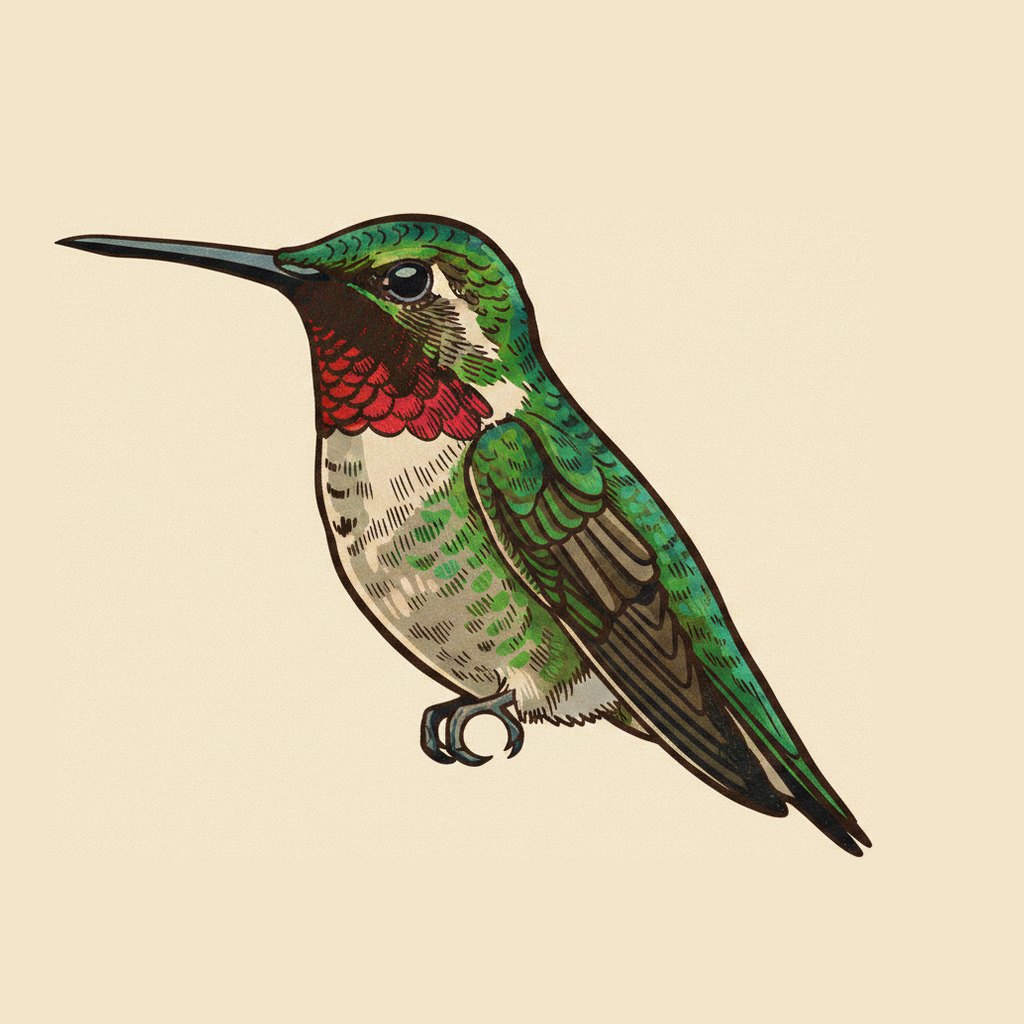
Photographs
what it really looks like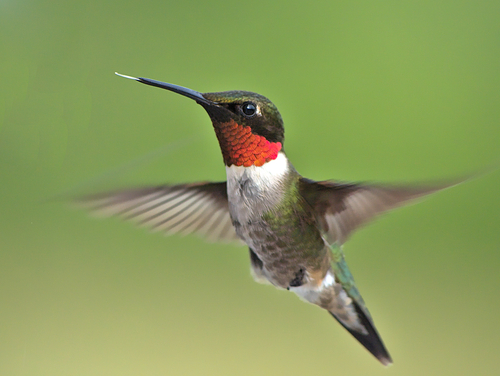
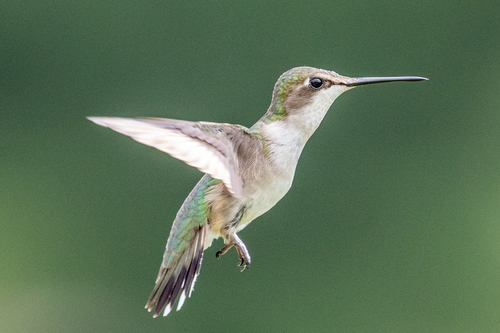
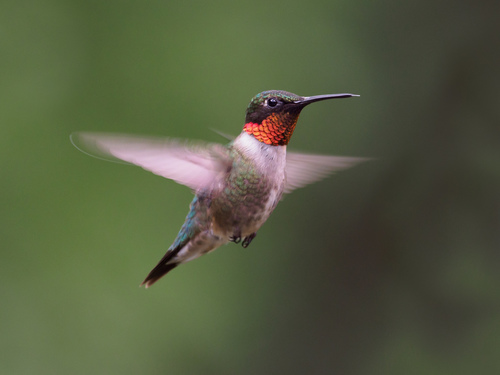
Photographs from iNaturalist · photographer credits
About from Wikipedia
Description
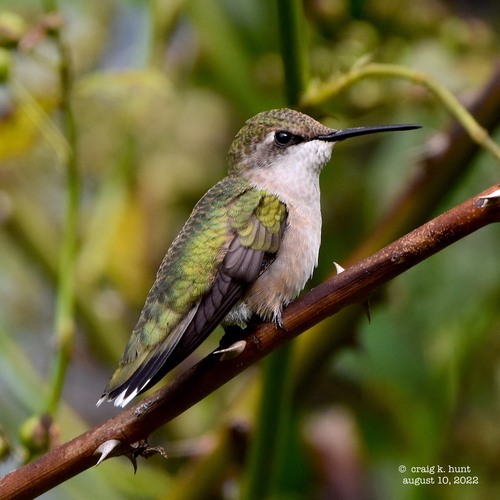
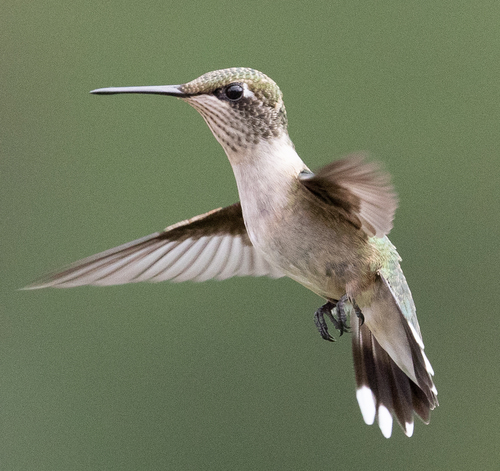
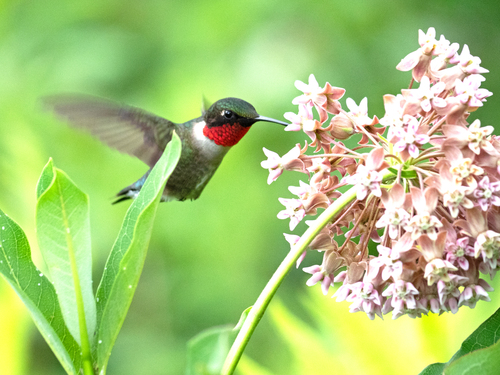
This hummingbird is from 7 to 9 cm (2.8 to 3.5 in) long and has an 8 to 11 cm (3.1 to 4.3 in) wingspan. Weight can range from 2 to 6 g (0.071 to 0.212 oz), with males averaging 3.4 g (0.12 oz) against the slightly larger female which averages 3.8 g (0.13 oz). Adults are metallic green above and grayish white below, with near-black wings. Their bill, at up to 2 cm (0.79 in), is long, straight, and slender. Hummingbird legs are short and have feet with three toes pointing forward and one backward – the hallux. The toes are formed as claws (image) with ridged inner surfaces to aid gripping onto flower stems or petals. The middle toe is around 0.6 cm (0.24 in). The ruby-throated hummingbird can only shuffle to move along a branch, although it can scratch-preen with its feet. The species is sexually dimorphic. The adult male has a gorget (throat patch) of iridescent ruby red bordered narrowly with velvety black on the upper margin and a forked black tail with a faint violet sheen. The red iridescence is highly directional and appears dull black from many angles. The female has a notched tail with outer feathers banded in green, black, and white and a white throat that may be plain or lightly marked with dusky streaks or stipples. Males are smaller than females and have slightly shorter bills. Juvenile males resemble adult females, though usually with heavier throat markings. The plumage is molted once a year on the wintering grounds, beginning in early fall and ending by late winter.
Range & habitat
The breeding habitat is throughout most of the Eastern United States and south-central and southeastern Canada in deciduous and pine forests and forest edges, orchards, and gardens. The female builds a nest in a protected location in a shrub or a tree. Of all hummingbirds in the United States, this species has the largest breeding range. The ruby-throated hummingbird is migratory, spending most of the winter in Florida, southern Mexico and Central America, as far south as extreme western Panama, and the West Indies. During migration, some birds embark on a nonstop 900-mile journey across the Gulf of Mexico and Caribbean from Panama or Mexico to the eastern United States. The bird breeds throughout the eastern United States, east of the 100th meridian, and in southern Canada, particularly Ontario, in eastern and mixed deciduous and broadleaved forest. In winter, it is seen mostly in Mexico and Florida. During migration southward in autumn along the northern coast of the Gulf of Mexico, older male and female birds were better prepared for long-distance flight than first-year birds by having higher body weights and larger fuel loads.
Behaviour
Ruby-throated hummingbirds are solitary. Adults of this species are not social, other than during courtship (which lasts a few minutes); the female also cares for her offspring. Both males and females of any age are aggressive toward other hummingbirds. They may defend territories, such as a feeding territory, attacking and chasing other hummingbirds that enter. As part of their spring migration, portions of the population fly from the Yucatan Peninsula of Mexico across the Gulf of Mexico, arriving first in Florida and Louisiana. This feat is impressive, as an 800 km (500 mi), non-stop flight over water would seemingly require a caloric energy that far exceeds an adult hummingbird's body weight of 3 g (0.11 oz). However, researchers discovered the tiny birds can double their fat mass in preparation for their Gulf crossing, then expend the entire calorie reserve from fat during the 20-hour non-stop crossing when food and water are unavailable. Hummingbirds have one of the highest metabolic rates of any animal, with heart rates up to 1260 beats per minute, breathing rate of about 250 breaths per minute even at rest, and oxygen consumption of about 4 ml oxygen/g/hour at rest. During flight, hummingbird oxygen consumption per gram of muscle tissue is approximately 10 times higher than that seen for elite human athletes. They feed frequently while active during the day. When temperatures drop, particularly on cold nights, they may conserve energy by entering hypothermic torpor.
Adapted from Ruby-throated hummingbird on Wikipedia, used under CC BY-SA 4.0.