Photographs
what it really looks like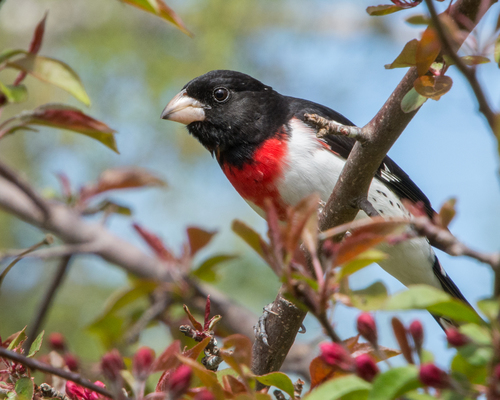
Photographs from iNaturalist · photographer credits
About from Wikipedia
Description
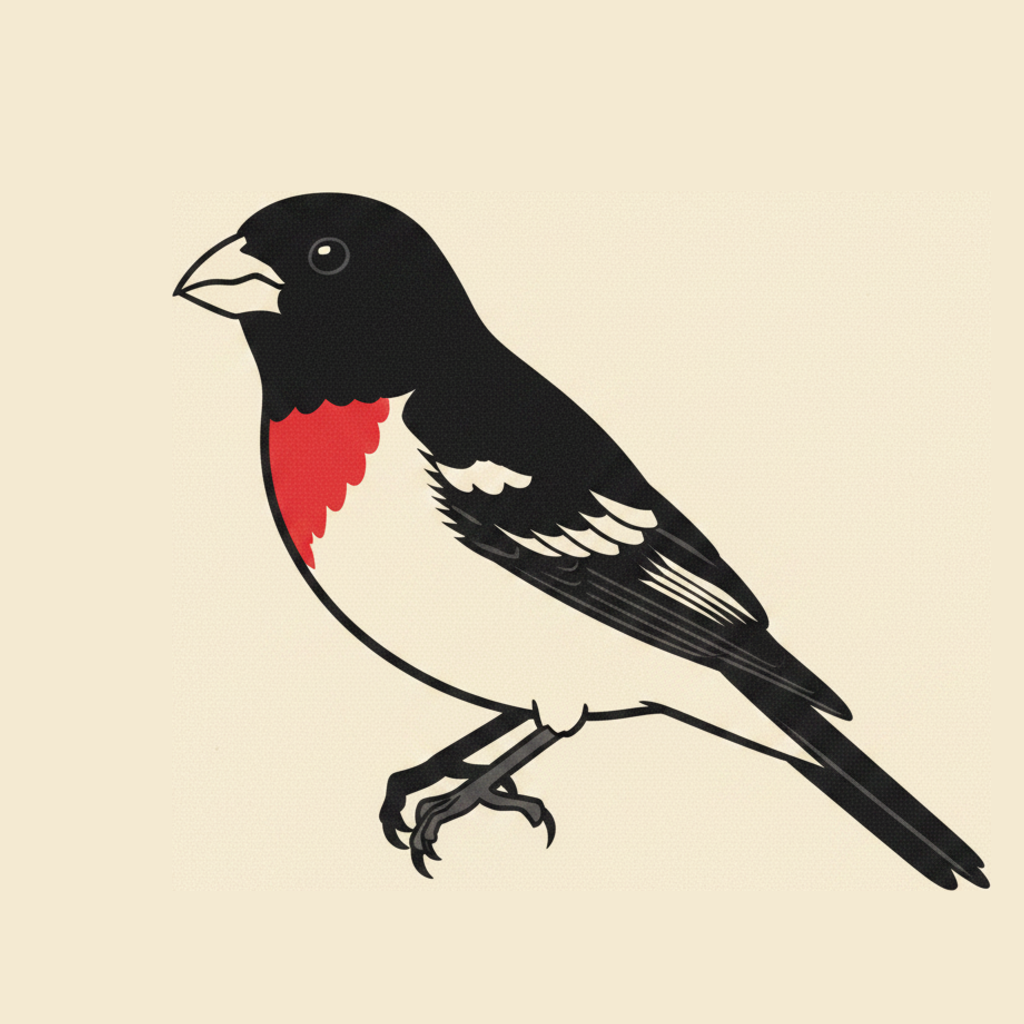
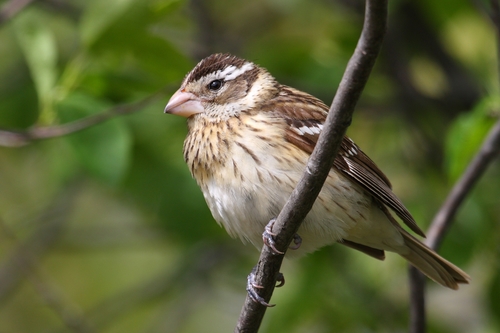
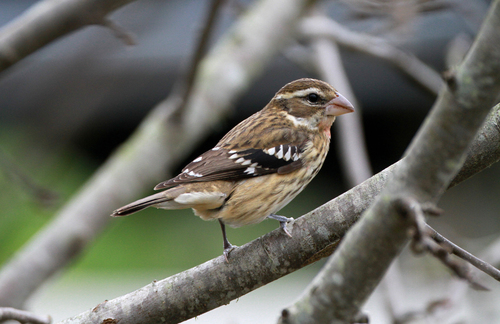
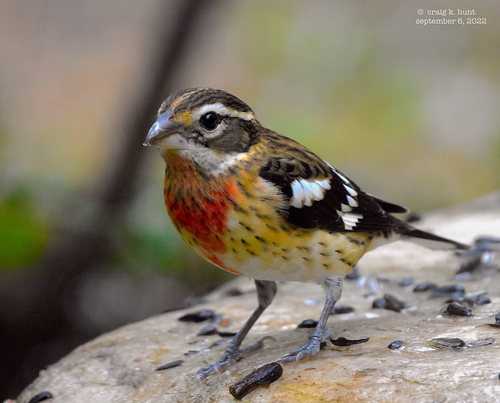
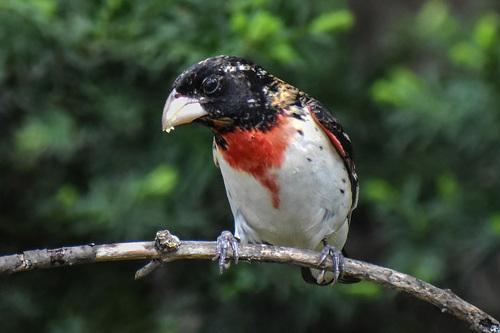
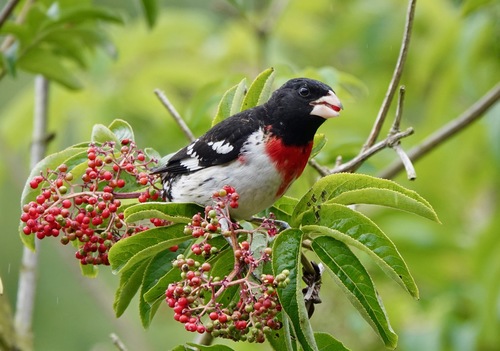
Adult birds are 18–22 cm (7.1–8.7 in) long, span 29–33 cm (11–13 in) across the wings and weigh 35–65 g (1.2–2.3 oz). Grosbeaks measured during migration in the West Indies averaged 43 g (1.5 oz), while those banded in Pennsylvania average about 45 g (1.6 oz). Very little sexual dimorphism in size is seen; females were found to be marginally smaller in standard measurements, but in some seasons were marginally heavier than males when banded in Pennsylvania. At all ages and in both sexes, the beak is dusky horn-colored, and the feet and eyes are dark. The adult male in breeding plumage has a black head, wings, back, and tail, and a bright rose-red patch on its breast; the wings have two white patches and rose-red linings. Its underside and rump are white. Males in nonbreeding plumage have largely white underparts, supercilium, and cheeks. The upperside feathers have brown fringes, and most wing feathers white ones, giving a scaly appearance. The bases of the primary remiges are also white. The coloration renders the adult male rose-breasted grosbeak (even while wintering) unmistakable if seen well. The adult female has dark grey-brown upperparts – darker on wings and tail – a white supercilium, a buff stripe along the top of the head, and black-streaked white underparts, which except in the center of the belly have a buff tinge. The wing linings are yellowish, and on the upperwing are two white patches like in the summer male. Immatures are similar, but with pink wing-linings and less prominent streaks and usually a pinkish-buff hue on the throat and breast. At one year of age—in their first breeding season—males are scaly above like fully adult males in winter plumage, and still retain the immature's browner wings. Unlike males, females can easily be confused with the black-headed grosbeak (Pheucticus melanocephalus) where their ranges overlap in the central United States and south-central Canada. The rose-breasted grosbeak female has slightly darker brown markings on the underside, paler rather yellowish streaking on both the head and wings and paler, pinkish (rather than bi-colored) bill when compared to the female black-headed grosbeak. A potential confusion species also is the female purple finch (Haemorhous purpureus), but that species is noticeably smaller with a less robust bill and a notched tail. The song is a subdued mellow warbling, resembling a more refined, sweeter version of the American robin's (Turdus migratorius). Males start singing early, occasionally even when still in winter quarters. The call is a sharp pink or pick, somewhat reminiscent of a woodpecker call.
Range & habitat
The rose-breasted grosbeak's breeding habitat is open deciduous woods across most of Canada and the northeastern United States. In particular, the northern birds migrate south through the United States east of the Rocky Mountains, to winter from central-southern Mexico through Central America and the Caribbean to Peru and Venezuela. The southern limit of its wintering range is not well known; it was, for example, only recorded in the Serranía de las Quinchas (Colombia) in the 1990s. In winter, they prefer more open woodland, or similar habitat with a loose growth of trees, such as forest edges, parks, gardens, and plantations, ranging from sea level into the hills, e.g. up to 5,000 ft (1,500 m) above mean sea level in Costa Rica. Since 1966 the rose-breasted grosbeak has experienced a greater than 1.5% yearly decline in population throughout the eastern part of its summer range, but a coincident >1.5% yearly increase in western parts of its summer range.
Adapted from Rose-breasted grosbeak on Wikipedia, used under CC BY-SA 4.0.