Photographs
what it really looks like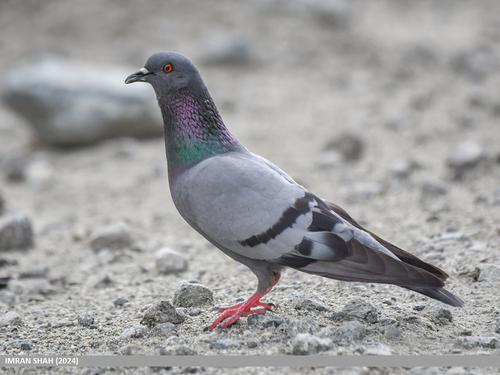
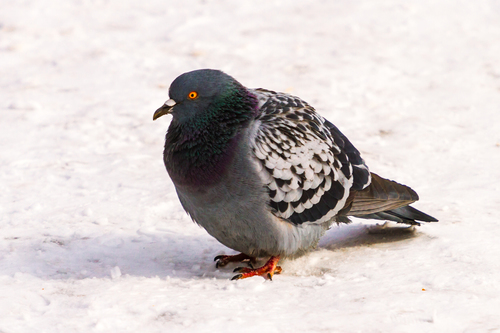
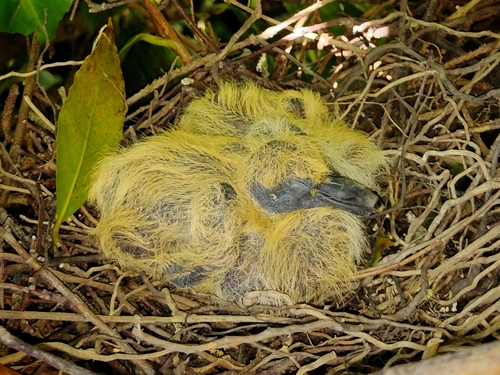
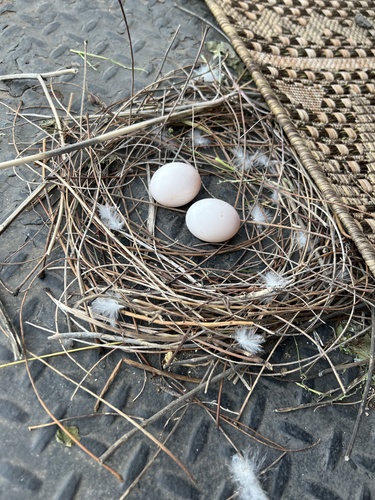
Photographs from iNaturalist · photographer credits
About from Wikipedia
Description
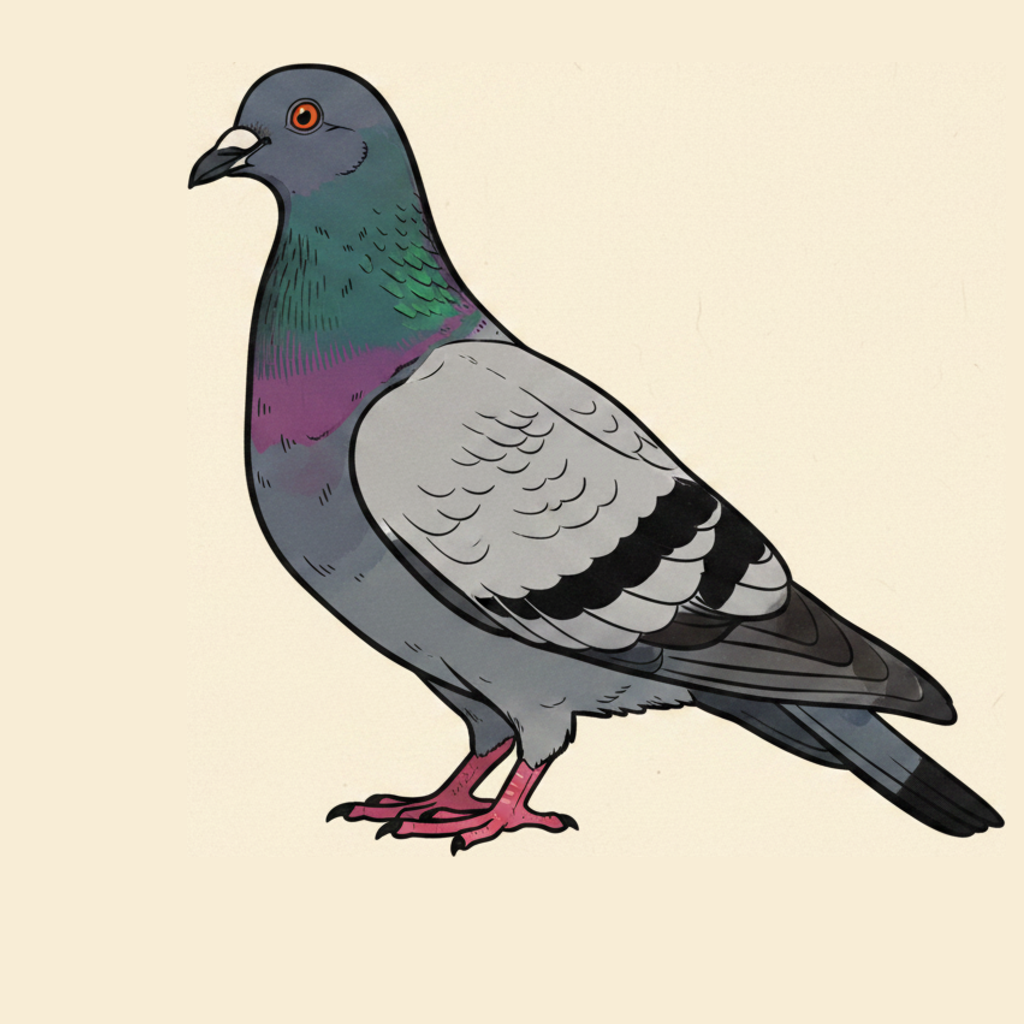
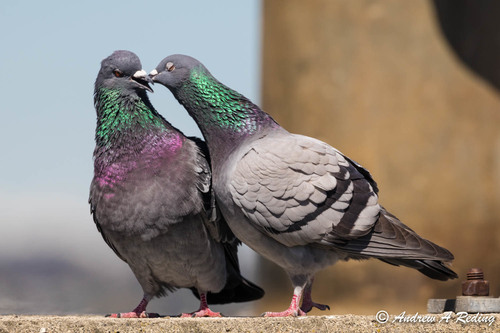
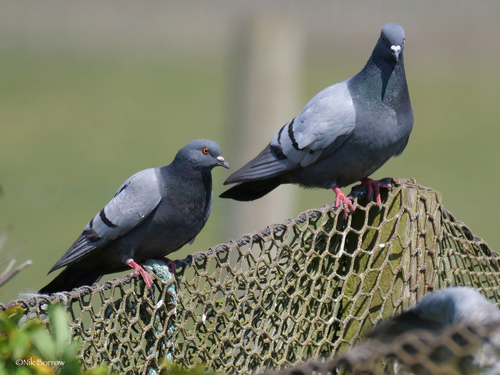
Millennia of domestication have greatly altered the rock dove in many regions. Domestic and Feral pigeons, which arose through selective breeding, not originating naturally, have significant variation in plumage from the natural wild birds. This wild type is endangered in many areas; the nominate subspecies C. l. livia persists most notably in the far north and west of Scotland, most strongly so in the Outer Hebrides. The adult of the nominate subspecies of the rock dove is 30 to 35 cm (12 to 14 in) long with a 62 to 68 cm (24 to 27 in) wingspan. Weight for wild or feral rock doves ranges from 238–380 g (8.4–13.4 oz), though overfed domestic and semi-domestic individuals can exceed normal weights. For standard measurements, the wing chord is typically around 22.3 cm (8.8 in), the tail is 9.5 to 11 cm (3.7 to 4.3 in), the bill is around 1.8 cm (0.71 in), and the tarsus is 2.6 to 3.5 cm (1.0 to 1.4 in). This species has dark bluish-grey head, neck, and chest feathers with glossy greenish to reddish-purple iridescence along its neck feathers. The white lower back of the pure rock dove is its best identification characteristic; the two black bars on its pale grey wings are also distinctive. The tail has a black band on the end, and the outer web of the tail feathers are margined with white. The iris is red-brown. The eyelids are grey with a very narrow bluish-grey to grey-white eye ring (wider in domesticated and feral birds). The bill is grey-black with a small off-white cere (with domesticated and feral birds having a much larger cere). The feet are red to pink. The adult female is almost identical in outward appearance to the male, but the iridescence on her neck is less intense and more restricted to the rear and sides, whereas that on the breast is often very obscure. Young females show little lustre and are duller. When circling overhead, the white underwing of the bird becomes conspicuous. In its flight, behaviour, and voice, which is more of a dovecot coo than the phrase of the wood pigeon, it is a typical Columba pigeon. Although it is a strong flier, it also glides frequently, holding its wings in a very pronounced V shape as it does. The various subspecies are similar to the nominate, but can be differentiated: C. l. livia, the nominate subspecies, has mid-grey mantle plumage, and a relatively short tail. C. l. gymnocycla is smaller and very much darker than the nominate. It is almost blackish on the head, rump and underparts with a white back and the iridescence of the nape extending onto the head. C. l. targia is slightly smaller than the nominate, with similar plumage, but the back is concolorous with the mantle instead of white. C. l. schimperi closely resembles C. l. targia, but has a distinctly paler mantle. C. l. dakhlae is smaller and much paler than the nominate. C. l. palaestinae is slightly larger than C. l. schimperi and has darker plumage. C. l. gaddi is larger and paler than C. l. palaestinae, with which it intergrades in the west. C. l. neglecta it is similar to the nominate in size but darker, with a stronger and more extensive iridescent sheen on the neck. It intergrades with C. l. gaddi in the south. C. l. intermedia is similar to C. l. neglecta but darker, with a less contrasting back. There have been numerous skeletal descriptions of the rock dove and the associated muscles including those of the eye, jaw, neck, and throat. The skull is dominated by the rostrum, eye socket, and braincase. The quadrate bone is relatively small and mobile and connects the rest of the cranium to the lower jaw. The latter has an angled shape in lateral view because the long-axis of the front half of the lower jaw is at a 30° angle to the back half. Beneath the skull, the hyoid skeleton involves three mid-line structures and a pair of elongate structures that stem from between the junction of the back two structures. The anterior structure (the paraglossum or entoglossum) is unpaired and shaped like an arrowhead. Pigeons feathers have two types of melanin (pigment), eumelanin and pheomelanin. A study of melanin in the feathers of both wild rock and domestic pigeons, of different colour types and known genetic background, measured the concentration, distribution and proportions of eumelanin and pheomelanin and found that gene mutations affecting the distribution, amounts and proportions of pigments accounted for the greater variation of colour in domesticated birds than in their wild relations. Eumelanin generally causes grey or black colours, while pheomelanin results in a reddish-brown colour. Other shades of brown may be produced through different combinations and concentrations of the two colours. Darker birds may be better able to store trace metals in their feathers due to their higher concentrations of melanin, which may help mitigate the negative effects of the metals, the concentrations of which are typically higher in urban areas.
Range & habitat
The natural distribution of the rock dove is restricted to a resident range in western and southern Europe, North Africa, and extending into South Asia. They were introduced into most of the rest of the world aboard European ships from 1603 onwards. When including feral birds, the species has a very large range, with an estimated global extent of occurrence of 10,000,000 km2 (3,900,000 sq mi). It has a large global population, including an estimated 17 to 28 million individuals in Europe. Fossil evidence suggests the rock dove originated in southern Asia, and skeletal remains, unearthed in Israel, confirm its existence there for at least 300,000 years. However, this species has such a long history with humans that it is impossible to identify its original range exactly. Wild rock doves reside in rock formations and cliff faces, settling in crevices to nest. Wild nesting sites include caves, canyons, and sea cliffs. They will even live in the Sahara so long as an area has rocks, water, and some plant matter. They prefer to avoid dense vegetation.
Behaviour
Pigeons are often found in pairs in the breeding season, but are often gregarious, living in flocks of 50 to 500 birds (dependent on the food supply). As prey birds, they must keep their vigilance, and when disturbed a pigeon within a flock will take off with a noisy clapping sound that cues for other pigeons to take to flight. The noise of the take-off increases the faster a pigeon beats its wings, thus advertising the magnitude of a perceived threat to its flockmates. Non-vocal sounds include a loud flapping noise at take-off, feet stamping, hisses, and beak snapping. Wings may also be clapped during flights, usually during display fights or after copulation. Juveniles particularly snap their bills, usually to respond to nest invasion. The foot stomping appears deliberate, though for what purpose is unclear. Foot stamping is done with a certain foot first, showing that rock doves have "footedness", similar to human handedness.
Adapted from Rock dove on Wikipedia, used under CC BY-SA 4.0.