Photographs
what it really looks like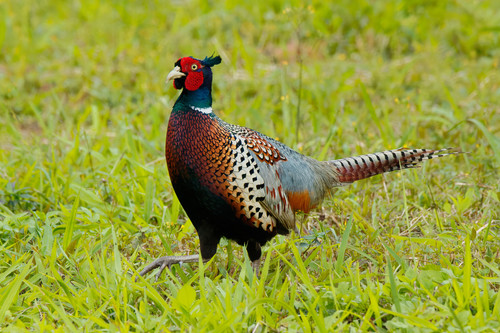
Photographs from iNaturalist · photographer credits
About from Wikipedia
Description
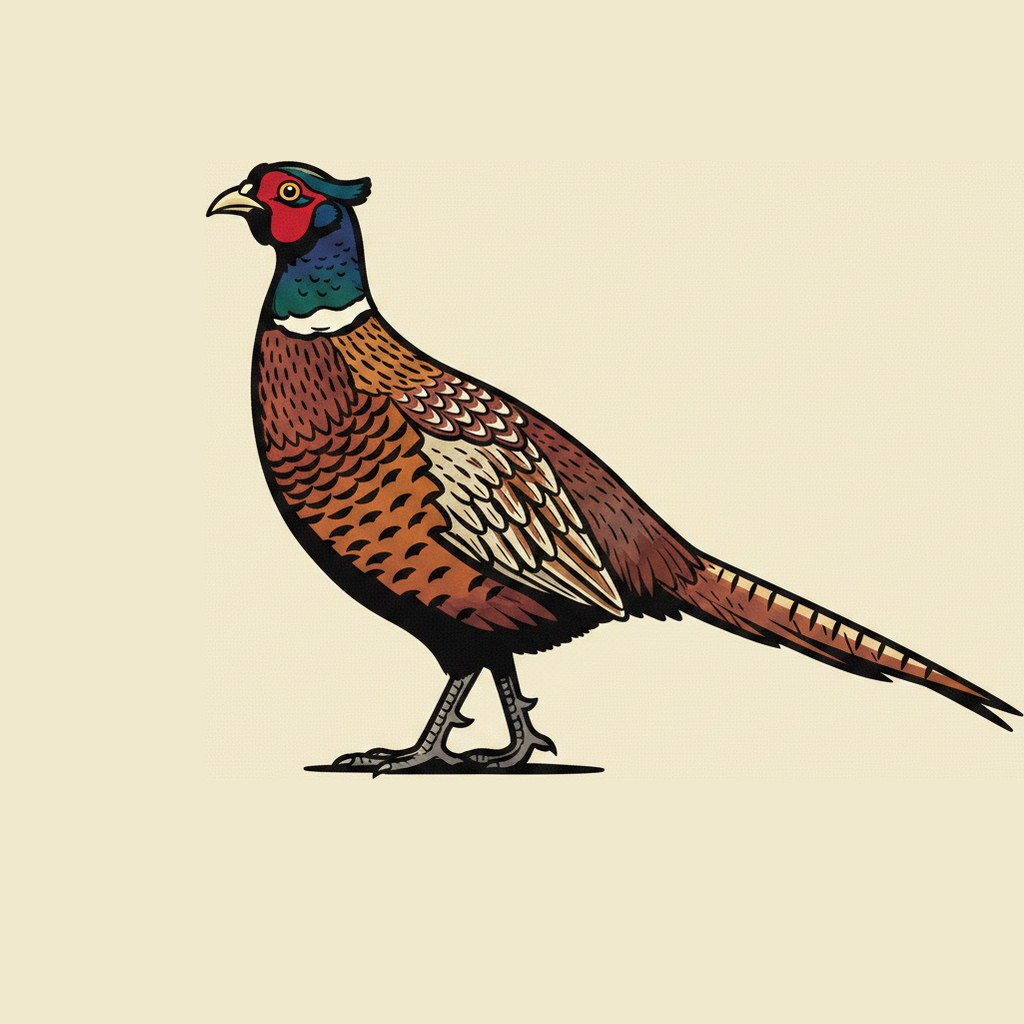
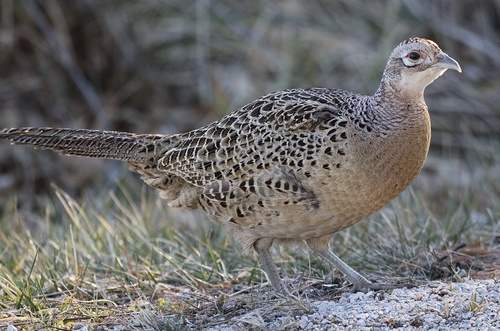
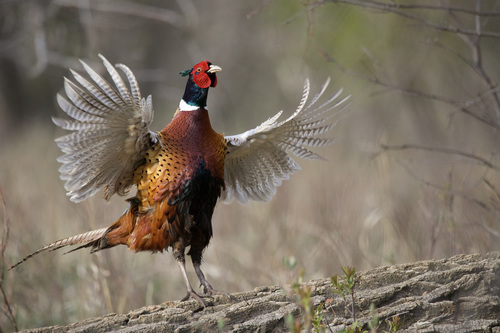
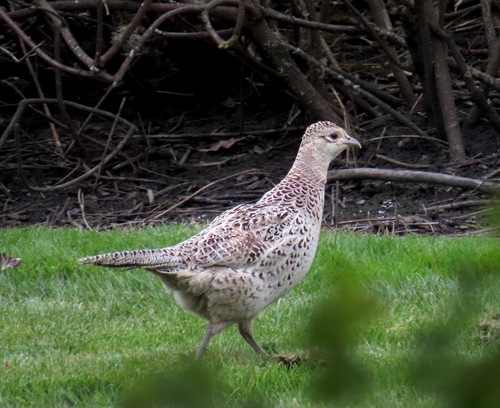
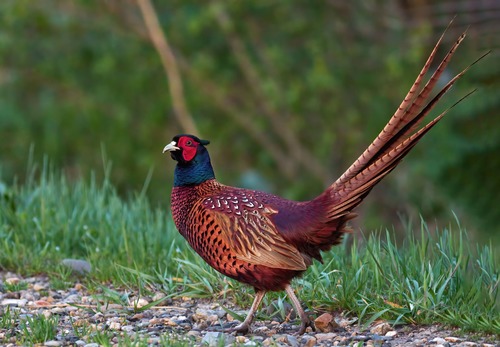
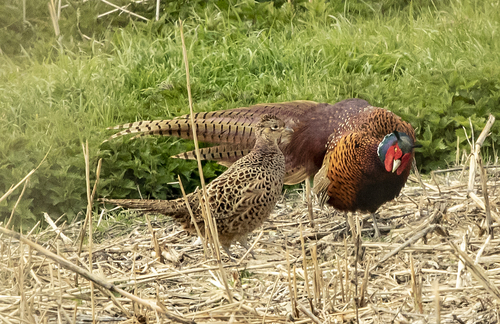
There are many colour forms of the male common pheasant, ranging in colour from nearly white to almost black in some melanistic examples. These are due to captive breeding and hybridisation between subspecies and with the green pheasant, reinforced by continual releases of stock from varying sources to the wild. For example, the "ring-necked pheasants" common in Europe, North America and Australia do not pertain to any specific taxon, they rather represent a stereotyped hybrid swarm. Body weight can range from 0.5 to 3 kg (1 to 7 lb), with males averaging 1.2 kg (2 lb 10 oz) and females averaging 0.9 kg (2 lb 0 oz). Wingspan ranges from 56–86 cm (22–34 in). The adult male common pheasant of the nominate subspecies Phasianus colchicus colchicus is 60–89 cm (23+1⁄2–35 in) in length with a long brown streaked black tail, accounting for almost 50 cm (20 in) of the total length. The body plumage is barred bright gold or fiery copper-red and chestnut-brown plumage with iridescent sheen of green and purple; but rump uniform is sometimes blue. The wing coverage is white or cream and black-barred markings are common on the tail. The head is bottle green with a small crest and distinctive red wattle. P. c. colchicus and some other races lack a white neck ring. Behind the face are two ear-tufts, that make the pheasant appear more alert. The female (hen) and juveniles are much less showy, with a duller mottled brown plumage all over and measuring 50–63 cm (19+1⁄2–25 in) long including a tail of around 20 cm (8 in). Juvenile birds have the appearance of the female with a shorter tail until young males begin to grow characteristic bright feathers on the breast, head and back at about 10 weeks after hatching. The green pheasant (P. versicolor) is very similar, and hybridisation often makes the identity of individual farmed birds difficult to determine. Green pheasant males on average have a shorter tail than the common pheasant and have darker plumage that is uniformly bottle-green on the breast and belly; they always lack a neck ring. Green pheasant females are darker, with many black dots on the breast and belly. In addition, various colour mutations are commonly encountered, mainly melanistic (black) and flavistic (isabelline or fawn) specimens. The former are rather commonly released in some areas and are named "tenebrosus pheasant" or simply "melanistic mutant".
Behaviour
Common pheasants are native to Asia and parts of Europe, their original range extending from the eastern Black Sea and the Caspian Sea to Manchuria, Siberia, Korea, Mainland China, and Taiwan. The birds are found in woodland, farmland, scrub, and wetlands. In their natural habitat, common pheasants live in grassland near water with small copses of trees, and are tolerant of both dry and humid soils. Extensively cleared farmland, however, is marginal habitat that cannot maintain self-sustaining populations for long. Common pheasants are gregarious birds and outside the breeding season form loose flocks. However, captive bred common pheasants can show strong sexual segregation, in space and time, with sex differences in the use of feeding stations throughout the day. Wherever they are hunted they are always timid once they associate humans with danger, and will quickly retreat for safety after hearing the arrival of hunting parties in the area. While common pheasants are able short-distance fliers, they prefer to run. If startled however, they can suddenly burst upwards at great speed, with a distinctive "whirring" wing sound and often giving kok kok kok calls to alert conspecifics. Their flight speed is only 43–61 km/h (23–33 kn) when cruising but when chased they can fly up to 90 km/h (49 kn).
Adapted from Common pheasant on Wikipedia, used under CC BY-SA 4.0.