Photographs
what it really looks like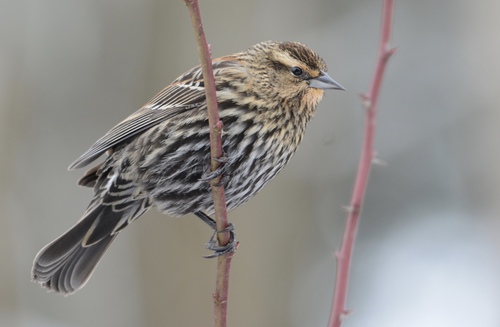
Photographs from iNaturalist · photographer credits
About from Wikipedia
Description
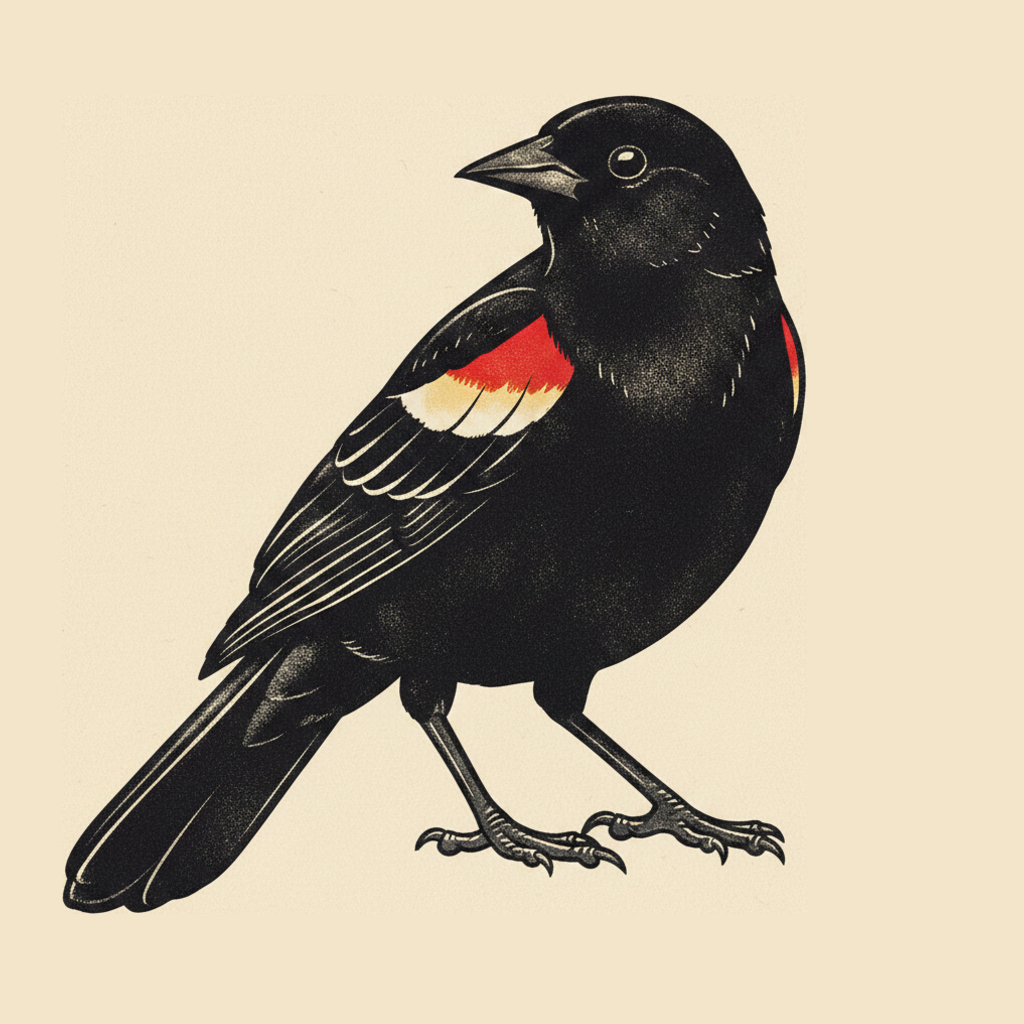
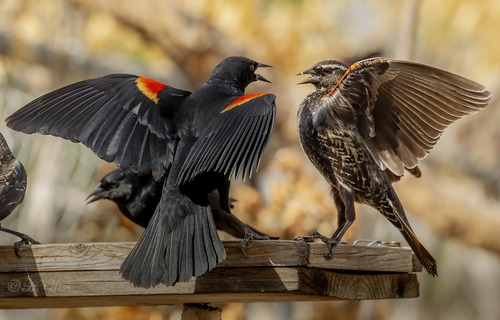
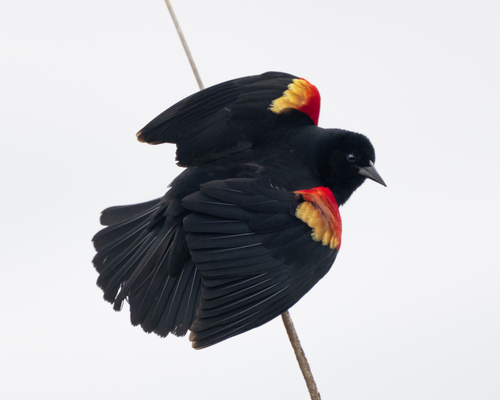
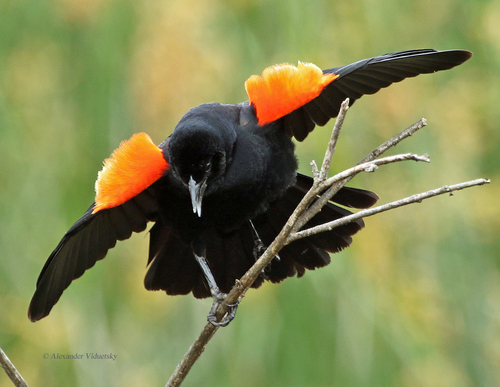
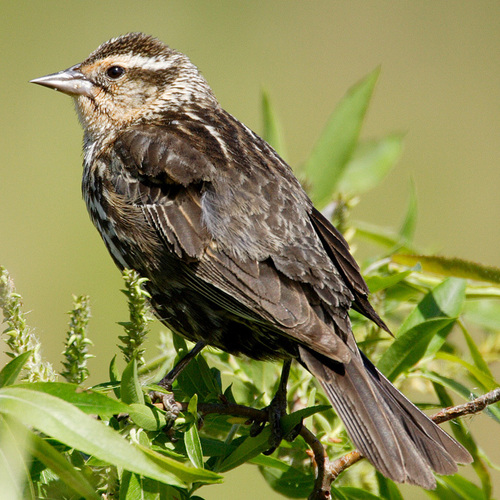
The common name for the red-winged blackbird is taken from the mainly black adult male's distinctive red shoulder patches, or epaulets, which are visible when the bird is flying or displaying. At rest, the male also shows a pale yellow wingbar. The spots of males less than one year old, generally subordinate, are smaller and more orange than those of adults. The female is blackish-brown and paler below. The female is smaller than the male, at 17–18 cm (6.7–7.1 in) long and weighing 41.5 g (1.46 oz), against his length of 22–24 cm (8.7–9.4 in) and weight of 64 g (2.3 oz). The smallest females may weigh as little as 29 g (1.0 oz) whereas the largest males can weigh up to 82 g (2.9 oz). Each wing can range from 8.1–14.4 cm (3.2–5.7 in), the tail measures 6.1–10.9 cm (2.4–4.3 in), the culmen measures 1.3–3.2 cm (0.51–1.26 in) and the tarsus measures 2.1 cm (0.83 in). The upper parts of the female are brown, while the lower parts are covered by an intense white and dark veining; also presents a whitish superciliary list. According to Crawford (1977), females exhibit a salmon-pink stain on the shoulders and a light pink color on the face and below this when they are a year old, while older females show a stain usually more crimson on the shoulders and a darker pink hue on and under the face. Observations in females in captivity indicate that small amounts of yellow pigment are present on the shoulders of these after leaving the nest, that the concentration of the pigment increases with the first winter plumage after the change of the feathers and that the passage from yellow to orange generally takes place in the second summer with the acquisition of the second winter plumage, after which no further changes in feather color occur. The colored area on the wing increases in surface with the age of the female, and varies in intensity from brown to a bright red-orange similar to that of the males in their first year. Young birds resemble the female, but are paler below and have buff feather fringes. Both sexes have a sharply pointed bill. The tail is of medium length and is rounded. The eyes, bill, and feet are all black. Unlike most North American passerines which develop their adult plumage in their first year of life so that the one-year-old and the oldest individual are indistinguishable in the breeding season, the red-winged blackbird does not. It acquires its adult plumage only after the breeding season of the year following its birth when it is between thirteen and fifteen months of age. Young males go through a transition stage in which the wing spots have an orange coloration before acquiring the most intense tone typical of adults. The male measures between 22 and 24 cm (8.7 and 9.4 in) in length, while the female measures 17 or 18 cm (6.7 or 7.1 in). Its wingspan is between 31 and 40 cm (12 and 16 in) approximately. Both the peak male and the legs, the claws and the eyes are black; in the female beak is dark brown and clear in the upper half at the bottom, and the tail is medium in length and rounded. As in other species polygyny exists, the red-winged blackbird exhibit considerable sexual dimorphism both in plumage and size, males weighing between 65 and 80 g (2.3 and 2.8 oz) the females about 35 g (1.2 oz). Males are 50% heavier than females, 20% larger in its linear dimensions, and 20% larger compared to the length of their wings. The trend towards greater dimorphism in the size of non-monogamous ichterid species indicates that the larger size of males has evolved due to sexual selection. The male is unmistakable except in the far west of the US, where the tricolored blackbird occurs. Males of that species have a darker red epaulet edged with white, not yellow. Females of tricolored, bicolored, red-shouldered and red-winged blackbirds can be difficult to identify in areas where more than one form occurs. In flight, when the field marks are not easily seen, the red-winged blackbird can be distinguished from less closely related icterids such as common grackle and brown-headed cowbird by its different silhouette and undulating flight.
Range & habitat
The red-winged blackbird is widely spread throughout North America, except in the arid desert, high mountain ranges, and arctic or dense afforestation regions. It breeds from central-eastern Alaska and Yukon in the northwest, and Newfoundland in the northeast, to northern Costa Rica in the south, and from the Atlantic to the Pacific. Northern populations migrate to the southern United States, but those that breed there, in Mexico, and in Central America are sedentary. Red-winged blackbirds in the northern reaches of the range are migratory, spending winters in the southern United States and Central America. Migration begins in September or October, but occasionally as early as August. In western and Central America, populations are generally non-migratory. The red-winged blackbird inhabits open grassy areas. It generally prefers wetlands and inhabits both freshwater and saltwater marshes, particularly if cattail is present. It is also found in dry upland areas, where it inhabits meadows, prairies, and old fields. In a large part of its distribution area, it constitutes the most abundant passerine bird in the swamps in which it nests. It is also present in areas without much water, where it inhabits open fields – often agricultural areas – and sparse deciduous forests. In the winter of 1975–1976, near Milan in western Tennessee, red-winged blackbirds were observed resting in a mixed roost that came to house 11 million individuals in January and early February in a plantation of 4.5 hectares of yellow pine (Pinus taeda) with little undergrowth. They were seen in soybean fields during the day, being that these constituted only 21% of the habitat in the area and that the other bird species present in the roost were not commonly observed in these fields; they were also common in cornfields. The presences of the bird in feedlots increased as winter progressed, but, accounting for less than 5% of the icterids and starlings recorded in both feedlots of cows and pigs, they were much rarer there than the brown-headed cowbird, common grackle and common starling.
Behaviour
The red-winged blackbird is territorial, polygynous, gregarious and a short-distance migratory bird. Its way of flying is characteristic, with rapid wing flaps punctuated by brief periods of gliding flight. The behavior of males makes their presence easily perceived: they perch in high places such as trees, bushes, fences, and telephone lines. Females tend to stay low, prowling through the vegetation and building their nests. They can be found in home gardens, particularly during their migration, if seeds have been scattered on the ground. The forest curtains serve as a resting place during the day. For several weeks after their first appearance in early spring, red-winged blackbirds are generally seen in flocks made up entirely of males. During those days, they are seldom seen at their breeding sites, except early morning and late afternoon. In most of the remaining hours of the day, they frequent open and often elevated agricultural land, where they feed mainly on grain stubble and grassy fields. When disturbed while eating, they fly to the nearest deciduous trees and immediately after landing they begin to sing.
Adapted from Red-winged blackbird on Wikipedia, used under CC BY-SA 4.0.