Photographs
what it really looks like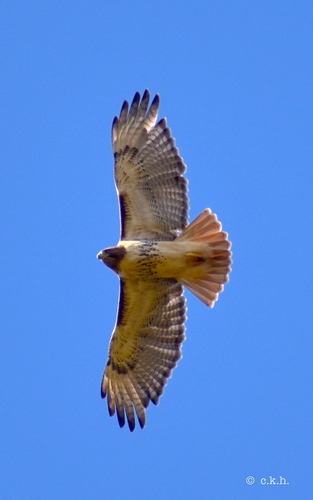
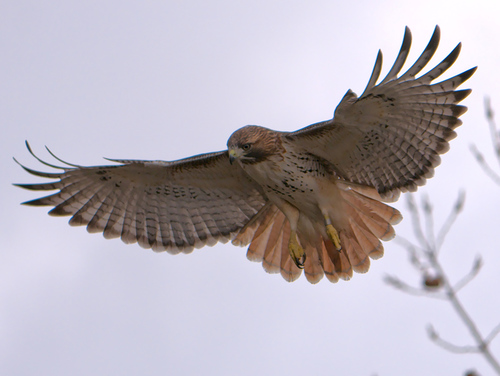
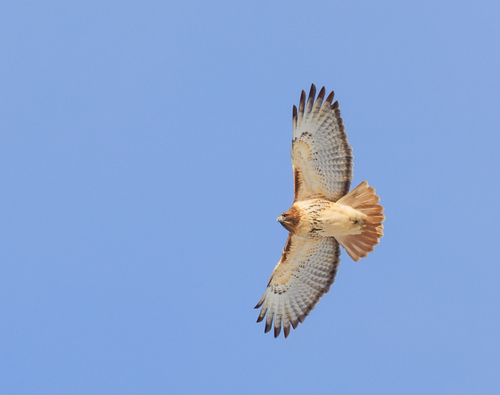
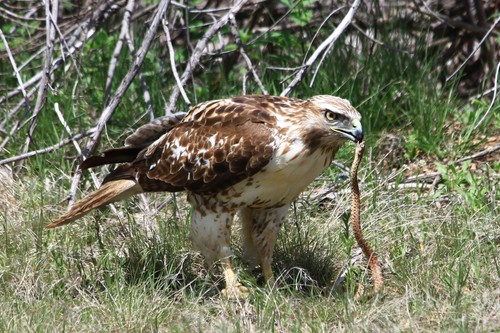
Photographs from iNaturalist · photographer credits
About from Wikipedia
Description
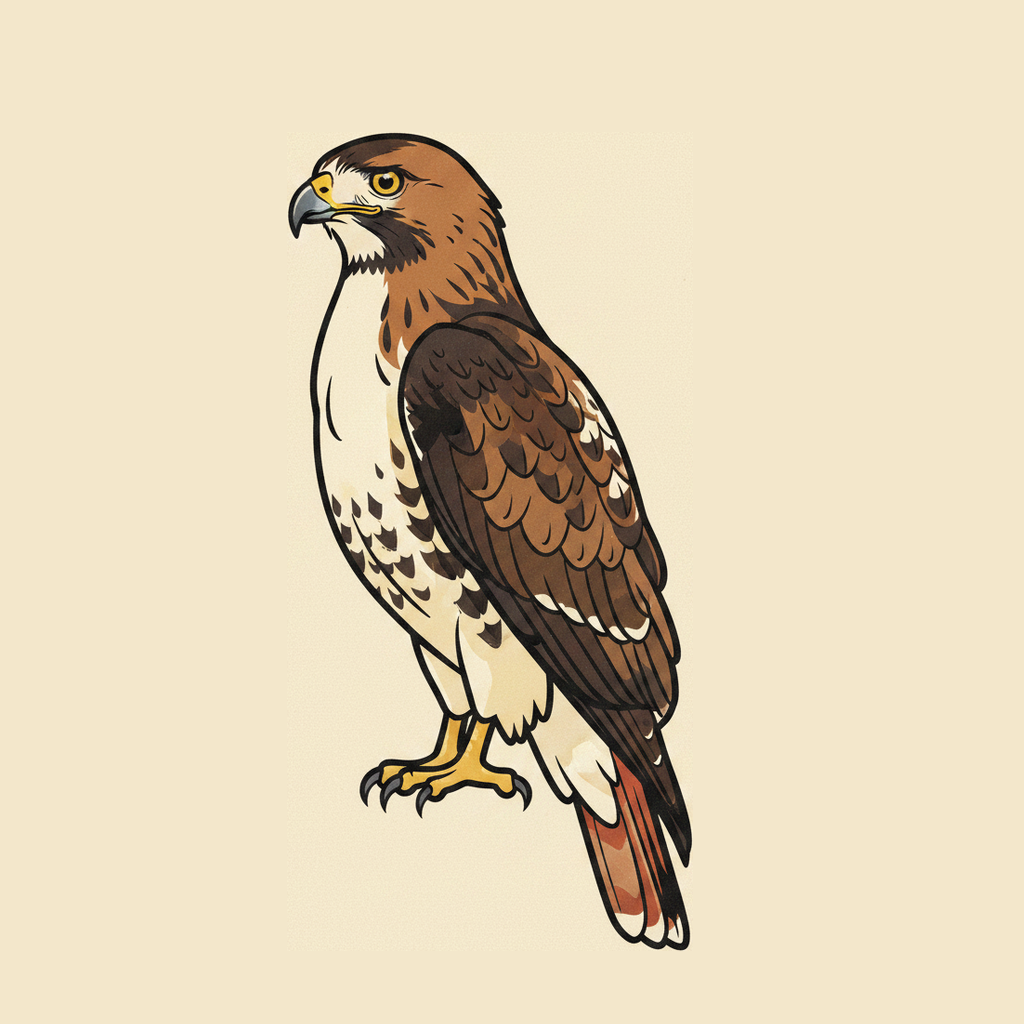
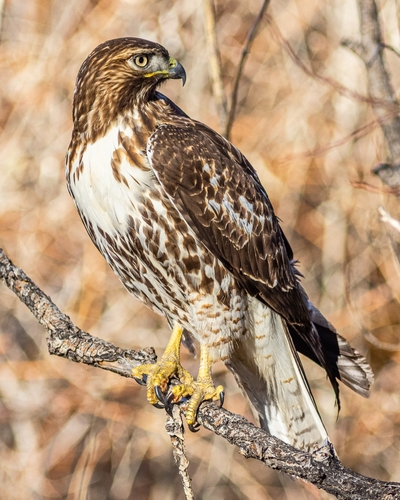
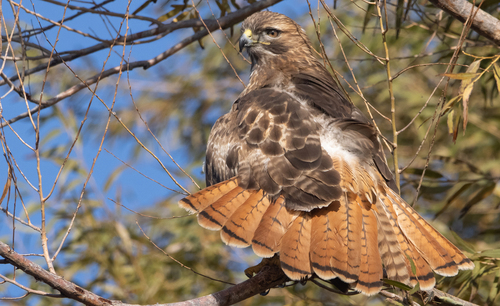
The red-tailed hawk is dimorphic in size, as females are up to 25% larger than males. As is typical in large raptors, frequently reported mean body mass for red-tailed hawks is somewhat higher than expansive research reveals. Part of this weight is highly seasonally variable and due to clinal variation; male red-tailed hawks may weigh from 690 to 1,300 g (1.52 to 2.87 lb) and females from 900 to 2,000 g (2.0 to 4.4 lb). Nine studies occurring at migration sites in the United States and two breeding studies, one from the smallest race in Puerto Rico, the other from larger races in Wisconsin, show that males weigh 837 g (1.845 lb) and females weigh 1,040.7 g (2.294 lb) on average, about 15% lighter than prior species-wide published weights. The heaviest surveyed weights came from migrants in Cape May, New Jersey, where females averaged 1,278 g (2.818 lb), while males averaged 990.8 g (2.184 lb) in weight. The lightest were from the breeding population in forest openings of Puerto Rico, where the females and males weighed an average of 1,023 g (2.255 lb) and 795 g (1.753 lb), respectively, also the highest size sexual dimorphism in the species. Size variation in body mass reveals that the red-tailed hawks typically vary only a modest amount; racial variation in average weights of great horned owls show that mean body mass is nearly twice (the heaviest race is about 36% heavier than the lightest known race on average) as variable as that of the hawk (where the heaviest race is only just over 18% heavier on average than the lightest). Males can reportedly measure 45 to 60 cm (18 to 24 in) in total length, females measuring 48 to 65 cm (19 to 26 in) long. The wingspan can range from 105 to 141 cm (41 to 56 in) and, in the standard scientific method of measuring wing size, the wing chord is 325.1–444.5 mm (12.80–17.50 in) long. The tail measures 188 to 258.7 mm (7.40 to 10.19 in) in length. The middle toe (excluding talon) can range from 38.3 to 53.8 mm (1.51 to 2.12 in), with the hallux-claw (the talon of the rear toe, which has evolved to be the largest in accipitrids) measuring from 24.1 to 33.6 mm (0.95 to 1.32 in) in length. Red-tailed hawk plumage can be variable, depending on the subspecies and the region. These color variations are morphs, so are not related to molting. The western North American population, B. j. calurus, is the most variable subspecies and has three color morphs - light, dark, and intermediate or rufus. The dark and intermediate morphs constitute 10–20% of the population. Though the markings and hue vary across the subspecies, the basic appearance of the red-tailed hawk is consistent. Overall, this species is blocky and broad in shape and often heavier than other Buteo species of similar length. A whitish underbelly with a dark brown band across the belly, formed by horizontal streaks in feather patterning, is present in most color variations. Especially in younger birds, the underside may be otherwise covered with dark brown spotting. The red tail, which gives this species its name, is uniformly brick-red above and light buff-orange below. The bill is short and dark, in the hooked shape characteristic of raptors, and the head can sometimes appear small in size against the thick body frame. They have relatively short, broad tails and thick, chunky wings. The cere, legs, and feet of the red-tailed hawk are all yellow. Adults are usually easy to identify by their red tails that end in a single black band. Immature birds are more difficult to identify, and their tails are patterned with about six darker bars. Their flight silhouette gives important clues for identification, and at close range, their yellowish irises are characteristic. As the bird attains full maturity over the course of 3–4 years, the iris slowly darkens into a reddish-brown hue.
Adapted from Red-tailed hawk on Wikipedia, used under CC BY-SA 4.0.