Photographs
what it really looks like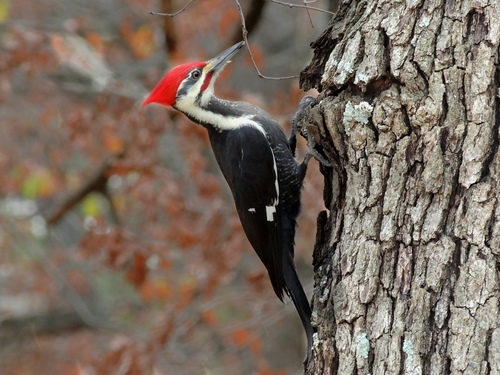
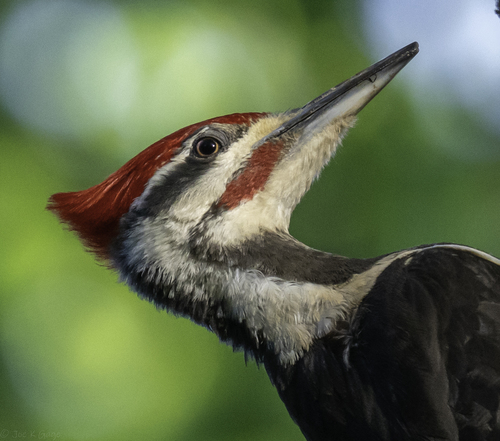
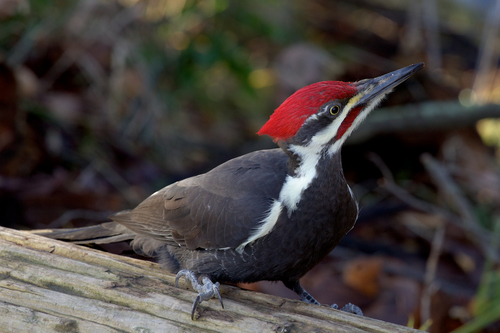
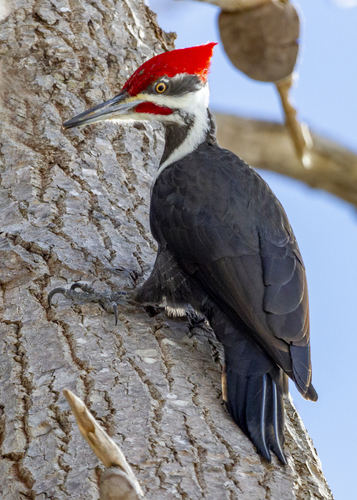
Photographs from iNaturalist · photographer credits
About from Wikipedia
Description
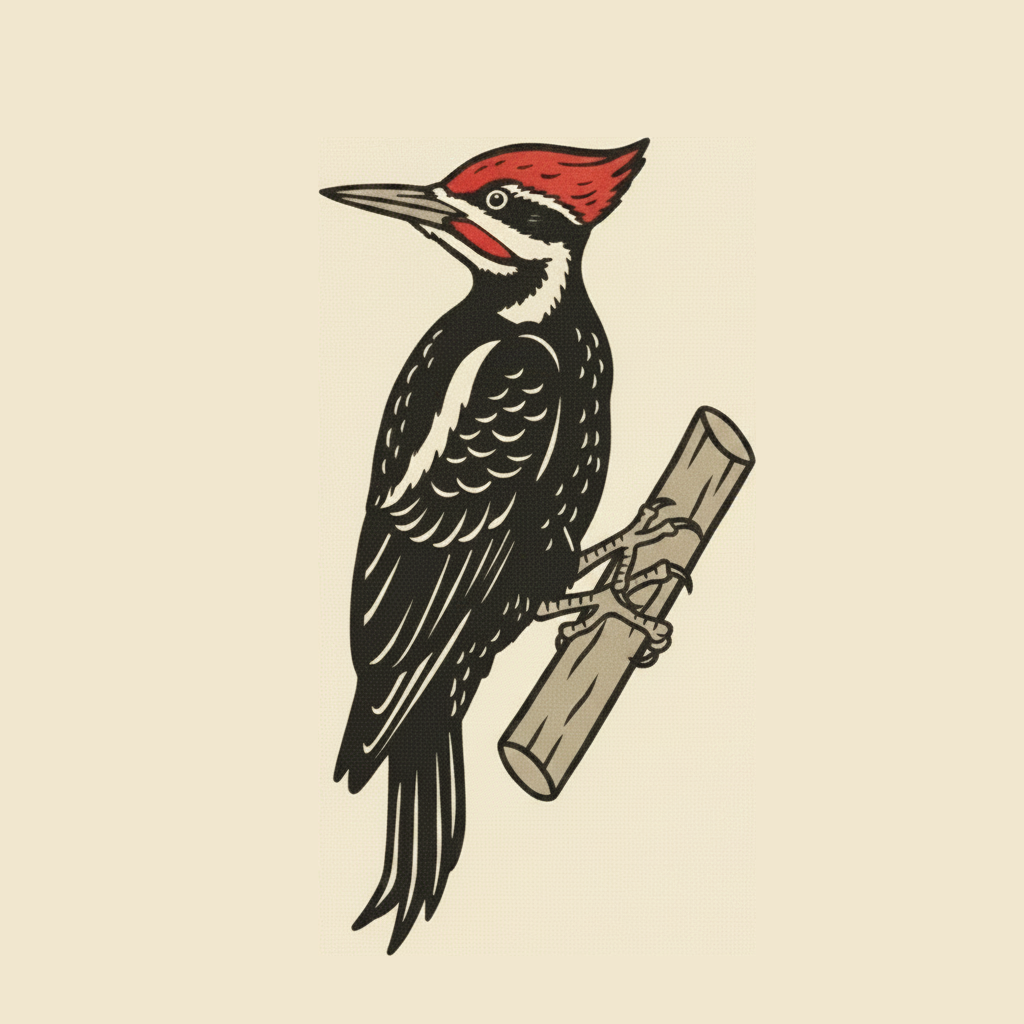
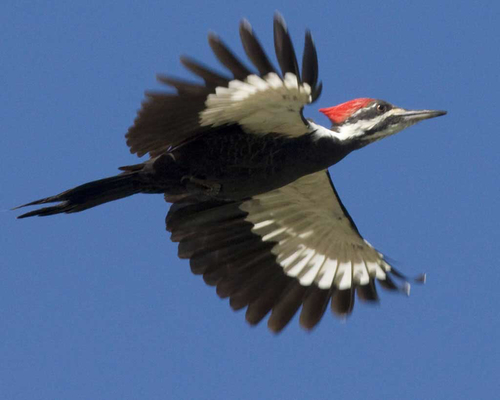
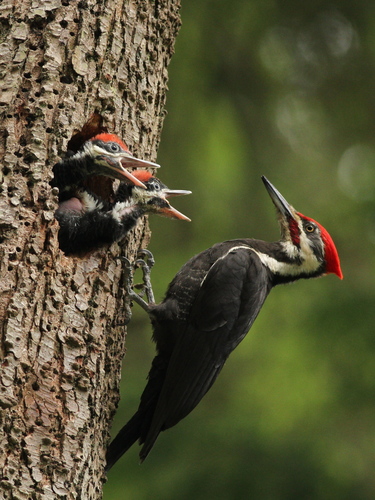
Pileated woodpeckers are mainly black with a red crest and have a white line down the sides of the throat. Adult males have a red line from the bill to the throat; in adult females, these are black. They also have white wing feathers that show when in flight. Adults are 40 to 49 cm (16 to 19 in) long, span 66 to 75 cm (26 to 30 in) across the wings, and weigh 225 to 400 g (7.9 to 14.1 oz). The average weight of females and males combined is about 277 g (9.8 oz), with males weighing about 300 g (11 oz) and females weighing about 256 g (9.0 oz) in mean body mass. The wing chord measures 21.4 to 25.3 cm (8.4 to 10.0 in), the tail measures 14.0 to 17.4 cm (5.5 to 6.9 in), the bill is 4.1 to 6.0 cm (1.6 to 2.4 in), and the tarsus measures 3.1 to 3.8 cm (1.2 to 1.5 in). Southern pileated woodpeckers have ebony feathers, less white on the feathers by the wings, and are smaller in overall size compared to their northern counterparts. Northern pileated woodpeckers are larger in wing, tail, and beak size. They also have feathers that are a lighter black with tinges of brown and gray and whiter feathers on their flanks. Juvenile pileated woodpeckers tend to have less curved crests, or "mohawks" as some refer to them. The flight of these birds is strong and direct, but undulates in the way characteristic of woodpeckers. Two species found in the Old World, the white-bellied woodpecker (D. javensis) and black woodpeckers (D. martius), are closely related and occupy the same ecological niche in their respective ranges that the pileated occupies in North America. The only North American birds of similar plumage and size are the ivory-billed woodpecker of the Southeastern United States and Cuba and the related imperial woodpecker of Mexico.
Range & habitat
The pileated woodpecker's breeding habitat is forested areas across Canada, the eastern United States, and parts of the Pacific Coast. This bird favors mature forests and heavily wooded parks. They specifically prefer mesic habitats with large, mature hardwood trees, often being found in large tracts of forest. However, they also inhabit smaller woodlots as long as they have a scattering of tall trees. These woodlots are known as late-successional forests. The pileated woodpecker population shrank drastically in the 1700s and 1800s due to habitat loss, but they have since made a nice recovery. Pileated woodpeckers are believed to be essential in their habitat for many reasons, such as providing nest cavities for other species due to their tree carvings, controlling some insect populations, and by breaking off bits of dying trees so that they can degrade faster. Pileated woodpeckers mainly eat insects, especially carpenter ants and wood-boring beetle larvae. They are also known to eat fruits, nuts, and berries, including those found on poison ivy.
Adapted from Pileated woodpecker on Wikipedia, used under CC BY-SA 4.0.