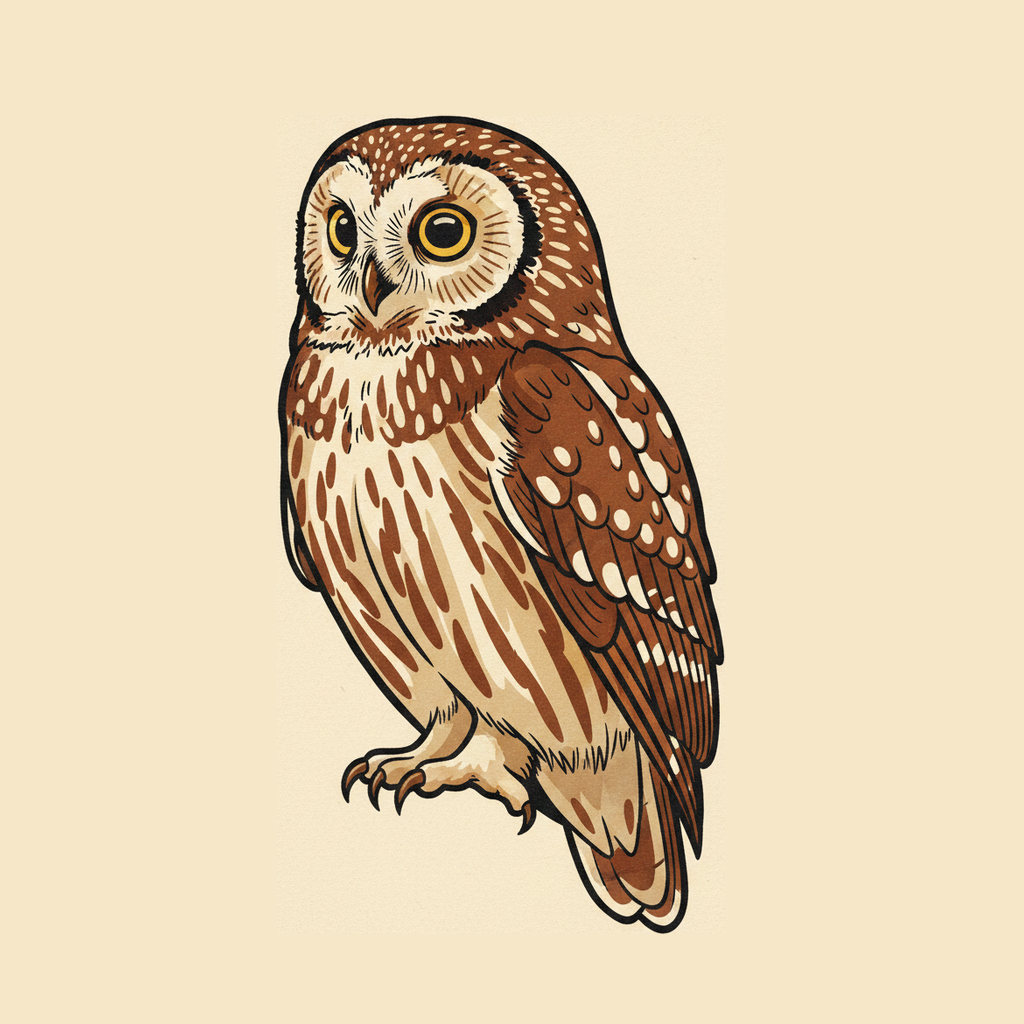
Photographs
what it really looks like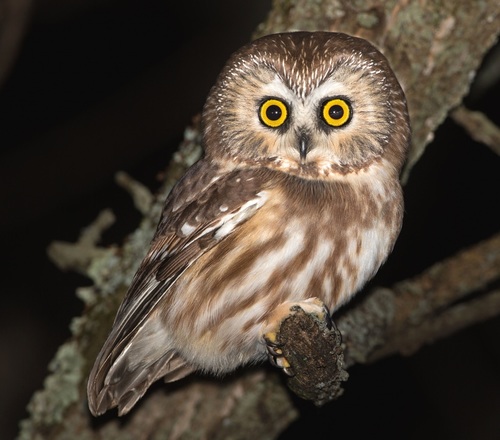
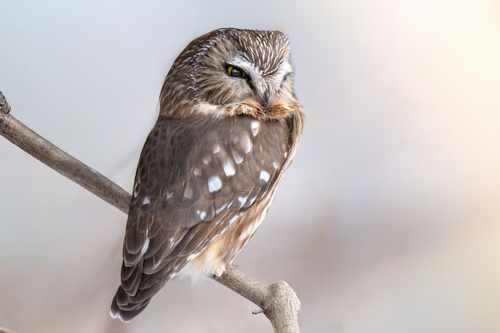
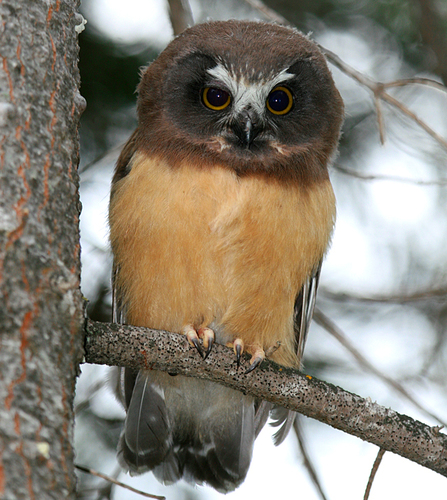
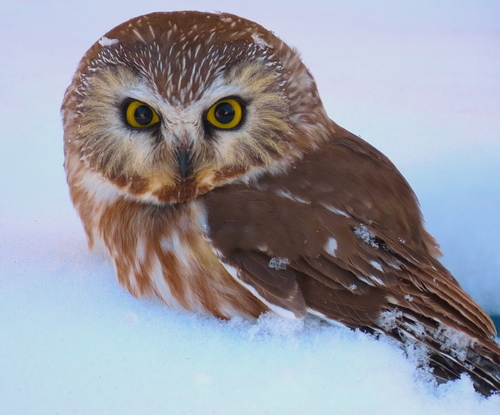
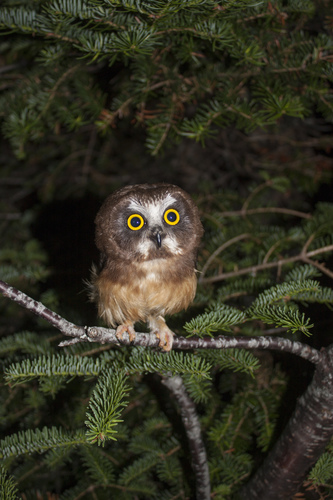
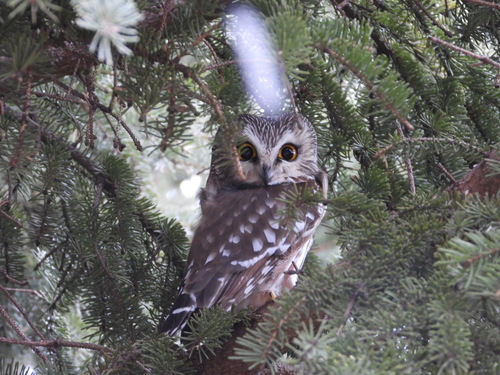
Photographs from iNaturalist · photographer credits
About from Wikipedia
Description
Adults are 17–22 cm (6.7–8.7 in) long with a 42–56.3 cm (16.5–22.2 in) wingspan. They can weigh from 54 to 151 g (1.9 to 5.3 oz) with an average of around 80 g (2.8 oz), making them one of the smallest owls in North America. They are similar in size to the American robin (78.5 g). Northern saw-whet owls do not exhibit sexual dimorphism in their plumage, so are often sexed by size dimorphism—females are larger than males. Females on average weigh 100 g and males on average weigh 75 g. Northern saw-whet owls have porphyrin pigments in their flight feathers. When exposed to a UV light, feathers on the ventral side of the wing fluoresce a neon pink. This is used in order to estimate molt and age in adults. The northern saw-whet owl has a round, light, white face with brown and cream streaks; they also have a dark beak and yellow eyes. The underparts are pale with dark shaded areas; the upper parts are brown or reddish with white spots. Juveniles have a dark brown head and wings, and a tawny rust-colored breast and belly. There is also a distinct white, Y-shaped coloration between their eyes. Saw-whet owls can be confused with boreal owls, but are distinguishable by their larger size, bill color, and lack of a spotted forehead. CornellLab's All About Birds entry says these small owls are "common and widespread", but their secretive lifestyle makes them hard to spot and makes population trends difficult to track. Partners in Flight estimates a global breeding population of 2 million and rate them 8 out of 20 on the Continental Concern Score, indicating a species of low conservation concern. However, their general population has probably declined in past decades due to habitat loss, and they are doing even worse locally in places like North Carolina, South Dakota, and in the Queen Charlotte Islands of British Columbia which are home to an endemic subspecies. Saw-whets take readily to nest boxes, which can be used to mitigate the loss of natural sites.
Range & habitat
The bird's habitat is coniferous forests, sometimes mixed or deciduous woods, across North America. Most birds nest in dense coniferous forests near wetlands during the breeding season, but may also breed in mixed-deciduous forests at the southern edge of their range in the eastern United States. Wintering birds prefer conifer stands or shrub thickets near water, but may occasionally be found in mixed-deciduous forest. They are secondary cavity nesters, meaning they do not make their own nest cavities but rather rely on naturally occurring holes or cavities excavated by other animals. Some are permanent residents, while others may migrate south in winter or move down from higher elevations. Their range covers most of North America south of the boreal forest, including southeastern and southcentral Alaska, southern Canada, most of the United States and the central mountains in Mexico. Some have begun to move more southeast in Indiana and neighboring states. Buidin et al. did a study of how far north the northern saw-whet owls breed and they found that they can breed northward of 50° N, farther than ever recorded before. Their range is quite extensive and they can even breed in the far north where most birds migrate from to breed. They are an adaptive species that can do well in the cold. There are two semi-isolated permanent populations in the eastern part of the United States. This first is a population along the West Virginia border in the Allegheny Plateau. The second population is in the higher elevations (over 4,000 ft or 1,200 m) of the southern Appalachian Mountains of western North Carolina, eastern Tennessee, and southwestern Virginia. Although there are abundant populations in the Northern and Western Regions of North America, in some counties of North Carolina, it is currently listed as a threatened species due to a decline in suitable habitat. This is due to loss of boreal forests from hemlock woolly adelgid, logging, and pollution.
Adapted from Northern saw-whet owl on Wikipedia, used under CC BY-SA 4.0.