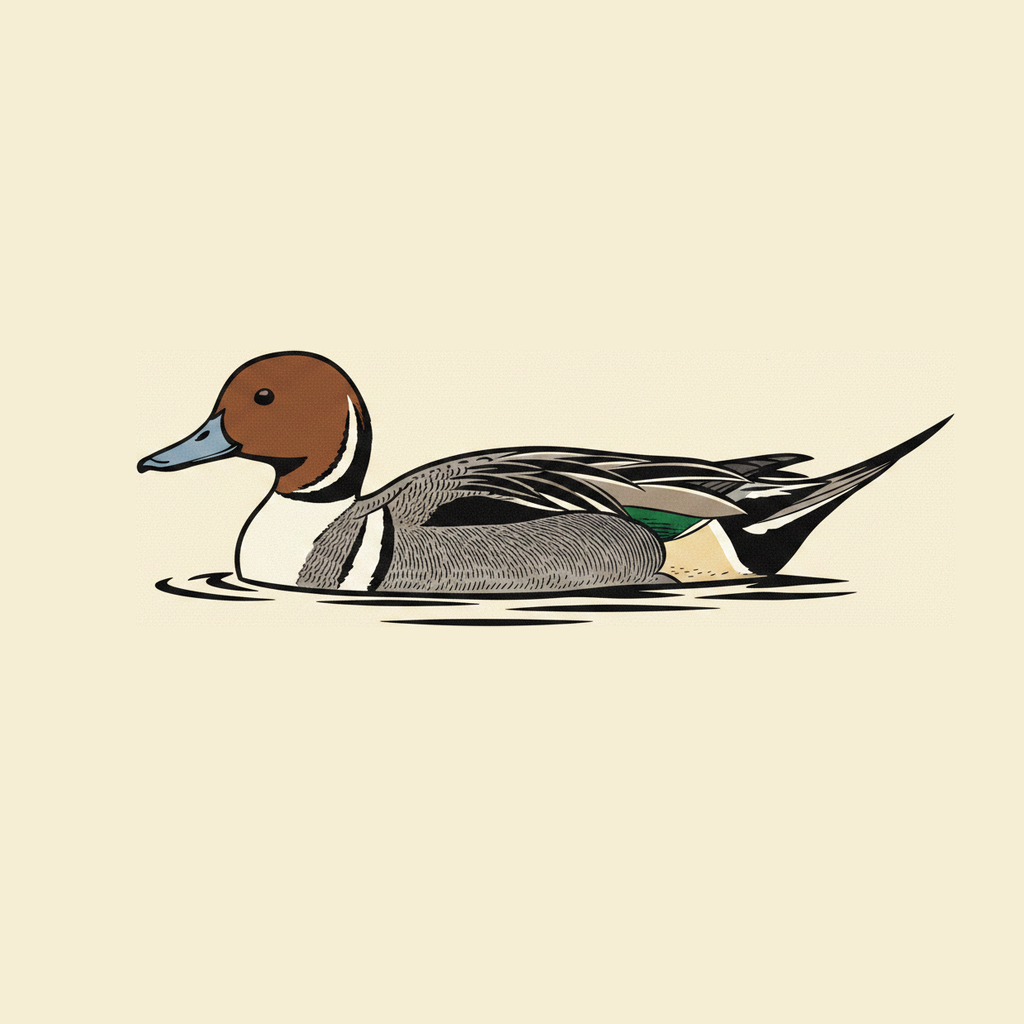
Photographs
what it really looks like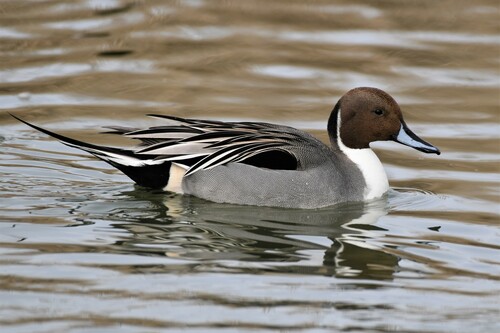
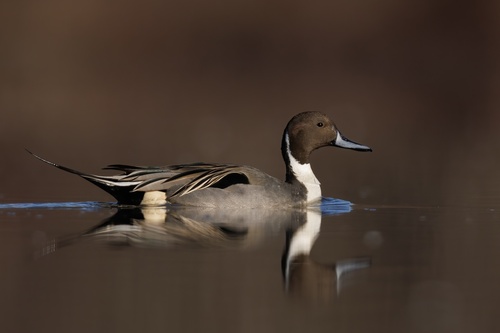
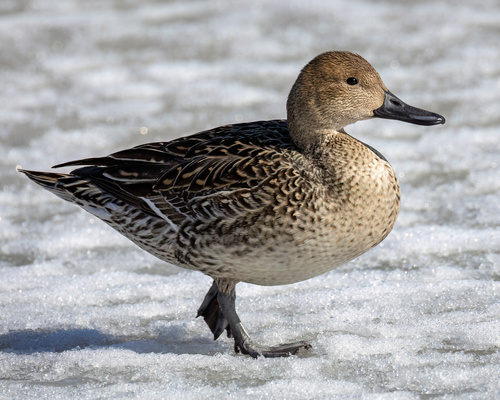
Photographs from iNaturalist · photographer credits
About from Wikipedia
Description
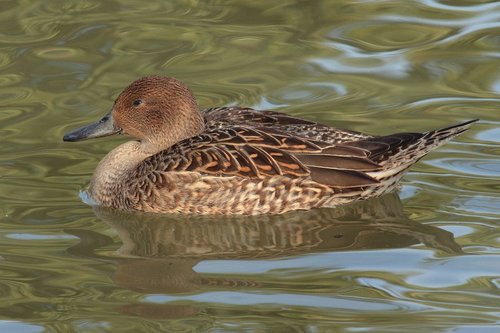
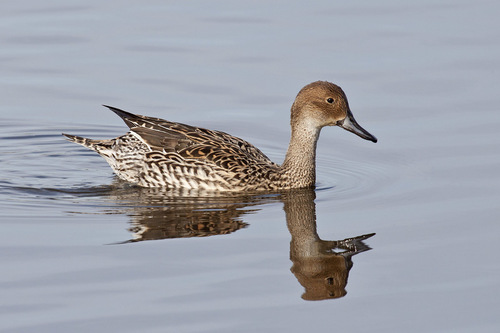
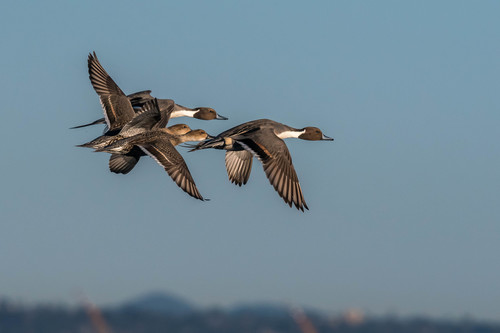
The northern pintail is a fairly large duck with a wing chord of 23.6–28.2 cm (9.3–11.1 in) and wingspan of 80–95 cm (31–37 in). The male is 59–76 cm (23–30 in) in length and weighs 450–1,360 g (0.99–3.00 lb), and therefore is considerably larger than the female, which is 51–64 cm (20–25 in) long and weighs 454–1,135 g (1.001–2.502 lb). The northern pintail broadly overlaps in size with the similarly widespread mallard, but is more slender, elongated and gracile, with a relatively longer neck and (in males) a longer tail. The unmistakable breeding plumaged male has a chocolate-brown head and white breast with a white stripe extending up the side of the neck. Its upperparts and sides are grey, but elongated grey feathers with black central stripes are draped across the back from the shoulder area. The vent area is yellow, contrasting with the black underside of the tail, which has the central feathers elongated to as much as 10 cm (3.9 in). The bill is bluish and the legs are blue-grey. The adult female is mainly scalloped and mottled in light brown with a more uniform grey-brown head, and its pointed tail is shorter than that of the male; it is still easily identified by its shape, long neck, and long grey bill. In non-breeding (eclipse) plumage, the drake pintail looks similar to the female, but retains the male upper wing pattern and long grey shoulder feathers. Juveniles resemble the female, but are less neatly scalloped and have a duller brown speculum with a narrower trailing edge. The pintail walks well on land, and swims well. In water, the swimming position is forward leaning, with the base of the neck almost flush with the water. It has a very fast flight, with the wings slightly swept back, rather than straight out from the body like other ducks. In flight, the male has a black speculum with a white border at the rear and pale rufous at the front, while the female's speculum is dark brown with a white border, narrow at the front edge but very prominent at the back, being visible at a distance of 1,600 m (1 mi). The male's call is a soft proop-proop whistle, similar to that of the common teal, whereas the female has a mallard-like descending quack, and a low croak when flushed.
Range & habitat
This dabbling duck breeds in northern areas of the Palearctic as far south as about Poland and Mongolia, and in Canada, Alaska and the Midwestern United States. It winters mainly south of its breeding range, reaching almost to the equator in Panama, northern sub-Saharan Africa and tropical South Asia. Small numbers migrate to Pacific islands, particularly Hawaii, where a few hundred birds winter on the main islands in shallow wetlands and flooded agricultural habitats. Transoceanic journeys also occur: a bird that was caught and ringed in Labrador, Canada, was shot by a hunter in England nine days later, and Japanese-ringed birds have been recovered from six US states east to Utah and Mississippi. In parts of the range, such as Great Britain and the northwestern United States, the pintail may be present year-round. The northern pintail's breeding habitat is open unwooded wetlands, such as wet grasslands, lake shores or tundra. In winter, it uses a wider range of open habitats, such as sheltered estuaries, brackish marshes and coastal lagoons. It is highly gregarious outside the breeding season, forming very large mixed flocks with other ducks.
Adapted from Northern pintail on Wikipedia, used under CC BY-SA 4.0.