Photographs
what it really looks like

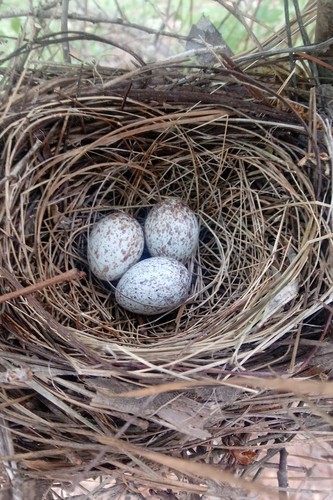
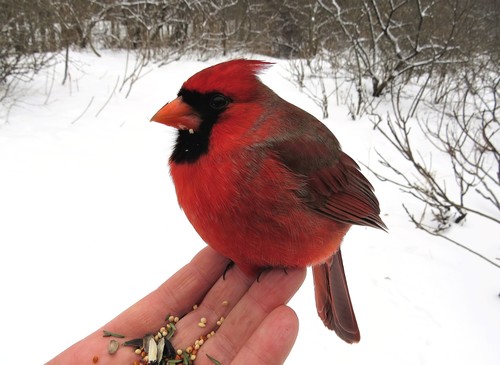
Photographs from iNaturalist · photographer credits
About from Wikipedia
Description
The northern cardinal is a mid-sized songbird with a body length of 21–23.5 cm (8.3–9.3 in) and a wingspan of 25–31 cm (9.8–12.2 in). The adult weighs from 33.6–65 g (1.19–2.29 oz), with an average 44.8 g (1.58 oz). The male averages slightly larger than the female. The oldest wild cardinal banded by researchers lived at least 15 years and 9 months, although 28.5 years was achieved by a captive bird. Annual survival rates for adult northern cardinals have been estimated at 60–65%.
Range & habitat
Northern cardinals are numerous across the eastern United States from the southern half of Maine to Minnesota to the Texas-Mexico border and in Canada in the southern portions of Ontario, Quebec, New Brunswick and Nova Scotia, all the way east to Cape Breton Island. Its range also extends south through Mexico to the Isthmus of Tehuantepec, northern Guatemala, and northern Belize. An allopatric population is found on the Pacific slope of Mexico from Jalisco to Oaxaca (this population is not shown on the range map). The species was introduced to Bermuda in 1700. It has also been introduced in Hawaii. Its natural habitat is in woodlands, gardens, shrublands, and wetlands. In 1929, Forbush described the species as rare in New England, and by 1955 Griscom reported the bird to be "pushing northward" when recorded annually at feeding stations. Audubon data shows that the population has grown rapidly in Massachusetts since 1960. In Massachusetts, the species is most abundant in the east, especially in areas where dense cover is interspersed with open areas, such as woodland edges, brushy fields, wooded wetlands, parks, and suburban areas. They tend to avoid extensive woodlands.
Behaviour
During winter, cardinals will fluff up their down feathers in order to retain warm air next to their body. The down feathers are small and hairlike at the base of each flight feather. The legs and feet are thin and lack feathers, and are vulnerable to rapid heat loss. In cold temperatures, cardinals will shiver and tense their muscles, especially breast muscles, to generate heat. Cardinals have the ability to drop their body temperature 3 to 6 °F (1.7 to 3.3 °C) if needed in order to survive cold temperatures.
Adapted from Northern cardinal on Wikipedia, used under CC BY-SA 4.0.