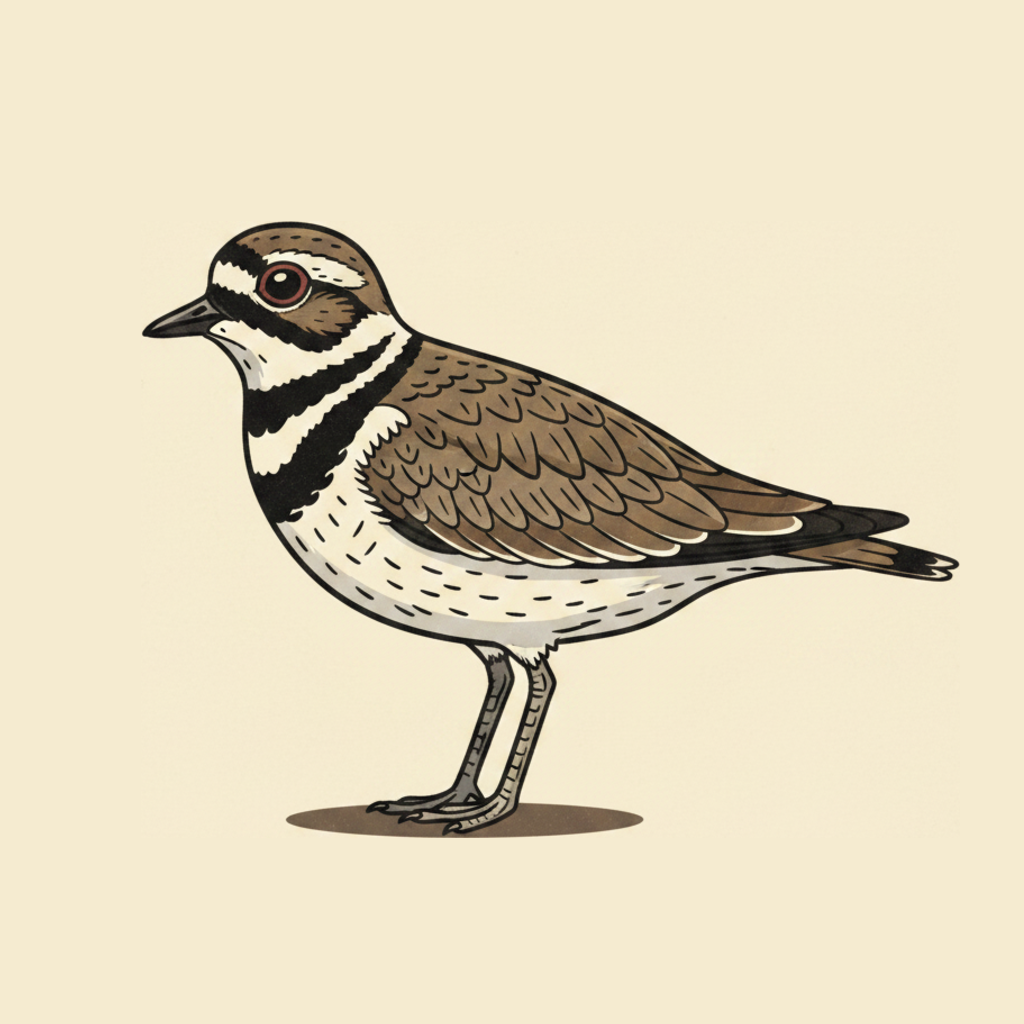
Photographs
what it really looks like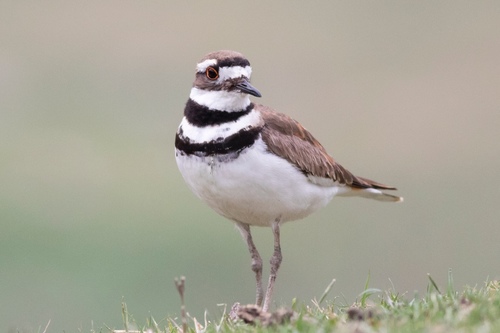
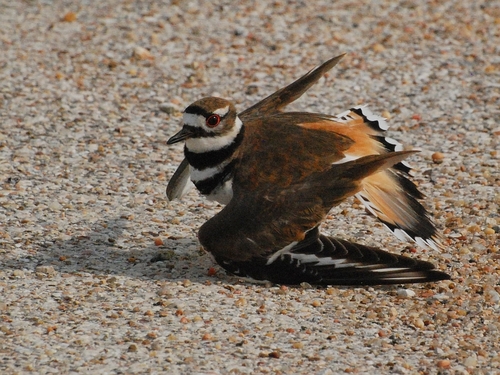
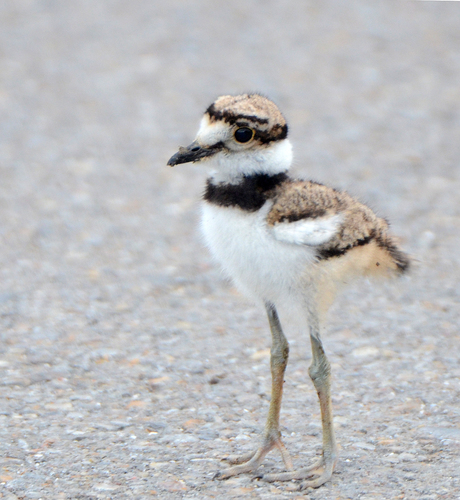
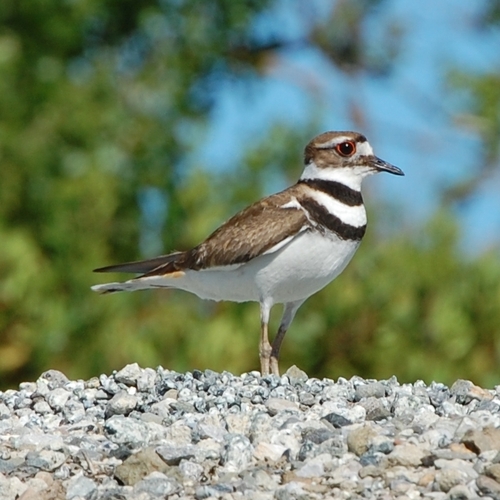
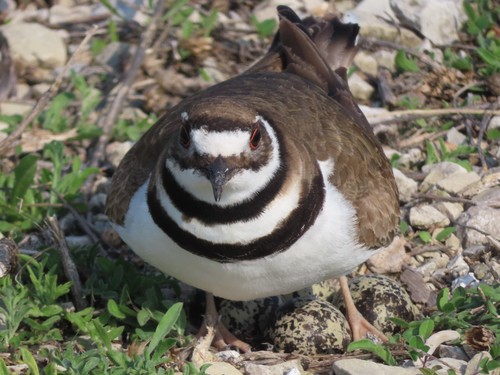
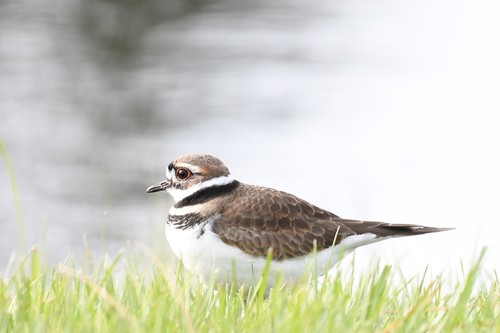
Photographs from iNaturalist · photographer credits
About from Wikipedia
Description
The killdeer is a tall and slender plover, with a relatively long tail. Adults ranging in length from 20 to 28 cm (7.9 to 11.0 in), having a wingspan between 59 and 63 cm (23 and 25 in), and usually being between 72 and 121 g (2.5 and 4.3 oz) in weight. It has a short, thick, and dark bill, flesh-colored legs, and a red eye ring. Its upper parts are mostly brown with rufous fringes, its cap, back, and wings being the former color. It has a white forehead and a white stripe behind the eye, and its lores and the upper borders to the white forehead are black. The killdeer also has a white collar with a black upper border. The rest of the face is brown. The breast and belly are white, except for two black breast bands. It is the only plover in North America with two breast bands. The rump is red, and the tail is mostly brown. The latter also has a black subterminal band, a white terminal band, and barred white feathers on the outer portion of the tail. A white wing stripe at the base of the flight feathers is visible in flight. The female's mask and breast bands tend to be browner than those of the male. The adult of the subspecies C. v. ternominatus is smaller, paler, and greyer than the nominate. The subspecies C. v. peruvianus is smaller than the nominate and has more extensive rufous feather fringes. The juvenile is similar to the adult. The upper parts of the chicks are colored dusky and buff. Their underparts, forehead, neck, and chin are white, and they have a single band across their breast. The killdeer is a vocal species, calling even at night. Its calls include nasal notes, like "deee", "tyeeee", and "kil-deee" (the basis of its common name). During display flights, it repeats a call of "kil-deer" or "kee-deeyu". When this plover is disturbed, it emits notes in a rapid sequence, such as "kee-di-di-di". Its alarm call is a long, fast trill.
Range & habitat
The nominate subspecies of the killdeer breeds in the US (including southeastern Alaska), southern Canada, and Mexico, with less widespread grounds further south, to Panama. Some northern populations are migratory. This bird is resident in the southern half of its breeding range, found throughout the year in most of the contiguous United States. It also winters south to Central America, the West Indies, Colombia, Ecuador, and islands off Venezuela, leaving its breeding grounds after mid-July, with migration peaking from August to September. Migration to the breeding grounds starts in February and ends in mid-May. The subspecies C. v. ternominatus is thought to be resident in the Bahamas, Greater Antilles, and Virgin Islands. C. v. peruvianus is seen year-round in western Ecuador, Peru, and extreme northwestern Chile. The killdeer uses beach habitats, coastal wetlands, and fields during the non-breeding season. It forages almost exclusively in these fields, especially those with short vegetation and with cattle (which likely shorten the vegetation) and standing water. When breeding, the killdeer has a home range of about 6 ha (15 acres), although this is generally larger when nesting more than 50 m (160 ft) away from water. Although generally a low-land species, it is found up to the snowline in meadows and open lakeshores during its autumn migration.
Adapted from Killdeer on Wikipedia, used under CC BY-SA 4.0.