Photographs
what it really looks like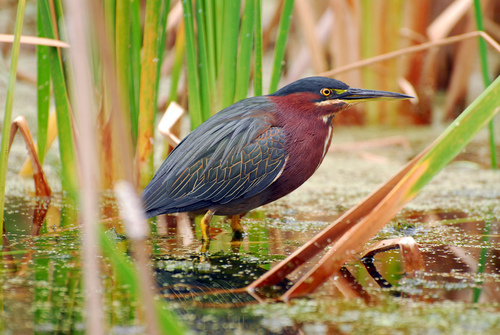
Photographs from iNaturalist · photographer credits
About from Wikipedia
Description
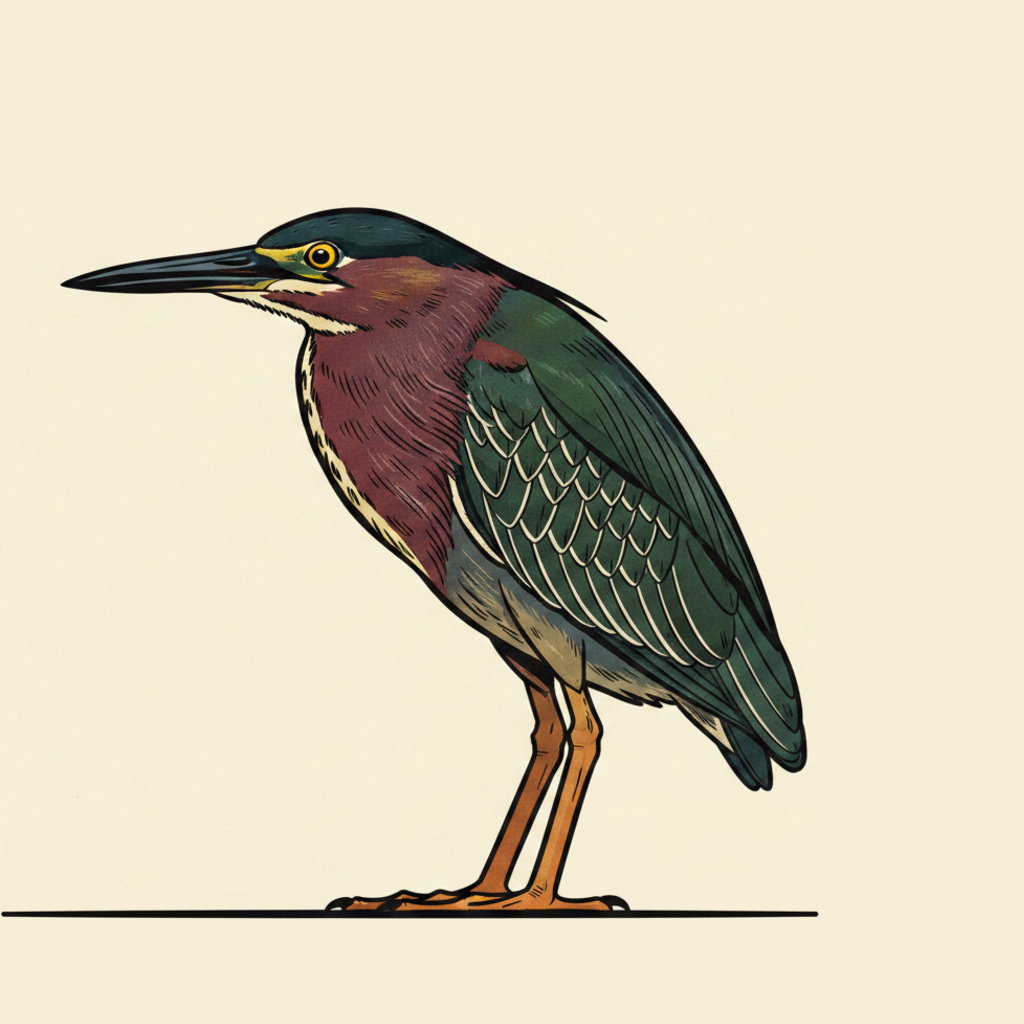
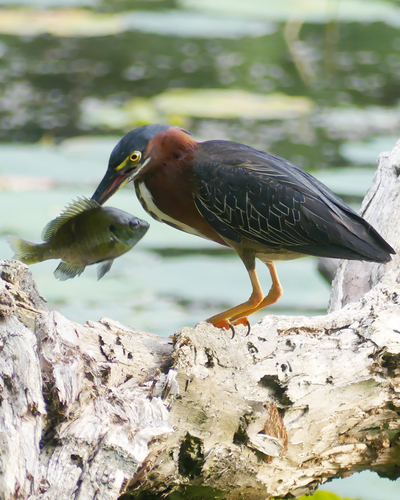
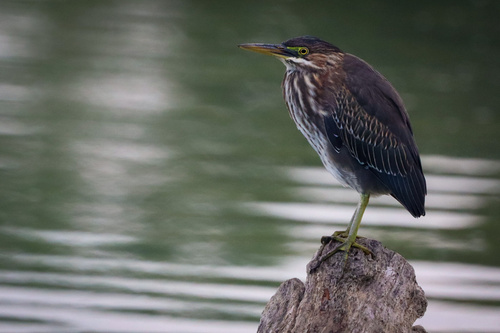
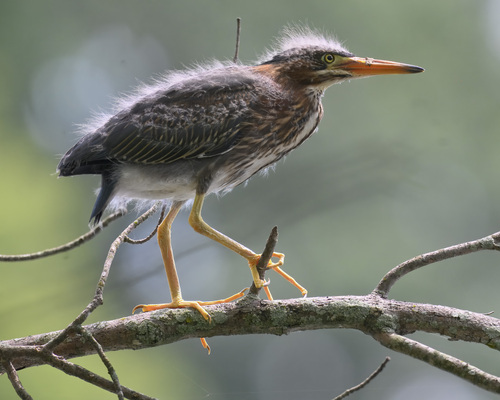
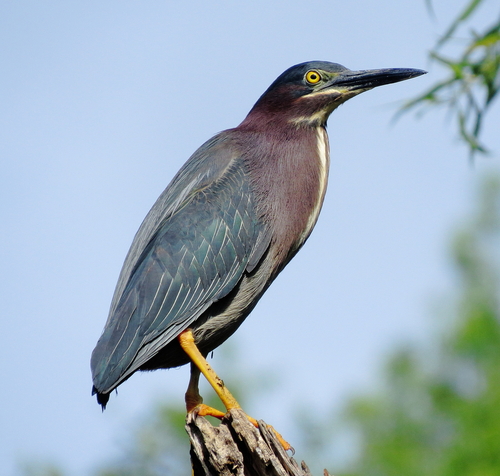
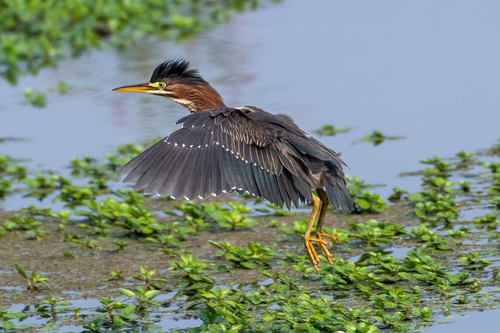
The green heron is a relatively small heron; adult body length is about 44 cm (17 in). The neck is often pulled in tight against the body. Adults have a glossy, greenish-black cap, an iridescent greenish back and wings that are gray-black grading into green or blue, a chestnut neck with a pair or more of white lines down the front, gray underparts and short yellow legs. The bill is dark with a long, sharp point. Female adults tend to be smaller than males, and have duller and lighter plumage, particularly in the breeding season. Juveniles are duller, with the head sides, neck and underparts streaked brown and white, tan-splotched back and wing coverts, and greenish-yellow legs and bill. Hatchlings are covered in down feathers, light gray above, and white on the belly. The green heron's call is a loud and sudden kyow; it also makes a series of more subdued kuk calls. During courtship, the male gives a raah-rahh call with wide-open bill, makes noisy wingbeats and whoom-whoom-whoom calls in flight, and sometimes calls roo-roo to the female before landing again. While sitting, an aaroo-aaroo courtship call is also given. Measurements: Length: 41–46 cm (16–18 in) Weight: 240 g (8.5 oz) Wingspan: 64–68 cm (25–27 in)
Behaviour
The habitat and foraging area of the green heron includes riparian zones, wetlands, ponds, and lakes, as well as human-made canals and ditches. Green herons do not exhibit a particular preference for diurnal or nocturnal foraging, often engaging in both. Shore-living individuals adapt to the rhythm of the tides. They mainly eat small fish, frogs and aquatic arthropods, but may take any invertebrate or vertebrate prey they can catch, including such animals like leeches, earthworms, dragonflies, damselflies, waterbugs, grasshoppers, spiders, crayfish, prawns, mice, other rodents, lizards, tadpoles and snakes. Some of the many fish eaten are minnows, sunfish, catfish, perch, eels and, in urban areas, goldfish. Green herons are intolerant of other birds (including conspecifics) when feeding, and are not seen to forage in groups. They typically stand still on shore or in shallow water or perch upon branches and await prey. They are able to hover briefly to catch prey. Green herons have been observed using captured prey (e.g. mayflies) or other objects (bread, feathers) to "bait-fish", using a lure on the water's surface to attract fish. This bait-fishing behavior is common among herons. The northern population moves to its breeding ranges during March and April; near the northernmost limit of the green heron's range, breeding is well underway by the end of May. The migration to the winter quarters starts in September; by late October, the birds are absent from regions where they do not stay all year. At least the northward migration has not currently adapted to global warming; birds appear in their breeding ranges at the same time they did 100 years ago. Individuals of non-migratory populations abandon their territories after breeding season to roam about the region. They may or may not return to the previous year's breeding location, depending on whether they found better habitat during these wanderings. In these populations, the breeding season is determined by rainfall and consequent prey availability. Green herons are seasonally monogamous. The pairs form in the breeding range, after an intense courtship display by the males, who select the nesting sites and fly in front of the female noisily and with puffed-up head and neck plumage. They nest in forest and swamp patches, over water or in plants near water. Nests are a platform of sticks, often in shrubs or trees, sometimes on the ground. Locations in trees are preferred, with some nests built up to 20 m (66 ft) off the ground although heights of several meters are more common. Rarely, large numbers of these birds congregate in heronries for nesting. The clutch is usually 2–6 pale green eggs, which are laid in two-day intervals (though the second egg may be laid up to six days later than the first). After the last egg has been laid, both parents incubate for about 19–21 days until hatching, and feed the young birds. The frequency of feedings decreases as the offspring near fledging. The young sometimes start to leave the nest at 16 days of age, but are not fully fledged and able to fend for themselves until 30–35 days old. Sometimes, particularly in the tropical parts of its range, the green heron breeds twice a year.
Adapted from Green heron on Wikipedia, used under CC BY-SA 4.0.