Photographs
what it really looks like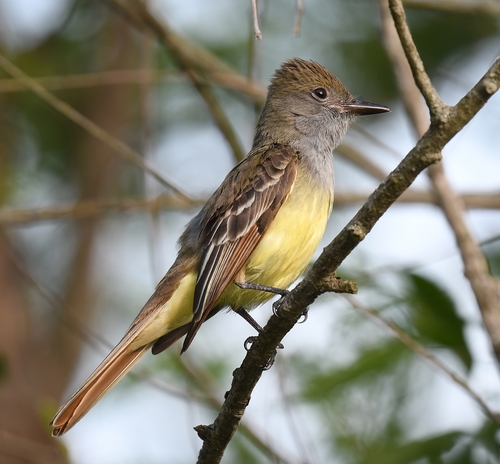
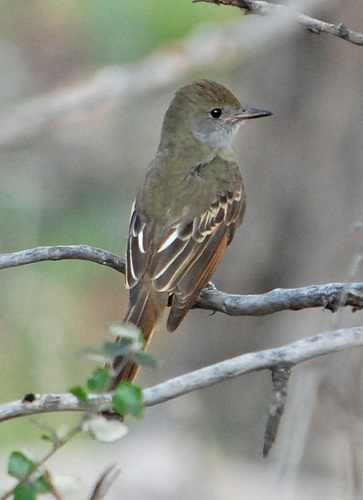
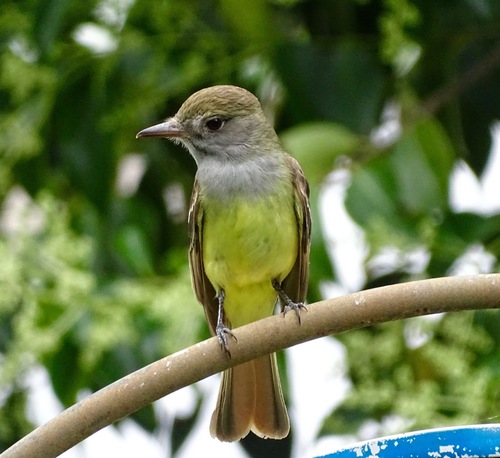
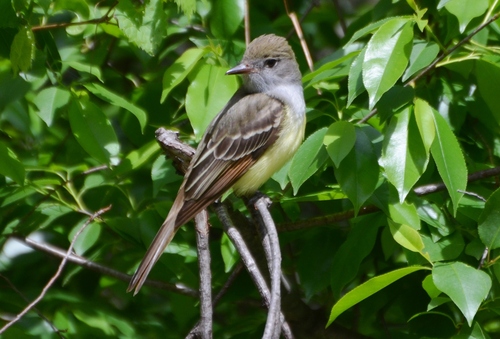
Photographs from iNaturalist · photographer credits
About from Wikipedia
Description
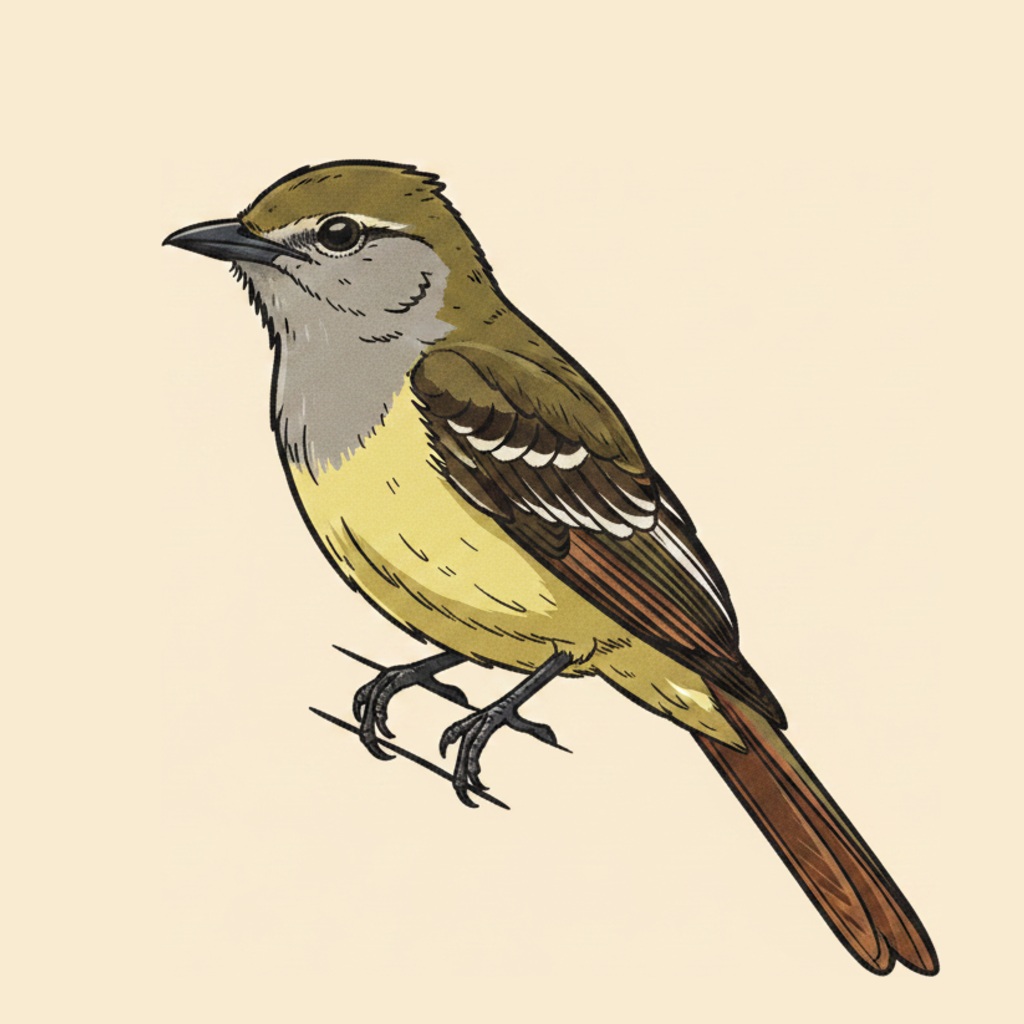
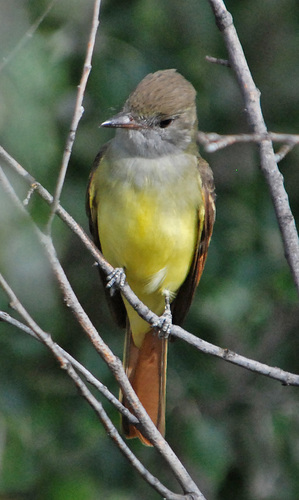
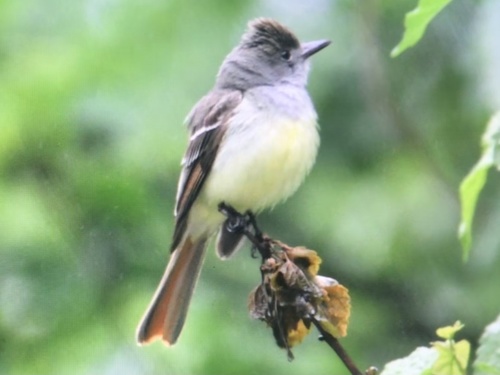
Adult great crested flycatchers usually measure between 17–21 cm (6.7–8.3 in) in length with a wingspan of around 34 cm (13 in). This bird usually weighs between 27–40 g (0.95–1.41 oz). There is no sexual dimorphism. All adults are brownish on the upperparts with yellow underparts; they have a long rusty brown tail and a bushy crest. Their throat and breast are grey. Males will sing a three-part song composed of two short whistles: a wheerreep followed by a higher-pitched whee, and a soft low churr. This song is meant to be heard by a mate at short distances, indicating periods of low disturbance and stress typically intensifying just before dawn. It is appropriately named "dawn song" (or twilight song). In addition to the dawn song, great crested flycatcher also produce various calls, a series of fast ascending huit, huit, huit is given in moments of stress or excitement during interactions of between neighbours. The most characteristic sound is perhaps a single loud whee-eep, called out to communicate between mates or parents and young birds. A faster repetition of this call often signal predators in proximity to nests and young. A rapid succession of harsh-sounds rasps signals alarm or stress often heard during territorial disputes between neighbouring birds
Range & habitat
The great crested flycatcher's habitat selection may vary slightly with different populations, but can be most often found breeding in deciduous forests and at edges of clearings and mixed woodlands. They also show a tendency to favour landscapes with open canopy, such as second growth forests or woodlands that have been subjected to selective cutting, and also appears to avoid coniferous dominant habitats such as the Canadian boreal forest. The summer breeding ground covers all eastern, mid-eastern and parts of central United States, including Northern and Southern parts of Florida, parts of Texas, central Oklahoma, and eastern and central North Dakota. In Canada, it is limited to southern Manitoba, extreme southern portions of the St-Lawrence forest of Ontario, Quebec, northeast Nova Scotia and parts of Prince Edward Island. Its winter range includes most of southern Mexico and the Yucatán Peninsula, and extends along the coasts of Central America. In southern peninsular Florida, Great Crested flycatcher can be found year-round. They migrate to Mexico and South America, as well as to Florida and the Caribbean.
Adapted from Great crested flycatcher on Wikipedia, used under CC BY-SA 4.0.