Photographs
what it really looks like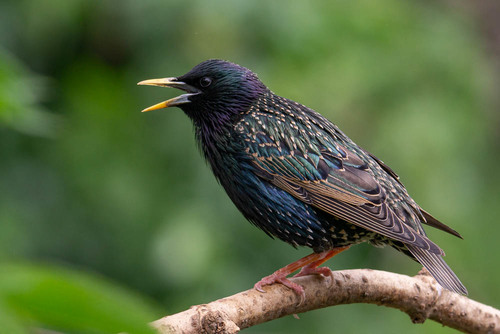
Photographs from iNaturalist · photographer credits
About from Wikipedia
Description
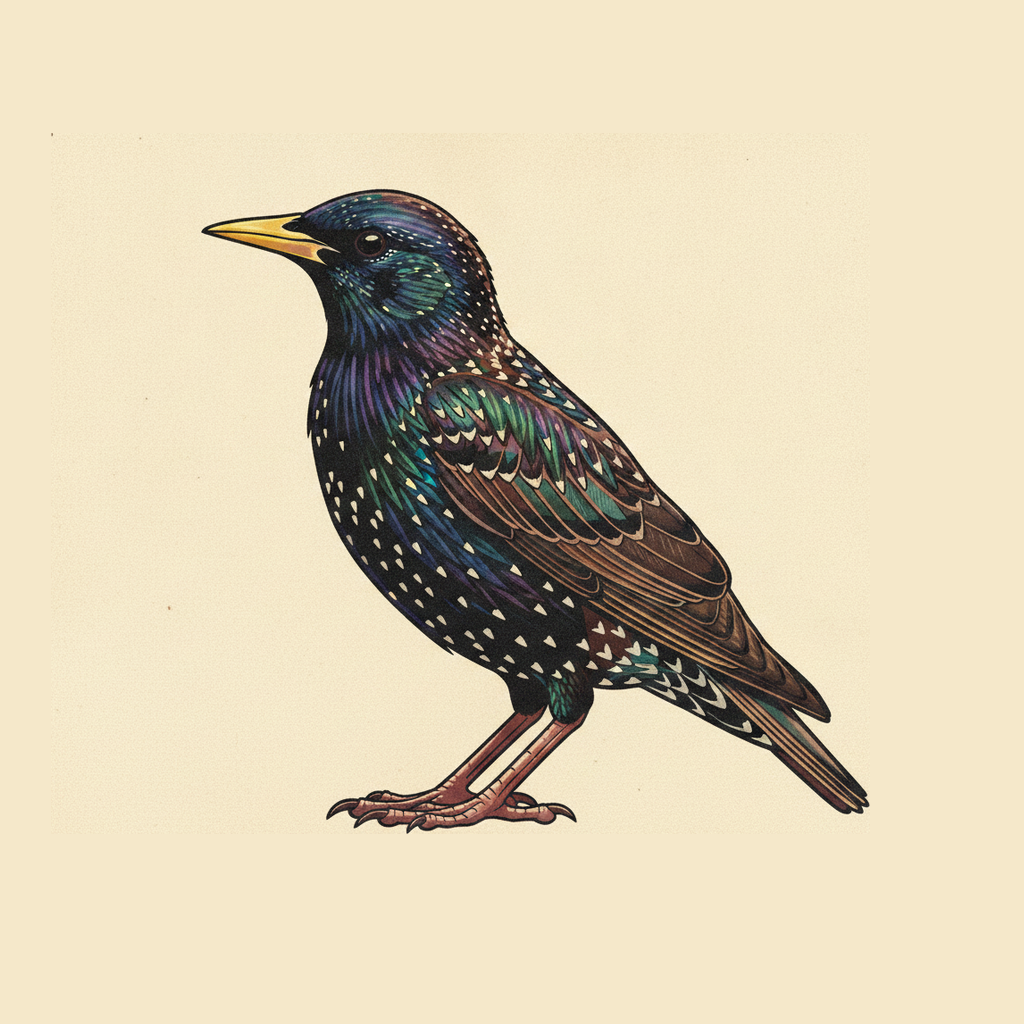
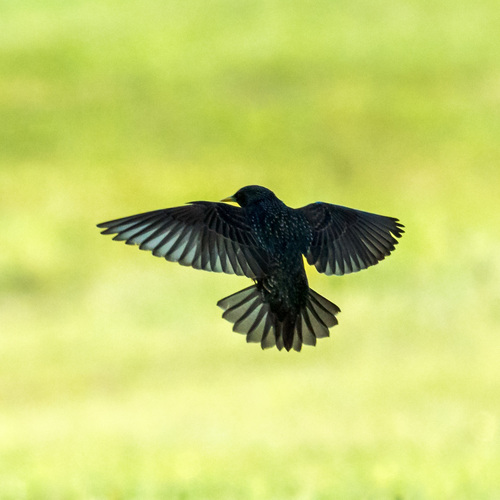
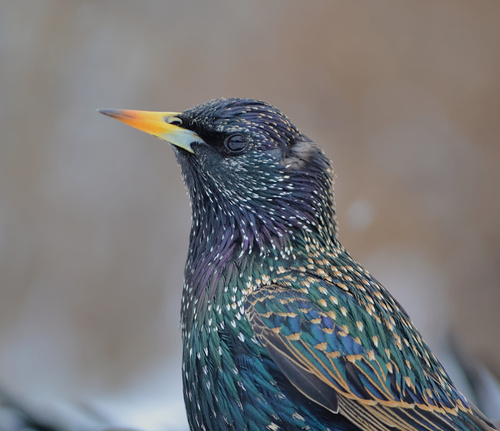
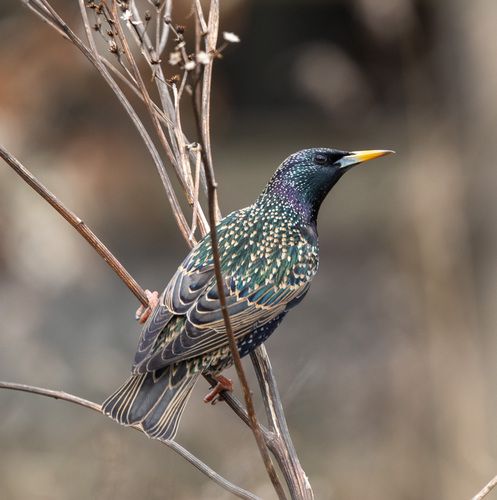
The common starling is 19–23 cm (7.5–9.1 in) long, with a wingspan of 31–44 cm (12–17 in) and a weight of 58–101 g (2.0–3.6 oz). Among standard measurements, the wing chord is 11.8 to 13.8 cm (4.6 to 5.4 in), the tail is 5.8 to 6.8 cm (2.3 to 2.7 in), the culmen is 2.5 to 3.2 cm (0.98 to 1.26 in) and the tarsus is 2.7 to 3.2 cm (1.1 to 1.3 in). The plumage is iridescent black, glossed purple or green, and spangled with white, especially in winter. The underparts of adult male common starlings are less spotted than those of adult females at a given time of year. The throat feathers of males are long and loose and are used in display while those of females are smaller and more pointed. The legs are stout, pinkish- or greyish-red in the breding season, and slightly darker in winter. The bill is narrow and conical with a sharp tip; in the winter it is brownish-black but in summer, females have lemon yellow beaks with pink bases while males have yellow bills with blue-grey bases. Moulting occurs once a year in late summer after the breeding season has finished; the fresh feathers are prominently tipped white (breast feathers) or buff (wing and back feathers), which gives the bird a speckled appearance. The reduction in the spotting in the breeding season is achieved through the white feather tips largely wearing off. Juveniles are grey-brown and by their first winter resemble adults though often retaining some brown juvenile feathering, especially on the head. They can usually be sexed by the colour of the irises, rich brown in males, mouse-brown or grey in females. Estimating the contrast between the iris and the central always-dark pupil is 97% accurate in determining sex, rising to 98% if the length of the throat feathers is also considered. The common starling is mid-sized by both starling standards and passerine standards. It is readily distinguished from most other mid-sized passerines, such as thrushes, icterids or small corvids, by its relatively short tail, sharp, blade-like bill, round-bellied shape and strong, sizeable (and rufous-coloured) legs. In flight, its strongly pointed wings and dark colour are distinctive, while on the ground its strange, somewhat waddling gait is also characteristic. The colouring and build usually distinguish this bird from other starlings, although the closely related spotless starling may be distinguished by the lack of pale feather tip spots in adult breeding plumage. The bohemian waxwing is structurally very similar in flight and also flies in dense flocks; it can be distinguished by being a paler reddish buff colour, marginally smaller, and also has a very different flight call. Like most terrestrial starlings the common starling moves by walking or running, rather than hopping. Their flight is quite strong and direct; their triangular wings beat very rapidly, and periodically the birds glide for a short way without losing much height before resuming powered flight. When in a flock, the birds take off almost simultaneously, wheel and turn in unison, form a compact mass or trail off into a wispy stream, bunch up again and land in a coordinated fashion. Common starling on migration can fly at 60–80 km/h (37–50 mph) and cover up to 1,000–1,500 km (620–930 mi). Several terrestrial starlings, including those in the genus Sturnus, have adaptations of the skull and muscles that help with feeding by probing. This adaptation is most strongly developed in the common starling (along with the spotless and white-cheeked starlings), where the protractor muscles responsible for opening the jaw are enlarged and the skull is narrow, allowing the eye to be moved forward to peer down the length of the bill. This technique involves inserting the bill into the ground and opening it as a way of searching for hidden food items. Common starlings have the physical traits that enable them to use this feeding technique, which has undoubtedly helped the species spread far and wide. In Iberia, the western Mediterranean and northwest Africa, the common starling may be confused with the closely related spotless starling, the plumage of which, as its name implies, has a more uniform colour. At close range it can be seen that the latter has longer throat feathers, a fact particularly noticeable when it sings.
Range & habitat
The global population of common starlings was estimated to be 310 million individuals in 2004, occupying a total area of 8,870,000 km2 (3,420,000 sq mi). Widespread throughout the Northern Hemisphere, the bird is native to Eurasia and is found throughout Europe, northern Africa (from Morocco to Egypt), India (mainly in the north but regularly extending farther south and extending into the Maldives) Nepal, the Middle East including Israel, Syria, Iran, and Iraq, and northwestern China. Common starlings in the south and west of Europe and south of latitude 40°N are mainly resident, although other populations migrate from regions where the winter is harsh, the ground frozen and food scarce. Large numbers of birds from northern Europe, Russia and Ukraine migrate south westwards or south eastwards. In the autumn, when immigrants are arriving from eastern Europe, many of Britain's common starlings are setting off for Iberia and North Africa. Other groups of birds are in passage across the country and the pathways of these different streams of bird may cross. Of the 15,000 birds ringed as nestlings in Merseyside, England, individuals have been recovered at various times of year as far afield as Norway, Sweden, Finland, Russia, Ukraine, Poland, Germany and the Low Countries. Small numbers of common starlings have sporadically been observed in Japan and Hong Kong but it is unclear whence these birds originated. In North America, northern populations have developed a migration pattern, vacating much of Canada in winter. Birds in the east of the country move southwards, and those from farther west winter in the southwest of the US. Common starlings prefer urban or suburban areas where artificial structures and trees provide adequate nesting and roosting sites. Reedbeds are also favoured for roosting and the birds commonly feed in grassy areas such as farmland, grazing pastures, playing fields, golf courses and airfields where short grass makes foraging easy. They occasionally inhabit open forests and woodlands and are sometimes found in shrubby areas such as Australian heathland. Common starlings rarely inhabit dense, wet forests (i.e. rainforests or wet sclerophyll forests) but are found in coastal areas, where they nest and roost on cliffs and forage amongst seaweed. Their ability to adapt to a large variety of habitats has allowed them to disperse and establish themselves in diverse locations around the world resulting in a habitat range from coastal wetlands to alpine forests, from sea cliffs to mountain ranges 1,900 m (6,200 ft) above sea level.
Behaviour
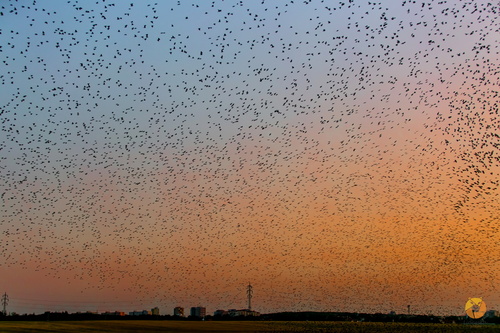
The common starling is a highly gregarious species, especially in autumn and winter. Although flock size is highly variable, huge, noisy flocks (murmurations) may form near roosts. These dense concentrations of birds are thought to be a defence against attacks by birds of prey such as peregrine falcons or Eurasian sparrowhawks. Flocks form a tight sphere-like formation in flight, frequently expanding and contracting and changing shape, seemingly without any sort of leader. Each common starling changes its course and speed as a result of the movement of its closest neighbours. Very large roosts, up to 1.5 million birds, form in city centres, woodlands and reedbeds, causing problems with their droppings. These may accumulate up to 30 cm (12 in) deep, killing trees by their concentration of chemicals. In smaller amounts, the droppings act as a fertiliser, and therefore woodland managers may try to move roosts from one area of a wood to another to benefit from the soil enhancement and avoid large toxic deposits. Flocks of more than a million common starlings may be observed just before sunset in spring in southwestern Jutland, Denmark, over the seaward marshlands of Tønder and Esbjerg municipalities between Tønder and Ribe. They gather in March until northern Scandinavian birds leave for their breeding ranges by mid-April. Their swarm behaviour creates complex shapes silhouetted against the sky, a phenomenon known locally as sort sol ("black sun"). Flocks of anything from five to fifty thousand common starlings form in areas of the UK just before sundown during mid-winter. These flocks are commonly called murmurations.
Adapted from Common starling on Wikipedia, used under CC BY-SA 4.0.