Photographs
what it really looks like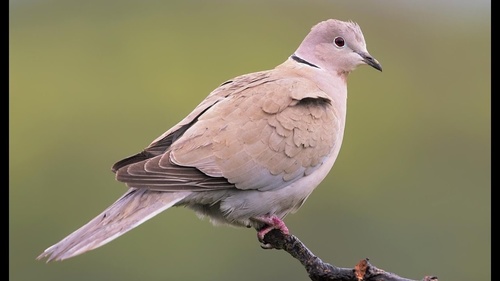
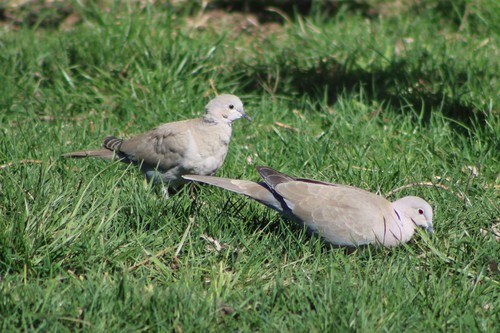
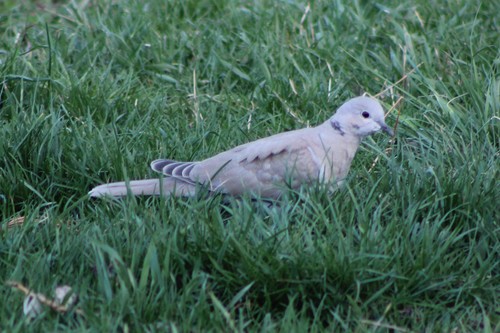
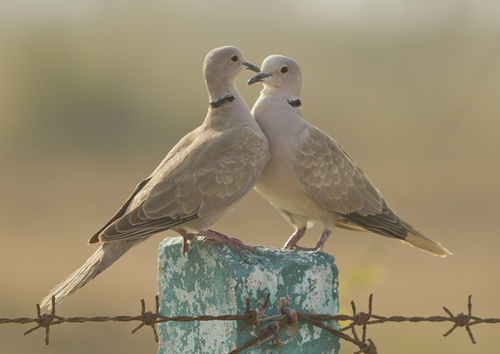
Photographs from iNaturalist · photographer credits
About from Wikipedia
Description
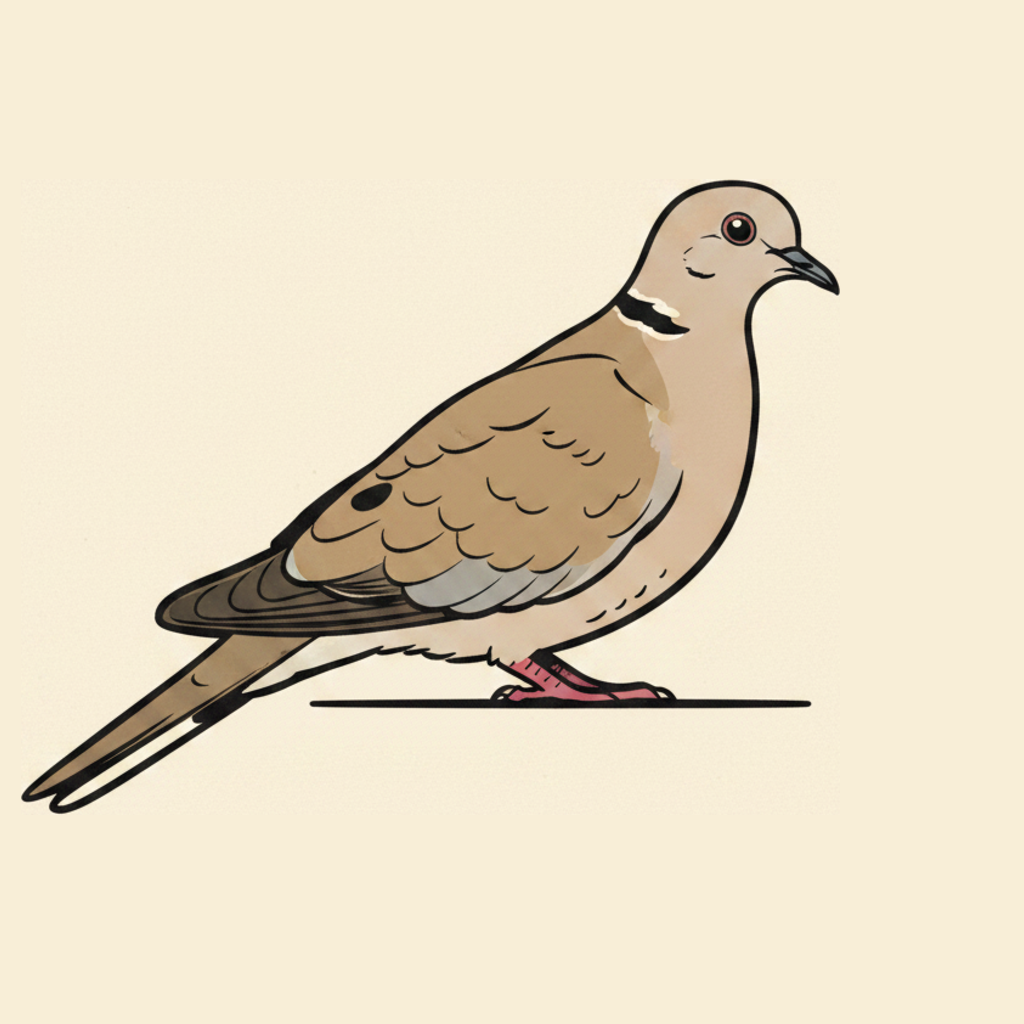
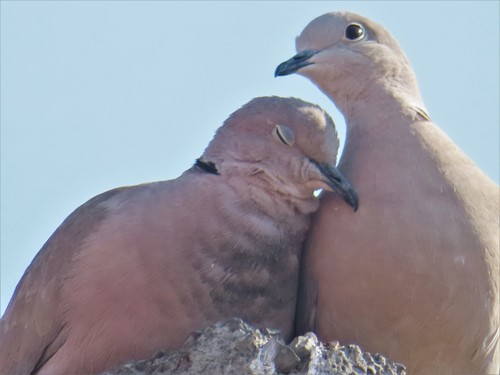
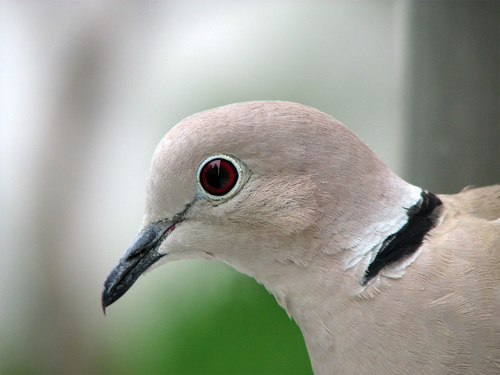
It is a medium-sized dove, with an average length of 32 cm (13 in) from tip of beak to tip of tail, a wingspan of 47–55 cm (19–22 in) and a weight of 125–240 g (4.4–8.5 oz). It is grey-buff to pinkish-grey, slightly darker above than below, and with a blue-grey underwing patch. The tail feathers are grey-buff above, and dark grey and tipped white below; the outer tail feathers are also tipped whitish above. It has a black half-collar edged with white on its nape. The short legs are red, and the bill is black. The iris is red, but from a distance the eyes appear to be black, as the pupil is relatively large; a narrow rim of reddish-brown iris surrounds the black pupil. The eye is surrounded by a small area of bare skin, either white or yellow. The two sexes are identical; juveniles only differ in having a poorly developed collar, and a brown iris. The Eurasian collared dove's call is a three-syllable goo-GOO-goo, with stress placed on the second syllable. It also makes a harsh loud screeching call chrrai-chrrai lasting about two seconds, particularly in flight just before landing. Eurasian collared doves cooing in early spring are sometimes mistakenly reported as the calls of early-arriving common cuckoos.
Range & habitat
The Eurasian collared dove is not migratory, but is strongly dispersive. Over the last century, it has travelled far beyond its native range to colonise colder countries, becoming a permanent resident in several of them. Its original range at the end of the 19th century was Asia, from eastern Turkey to southern China, and south through India to Sri Lanka. In 1838, it was reported in Bulgaria, but not until the 20th century did it expand across Europe, appearing in parts of the Balkans between 1900 and 1920, and then spreading rapidly northwest, reaching Germany in 1945, Denmark in 1948, Great Britain on 14 May 1952 (breeding for the first time in 1956), Ireland in 1959, and the Faroe Islands in the early 1970s. Subsequent spread was 'sideways' from this fast northwestern spread, reaching northeast to north of the Arctic Circle in Norway and east to the Ural Mountains in Russia, and southwest to the Canary Islands and northern Africa from Morocco to Egypt, by the end of the 20th century. In the east of its range, it has also spread northeast to most of central and northern China, and locally (probably introduced) in Japan. It has also reached Iceland as a vagrant (41 records up to 2006), but has not colonised there. Despite this spread, a population decline occurred in Britain from 2005, possibly caused by finch trichomonosis. By 2026, numbers had dropped by 40%.
Adapted from Eurasian collared dove on Wikipedia, used under CC BY-SA 4.0.