Photographs
what it really looks like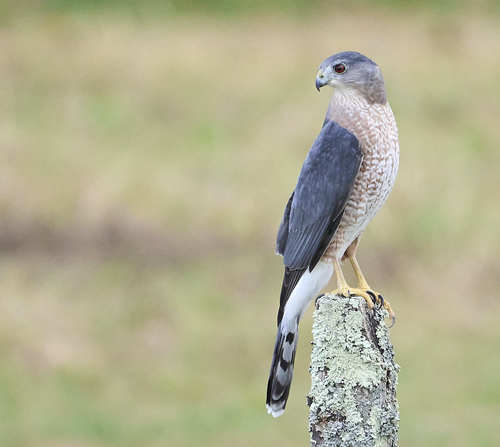
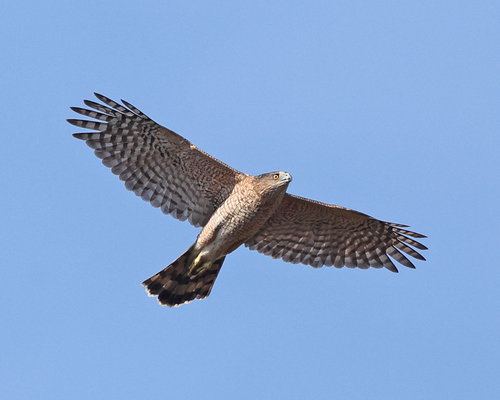
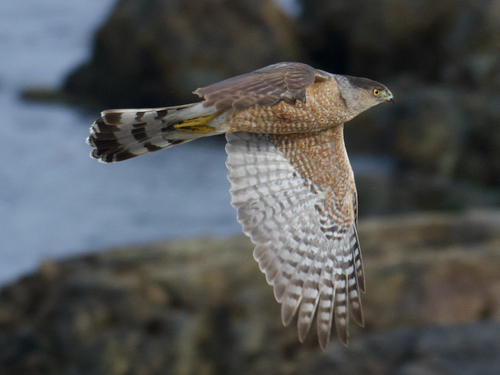
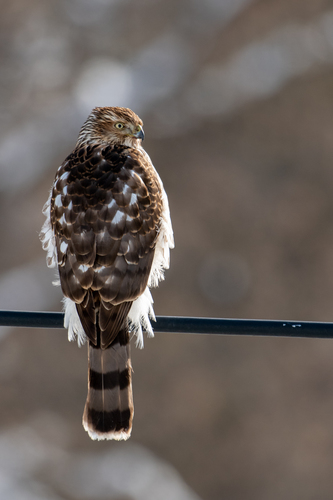
Photographs from iNaturalist · photographer credits
About from Wikipedia
Description
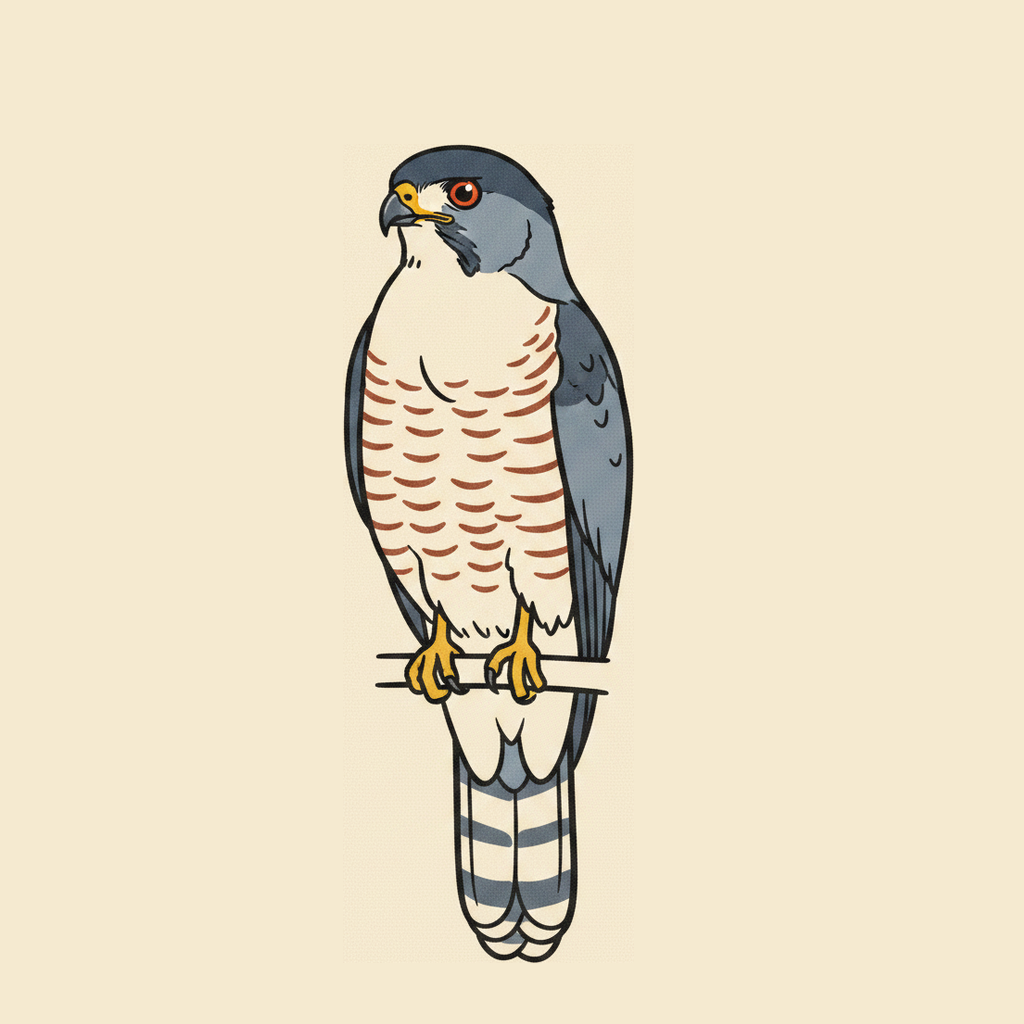
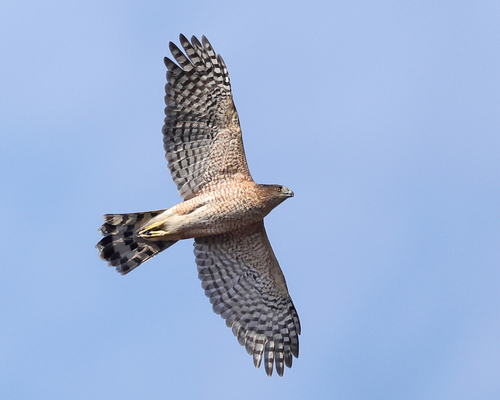
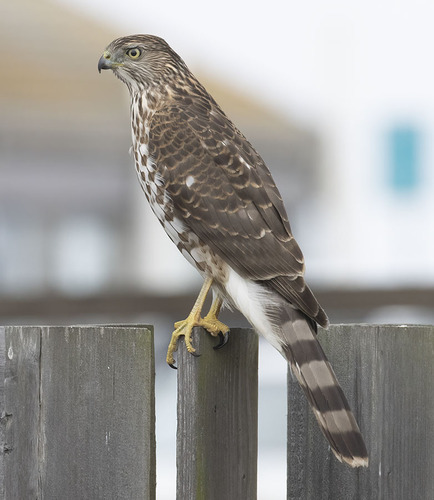
Cooper's hawk is a medium-sized hawk, but roughly average to small-sized for an Astur species. Compared to related species, it tends to have moderate-length wings, a long, often graduated or even wedge-shaped tail, and long though moderately thick legs and toes. Its eyes tend to be set well forward in the sides of the relatively large and squarish-looking head (though the head can look somewhat rounded if the feathers on the nape are held flush) and a relatively short but robust bill. It has a hooked bill well-adapted for tearing the flesh of prey, as is typical of raptors. Generally, Cooper's hawks can be considered secretive, often perching within the canopy, but uses more open perches, especially in the western part of the range or in winter, when they may use leafless or isolated trees, utility poles, or exposed stumps. On perched hawks, the wing tips tend to appear to cover less than one-third of the tail, sometimes seeming to barely cover the covert feathers. As adults, they may be a solid blue-gray or brown-gray color above. Adults usually have a well-defined crown of blackish-brown feathers above a paler nape and hind neck offset against their streaked, rufous cheeks. Their tails are blue-gray on top and pale underneath, barred with three black bands in a rather even pattern and ending in a rather conspicuous white tip. The adult's underside shows a whitish base color overlaid heavily with coarse, irregular rufous to cinnamon bands, though these narrow into marginal shaft streaks around the throat. Against the rich color on the rest of the underside, the pure white crissum on adults is conspicuous. Adult females typically are slightly more brownish or grayish above, while some adult males can range rarely into almost a powder blue color. Although little regional variation is seen in the plumage, adult coloring in the Pacific Northwest typically is slightly darker overall. Aberrant pale plumage was recorded in at least four birds, all of which were almost completely white and lacked any underside streaking. These birds had faded back color and lacked strong barring on the tail. An aberrant dark female was also recorded. As a juvenile, she had a blackish-brown (rather than mid-brown) back and dark, inky feathers below with grayish ground color barely showing. Later, she produced an aberrant male with similar characteristics that successfully fledged. The latter two were possible cases of melanism; such dark variations are virtually unprecedented in any Astur or Accipiter species. Juveniles of the species are generally dark brown above, though the feathers are not infrequently edged with rufous to cinnamon and have a variable whitish mottling about the back, wing coverts, and mainly the scapulars. Juveniles tend to have streaking or washing of tawny on the cheeks, ending in a light nuchal strip, giving them a hooded appearance unlike the capped appearance of adults (some juveniles, unlike adults, also may manifest a slim supercilium). The crown is brown on juveniles rather than blackish as in adults. The tail is similar to that of the adult but more brownish and sometimes shows an additional fourth band. The juvenile has more pale white to cream base color showing than older birds, with variable dusky throat striping and mid-brown streaks, which appear as sharply defined from about the lower throat to the lower breast. The juvenile may have brown to black spots or bars on the thighs with thin black streaks mostly ending at the belly and conspicuous white crissum and undertail coverts. Juveniles may tend to appear more "disheveled" and less compact than adults in feather composition. In flight, though usually considered medium-sized, Cooper's hawks appear fairly small, as emphasized by the short wings relative to the elongated tail (unlike unrelated hawks, the wingspan is usually less than twice as broad as the total length). The species tends to have rounded wings, a long, rounded tail, and long legs, much like other Astur and Accipiter species. Cooper's hawks have a strong flight with stiff beats and short glides, tending to do so on quite level wings with wrist thrust forward yet the head consistently projects. The five outer functional primaries are notched on their inner webs, the outermost is the longest, the next outermost nearly as long. When soaring, these hawks do so on flattish, or more commonly, slightly raised wings, with fairly straight leading edges. Against the barred underbody on adults, the wings are more or less flecked in similar color, with pale greyish flight feathers and a broadly white-tipped tail correspondingly barred with dark gray. Meanwhile, the upper side of adults is essentially all blue-grey. Juveniles are mostly dark above, though manifest a hooded effect on the head and rufous-buff edges and especially whitish mottling; the latter can be fairly apparent. Juveniles are mainly whitish below with neatly dark streaks about the wing linings, breast, flanks, and thighs, with bars on the axillaries and flight feathers. The tail of the juvenile has a broadly white tip and bars like adults, but the ground color is a paler shade of gray. Adults' eyes range from light orange to red, with males typically darker in eye color, while those of juveniles are yellow. Among 370 breeding hawks from different parts of the range, 1-year-old males usually had light orange eyes and 1-year-old females usually yellow eyes. Males two or older typiclly have either orange (40.4%) or dark orange (32.3%) eyes, while females' eyes at this stage were light orange or lighter. From the second year, the eyes may grow darker still, but stop darkening soony thereafter. Three-year or older males were found to have predominantly dark orange (37.3% vs 21.6% of similar-aged females), red (34.6% vs 3.3% of similar-aged females) or mid-orange (26.6% vs 55% of similar-aged females). The purpose of bright eye color in the hawks may be correlated to feeding stimulation of nestling hawks (i.e. darker orange or red objects may be more perceptible and tend to be pecked at more so than duller colors). The eyes of this hawk, as in most predatory birds, face forward, enabling good depth perception for hunting and catching prey while flying at top speeds. The molt begins in late April–May and takes about 4 months. The female usually begins to molt about 7–10 days sooner than the male, occurring inward towards the body on the wing feathers. Tail molt may generally start with the middle tail feathers, proceeding posteriorly to the upper tail coverts, also starting with the median feathers on the scapulars. Arrested molt has been recorded in the late nesting period, often pausing after the third primary is molted, or especially when food supplies are down during the brooding stage, and may be resumed after the stress of feeding the brooding diminishes.
Range & habitat
Cooper's hawk's breeding range extends from southern Canada to northern Mexico. In southern Canada, they breed (but do not normally winter) in the southerly parts of the provinces of British Columbia, Alberta, Saskatchewan, Manitoba, Ontario, Quebec to extreme southwestern Nova Scotia. The northern extent of their breeding range reaches roughly to Jasper National Park and Cedar Lake, Manitoba. Cooper's hawks can be found across the entirety of the contiguous United States at some part of the year, excepting the northernmost region of Maine. Their breeding range terminates along the Gulf Coast and south Florida, and south of the Rio Grande, excepting their Mexican breeding range consisting of northern Baja California, the mountains from eastern Sonora and Chihuahua to Durango, also recently in northern Coahuila, formerly east into Nuevo Leon and south to Michoacán and possibly still in Guerrero. In Oaxaca, records show that the species has been recorded year-around with the first confirmed breeding reported in 2001. In winter, they are found up to the southern half of Washington, the southern two-thirds of Idaho and Wyoming, southern South Dakota, the southern parts of Minnesota, Wisconsin, and Michigan, extreme southwestern Ontario, southwestern and southeastern New York, and New England through all but northwestern Massachusetts and to the southeastern part of New Hampshire. In winter, they range regularly throughout the parts of the southern United States, where they do not breed, such as all Gulf Coast areas and in South Florida. Wintering Cooper's hawks are common through all parts of Mexico except the Yucatán Peninsula, with Central American populations occurring in Guatemala and the border regions of Honduras and Nicaragua.
Behaviour
This species tends to be active earlier in the morning than sharp-shinned hawks and in the morning than in the afternoon. These hawks may readily take to conifers to roost, generally sleeping with their heads tucked in. During daylight hours, they tend to preen while sitting on a perch about 11 times a day, and may take about up to 20 minutes to do so. When drinking, Cooper's hawks prefer relatively secluded waterways. In more arid regions, they may seek artificial bodies of water to drink from. Although a rare behavior, several cases of juvenile hawks proning, wherein they lie on their backs along a branch (or rarely the ground), apparently as a form of sunning, have been reported. Cooper's hawks may walk on ground to gather nesting materials or hunt. Their well-developed muscle mass powers their flight, especially helping with acceleration during hunts and when carrying heavy prey, but some other nonraptorial birds may have similar muscularity relative to their mass, such as the Canada goose (Branta canadensis) and even pied-billed grebes (Podilymbus podiceps), and these ample muscle masses may be correlated with migratory (rather than hunting) behavior. Cooper's hawks have been recorded as engaging in an exaggerated, nighthawk-like flight in noncourtship circumstances, such as during migration or by recent fledglings.
Adapted from Cooper's hawk on Wikipedia, used under CC BY-SA 4.0.