Photographs
what it really looks like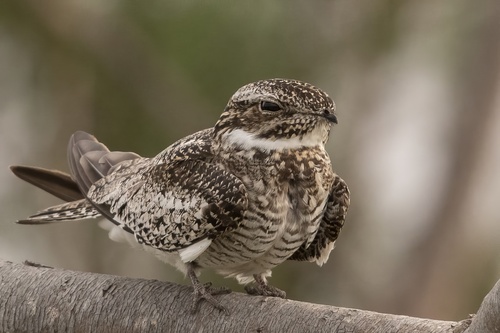
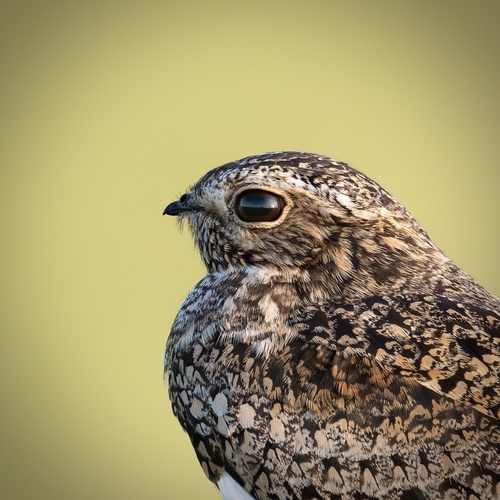
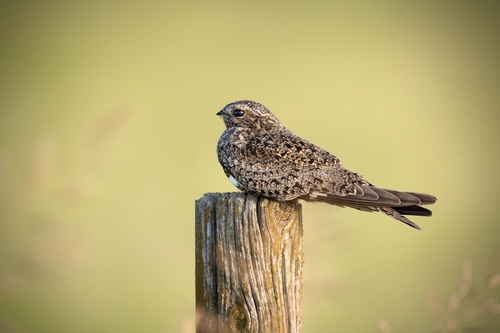
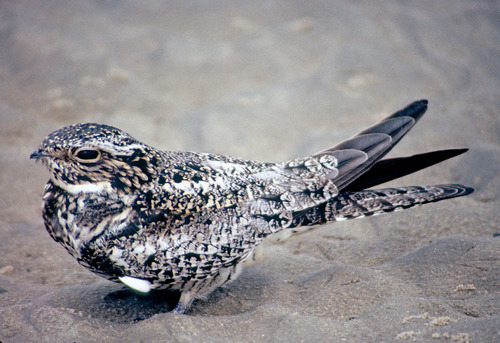
Photographs from iNaturalist · photographer credits
About from Wikipedia
Description
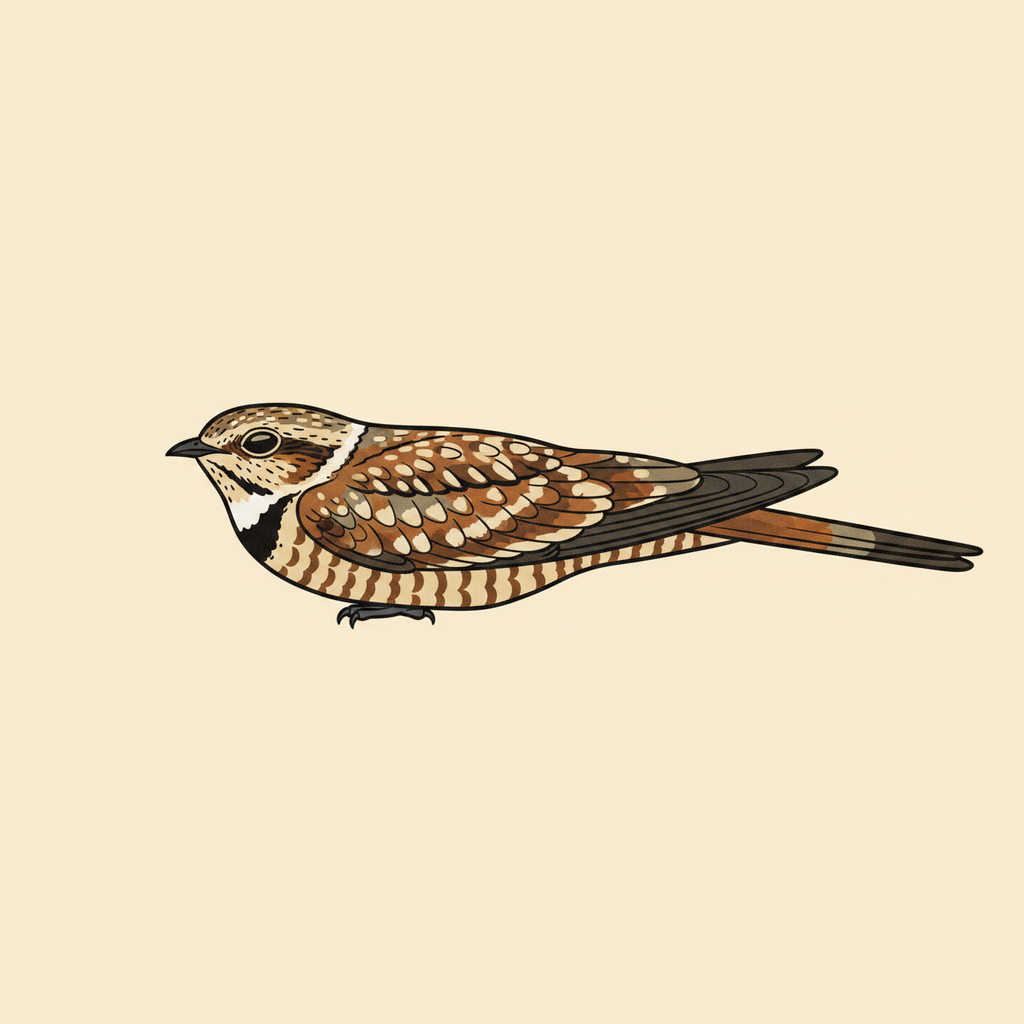
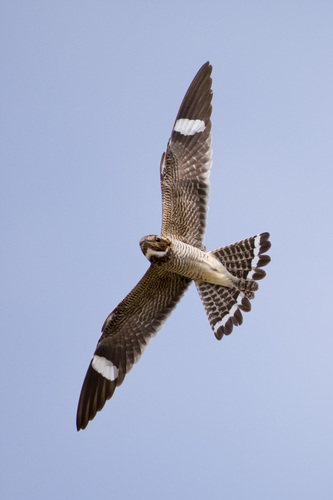
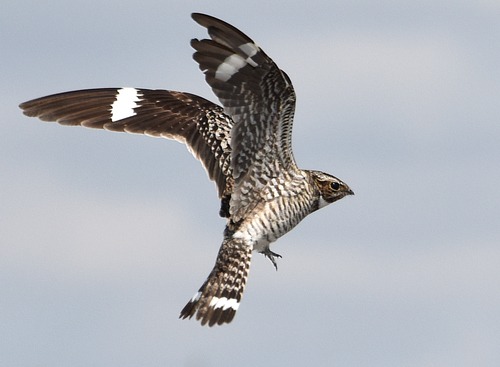
The common nighthawk is distinguished from other caprimulguids by its forked tail (includes a white bar in males); its long, unbarred, pointed wings with distinctive white patches; its lack of rictal bristles, and the key identifier – their unmistakable calls. These birds range from 21 to 25 cm (8.3 to 9.8 in) in total length and from 51 to 61 cm (20 to 24 in) in wingspan. Body mass can vary from 55 to 98 g (1.9 to 3.5 oz). Among standard measurements, the wing chord is 17.2 to 21.3 cm (6.8 to 8.4 in), the tail is 13 to 15.1 cm (5.1 to 5.9 in), the bill is 0.5 to 0.8 cm (0.20 to 0.31 in) and the tarsus is 1.2 to 1.6 cm (0.47 to 0.63 in). The common nighthawk resembles both the Antillean nighthawk and the lesser nighthawk and occurs at least seasonally in the entire North American range of both of these species. The lesser nighthawk is a smaller bird and displays more buffy on the undertail coverts, where the common nighthawk shows white. Common nighthawks and Antillean nighthawks exhibit entirely dark on the basal portion of the primary feathers, whereas lesser nighthawks have bands of buffy spots. Common and Antillean nighthawks have a longer outermost primary conveying a pointier wing tip than the lesser nighthawk. The common nighthawk forages higher above ground than the lesser nighthawk and has a different call. The only reliable way to distinguish Antillean nighthawk without disturbance is also by the differences in their calls. Visually, they may only be distinguished as different from the common nighthawk once in the hand. Subtle differences are reported to be a challenge in field identification.
Range & habitat
The common nighthawk may be found in forests, desert, savannahs, beach and desert scrub, cities, and prairies, at elevations of sea level or below to 3,000 m (9,800 ft). Nighthawks prefer to nest in edge and early successional habitats, making them one of only a handful of birds which will live and hunt in burned or clearcut patches of forest. The common nighthawk is drawn into urban built-up areas by insects. The common nighthawk is the only nighthawk occurring over the majority of northern North America. Food availability is likely a key factor in determining which and when areas are suitable for habitation. The common nighthawk is not well adapted to survive in poor conditions, specifically low food availability. Therefore, a constant food supply consistent with warmer temperatures is a driving force for migration and ultimately survival. It is thought that the bird is not able to enter torpor, although recent evidence suggests it does.
Adapted from Common nighthawk on Wikipedia, used under CC BY-SA 4.0.