Photographs
what it really looks like

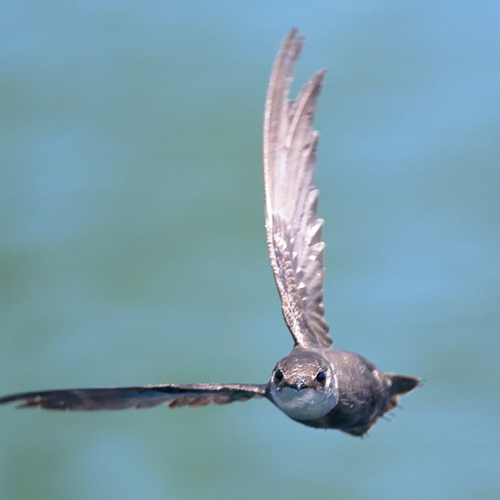
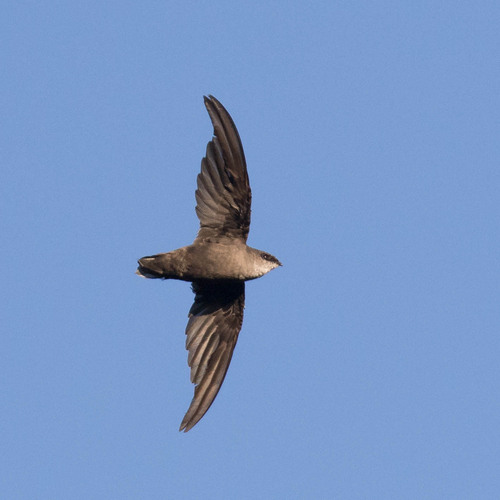
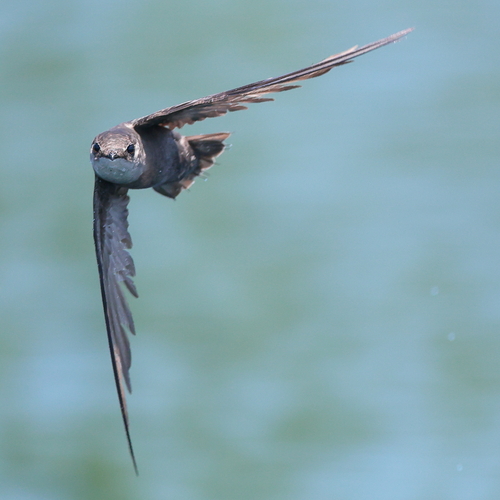
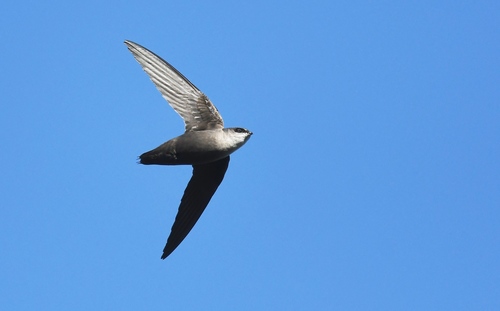
Photographs from iNaturalist · photographer credits
About from Wikipedia
Description
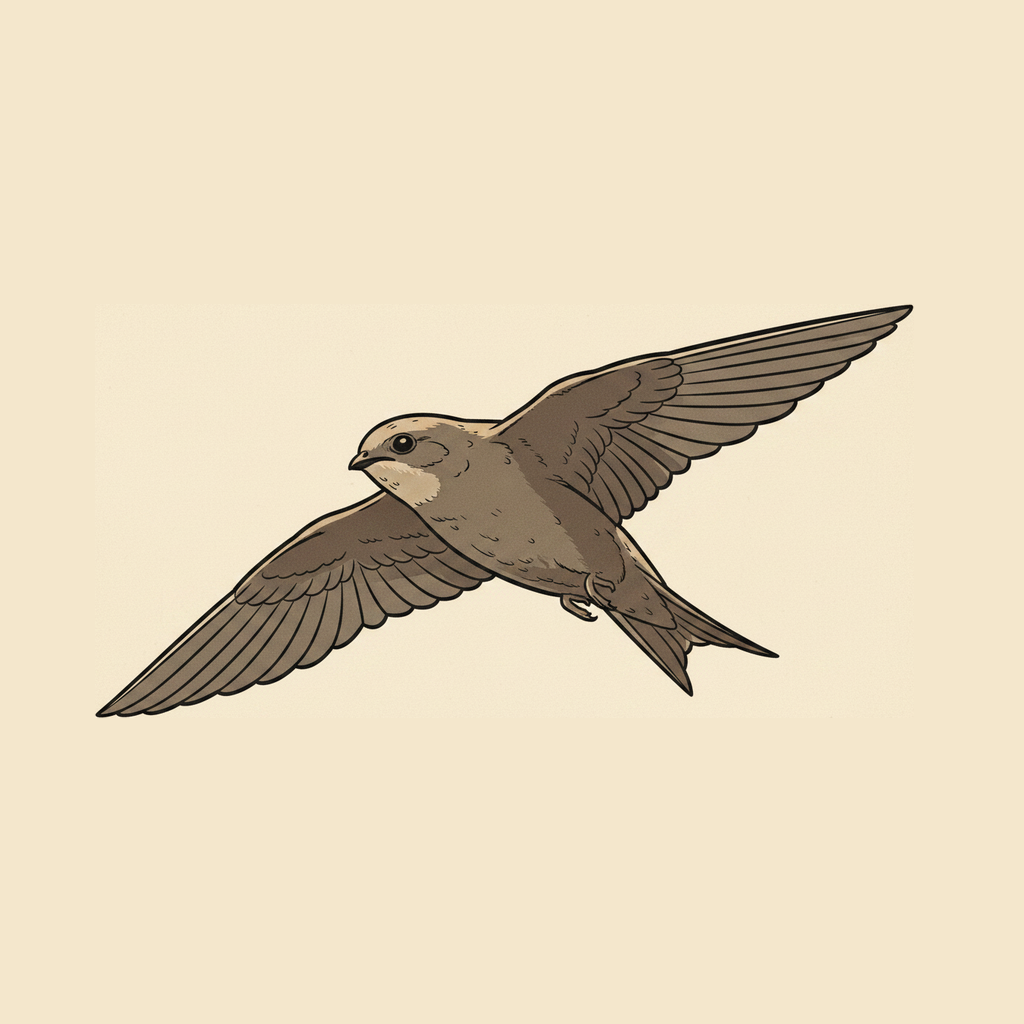
This is a medium-sized swift, measuring from 12 to 15 cm (4.7 to 5.9 in) in length, with a wingspan of 27 to 30 cm (11 to 12 in) and a weight ranging from 17 to 30 g (0.60 to 1.06 oz). The sexes are identical in plumage, though males average slightly heavier than females. The adult's plumage is a dark sooty olive above and grayish brown below, with a slightly paler rump and uppertail covert feathers, and a significantly paler throat. Its upperparts are the most uniformly colored of all the Chaetura swifts, showing little contrast between back and rump. Its beak is black, as are its feet and legs. Its iris is dark brown. The juvenile plumage (held by young birds for their first few months after fledging) is very similar to that of adults, but with whitish tips to the outer webs of the secondaries and tertials. The chimney swift's wings are slender, curved and long, extending as much as 1.5 in (3.8 cm) beyond the bird's tail when folded. Its wingtips are pointed, which helps to decrease air turbulence (and therefore drag) during flight. Its humerus (the bone in the inner part of the wing) is quite short, while the bones farther out (more distally) along the wing are elongated, a combination which allows the bird to flap very quickly. In flight, it holds its wings stiffly, alternating between rapid, quivering flaps and longer glides. Its flight profile is widely described as a "cigar with wings"—a description first used by Roger Tory Peterson. Although the bird often appears to beat its wings asynchronously during flight, photographic and stroboscopic studies have shown that it beats them in unison. The illusion that it does otherwise is heightened by its very fast and highly erratic flight, with many rapid changes of direction. The legs of the chimney swift, like those of all swifts, are very short. Its feet are small but strong, with very short toes that are tipped with sharp, curved claws. The toes are anisodactyl—three forward, one back—like those of most birds, but the chimney swift can swivel its back toe (its hallux) forward to help it get a better grip. Unlike the legs and feet of most birds, those of the chimney swift have no scales; instead, they are covered with smooth skin. Its tail is short and square, measuring only 4.8 to 5.5 cm (1.90 to 2.15 in) in length. All ten of its tail feathers have shafts which extend as much as 1.3 cm (0.5 in) beyond the vanes, ending in sharp, stiff points. These help the bird to prop itself against vertical surfaces. The chimney swift has large, deep set eyes. These are protected by small patches of coarse, black, bristly feathers, which are located in front of each eye. The swift can change the angle of these feathers, which may help to reduce glare. It is far-sighted and, like some birds of prey, this swift is bifoveal: each eye having both a temporal and a central fovea. These are small depressions in the retina where visual acuity is highest, and help to make its vision especially acute. Like most vertebrates, it is able to focus both eyes at once; however, it is also able to focus a single eye independently. Its bill is very small, with a culmen that measures a mere 5 mm (0.20 in) in length. However, its gape is huge, extending back below its eyes, and allowing the bird to open its mouth very widely. Unlike many insectivorous birds, it lacks rictal bristles at the base of the beak.
Range & habitat
A widespread breeding visitor to much of the eastern half of the United States and the southern reaches of eastern Canada, the chimney swift migrates to South America for the winter. It is a rare summer visitor to the western U.S, and has been recorded as a vagrant in Anguilla, Barbados, Greenland, Jamaica, Portugal, the United Kingdom and the U.S. Virgin Islands. It is found over open country, savanna, wooded slopes and humid forests. The chimney swift's wintering grounds were only discovered in 1944, when bands from birds banded (ringed) in North America were recovered in Peru. An indigenous Peruvian had been wearing the bands as a necklace.
Behaviour
The chimney swift is a gregarious species, and is seldom seen alone. It generally hunts in groups of two or three, migrates in loose flocks of 6–20, and (once the breeding season is over) sleeps in huge communal roosts of hundreds or thousands of birds. Like all swifts, it is a superb aerialist, and only rarely seen at rest. It drinks on the wing, skimming the surface of the water with its beak. It also bathes on the wing, gliding above the surface of a body of water, briefly smacking its breast into the water, then flying off again, shaking its feathers as it goes. It has been recorded by pilots flying more than a mile above the surface of the earth, including one seen at 7,300 ft (2,200 m). It is incapable of perching upright like most birds do; instead, it clings to vertical surfaces. If it is disturbed while at rest, the chimney swift will clap its wings loudly once or twice against its body; it does this either in place, or while dropping down several feet to a lower location. This behavior can result in a loud "thundering" sound if large roosts of the birds are disturbed. The sound is thought to be the bird's way of scaring away potential predators.
Adapted from Chimney swift on Wikipedia, used under CC BY-SA 4.0.