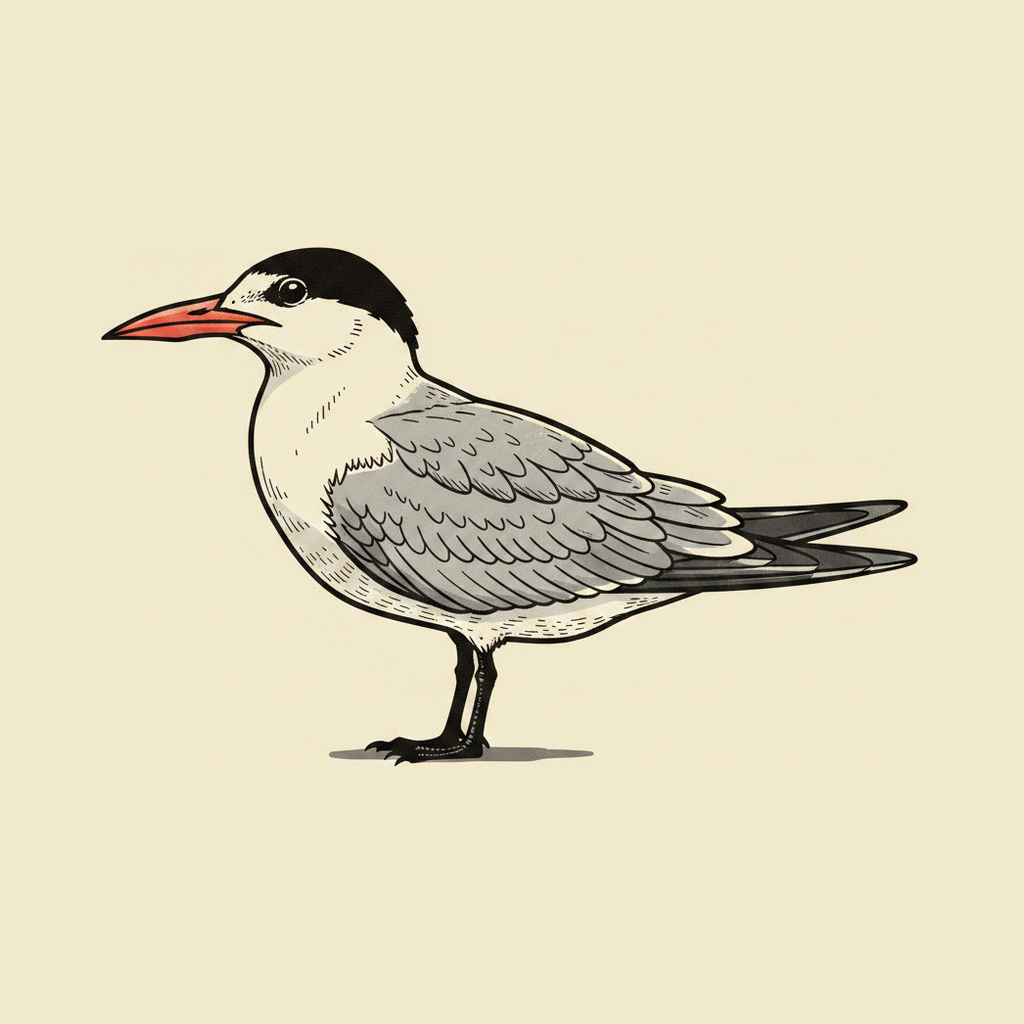
Photographs
what it really looks like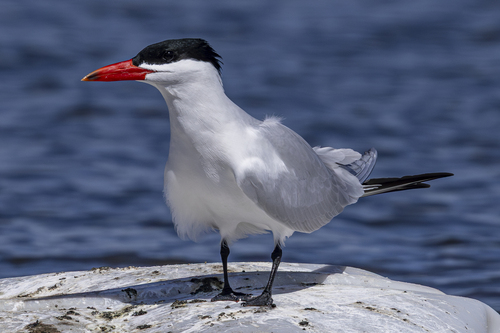
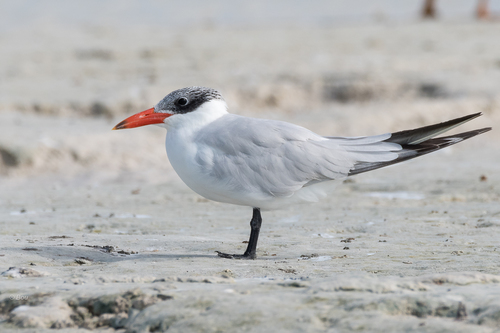

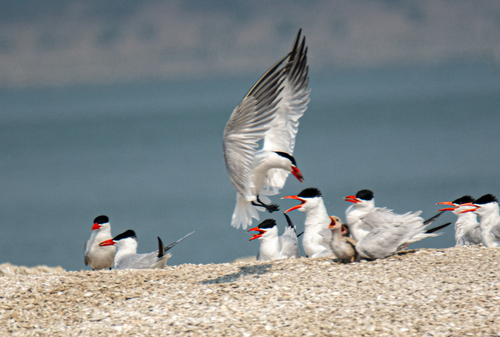


Photographs from iNaturalist · photographer credits
About from Wikipedia
Description
It is the world's largest tern with a length of 48–60 cm (19–24 in), a wingspan of 127–145 cm (50–57 in) and a weight of 530–782 g (18.7–27.6 oz). Adult birds have black legs, and a long thick red-orange bill with a small black tip. They have a white head with a black cap and white neck, belly, and tail. The upper wings and back are pale grey; the underwings are pale with dark primary feathers. In-flight, the tail is less forked than other terns, and wingtips are black on the underside. In winter, the black cap is still present (unlike many other terns), but with some white streaking on the forehead. The call is a loud heron-like croak.
Range & habitat
Their breeding habitat is large lakes and ocean coasts in North America (including the Great Lakes), and locally in Europe (mainly around the Baltic Sea and Black Sea), Asia, Africa, and Australasia (Australia and New Zealand). North American birds migrate to southern coasts, the West Indies and northernmost South America. European and Asian birds spend the non-breeding season in the Old World tropics. African and Australasian birds are resident or disperse over short distances. In 2016, a pair of Caspian terns bred successfully in the Cape Krusenstern National Monument in northwestern Alaska, 600 km further north than any previous North American breeding record. This development was part of a general trend in Alaska of species moving to the north, a tendency ascribed to global warming. The global population is about 50,000 pairs; numbers in most regions are stable, but the Baltic Sea population (1400–1475 pairs in the early 1990s) is declining and of conservation concern. The Caspian tern is one of the species to which the Agreement on the Conservation of African-Eurasian Migratory Waterbirds (AEWA) applies.
Adapted from Caspian tern on Wikipedia, used under CC BY-SA 4.0.