
Photographs
what it really looks like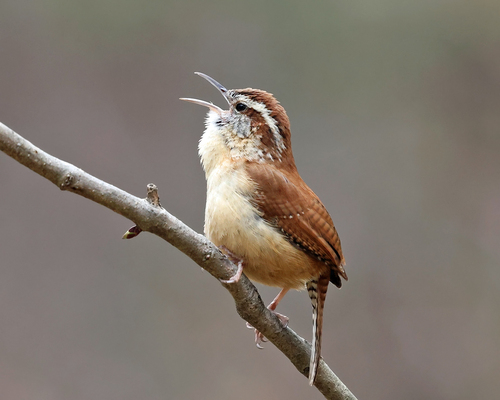




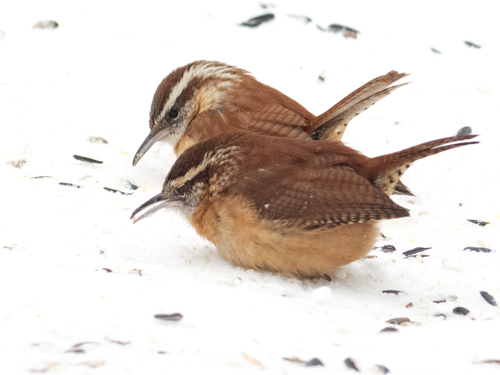
Photographs from iNaturalist · photographer credits
About from Wikipedia
Description
At 12.5 to 14 cm (4.9 to 5.5 in) long, with a 29 cm (11 in) wingspan and a weight of about 18 to 23 g (0.63 to 0.81 oz), the Carolina wren is a fairly large wren; the second largest in the United States species after the cactus wren. Among standard measurements, the wing chord is 5.4 to 6.4 cm (2.1 to 2.5 in), the tail is 4.5 to 5.6 cm (1.8 to 2.2 in), the culmen is 1.4 to 1.8 cm (0.55 to 0.71 in) and the tarsus is 2 to 2.3 cm (0.79 to 0.91 in). Sexual dimorphism is slight with males being larger than their mates. A study indicated that of 42 mated pairs, every male but one was larger than the female of the pair. The males were on average 11 percent heavier along with having longer wing chords. For T. l. ludovicianus, the crown is rich brown that appears more chestnut-colored on its rump and upper tail coverts. Shoulders and greater coverts are a rich brown, with a series of small white dots on the lesser primary coverts. The secondary coverts are rich brown with a darker brown barring on both webs; the bars on the primaries are on the outerwebs only, but darker and more noticeable. The rectrices are brown with 18 to 20 bars that span across the tail. The white supercilious streak borders thinly with a black above and below, and extends above and beyond its shoulders. The ear coverts are speckled gray and grayish-black. Its chin and throat are grey that becomes buff on its chest, flank and belly, though the latter two are of a warmer color. The underwing coverts sport a grayish buff color. Its iris is reddish-brown, the upper mandible is dark gray to pinkish-gray, paler at the base and on the lower mandible. The legs are light pinkish to yellowish-brown color. Several differences are seen among the subspecies. In contrast to T. l. ludovicianus, T. l. berlandieri is of a slightly smaller build, but possesses a larger bill, the upperparts are duller brown with deeper colored underparts, T. l. lomitensis is of a duller color (than either T. l. ludovicianus or T. l. berlandieri) with its underparts either pale or almost white, T. l. miamensis contains darker rusty chestnut upperparts and deeper colored below. T. l. burleighi is duller and sootier with less distinct tail markings, T. l. mesophilus has paler underparts and a whiter supercilium, and T. l. tropicalis is darker than all races, and contains heavier bars than T. l. berlandieri.
Range & habitat
These birds are largely resident, and will only disperse beyond their range after mild winters. Carolina wrens sporadically breed as far north as Maine and Quebec after mild winters. In certain parts of their range, such as most of Iowa, prolonged periods of snow can curtail potential expansion. Permanent breeding locations range from eastern Nebraska, southern Michigan, southeast Ontario and the New England states to Mexican states such as Coahuila, Nuevo León, San Luis Potosí and Tamaulipas and the Gulf Coast of the United States. Local occurrences with infrequent and likely breeding locations include southeast South Dakota, central Kansas, eastern Colorado, western Oklahoma and Texas as far as Maine and New Brunswick. There have been occasional vagrants spotted in Colorado, New Mexico, and Arizona, Wyoming, South Dakota, Manitoba, Nova Scotia, and the Gulf of St. Lawrence. The range of the wrens increased northward and westward in several regions over the past few centuries. In Massachusetts, the wrens had expanded westward and northeastward from its former southeastern location in approximately 35 years, in New York the population increased three-fold in roughly 25 years, while in the midwest states of Ohio and Michigan, numbers have increased since the mid-1800s and early 1900s, respectively. Expansion around Ontario occurred since early reports in 1890 and 1905. Explanations given include infrequent winter storms in the 20th century, expanded forest habitats, and the wrens taking advantage of urban areas containing feeders, especially in winter. From 1966 to 2015 the Carolina wren experienced a greater than 1.5% annual population increase throughout most of its northern range, extending from southern Maine to southern Nebraska. Carolina wrens adapt to various habitats. Natural habitats include various types of woodland such as oak hardwoods and mixed oak-pine woodlands, ash and elmwoods, hickory-oak woodlands with a healthy amount of tangled undergrowth. The preferred habitats are riparian forest, brushy edges, swamps, overgrown farmland, and suburban yards with abundant thick shrubs and trees, and parks. It has an affinity for dilapidated buildings and unkempt yards in man-made areas. Subspecies T. l. burleighi and T. l. neophilus inhabit slash pine and palmettos.
Adapted from Carolina wren on Wikipedia, used under CC BY-SA 4.0.