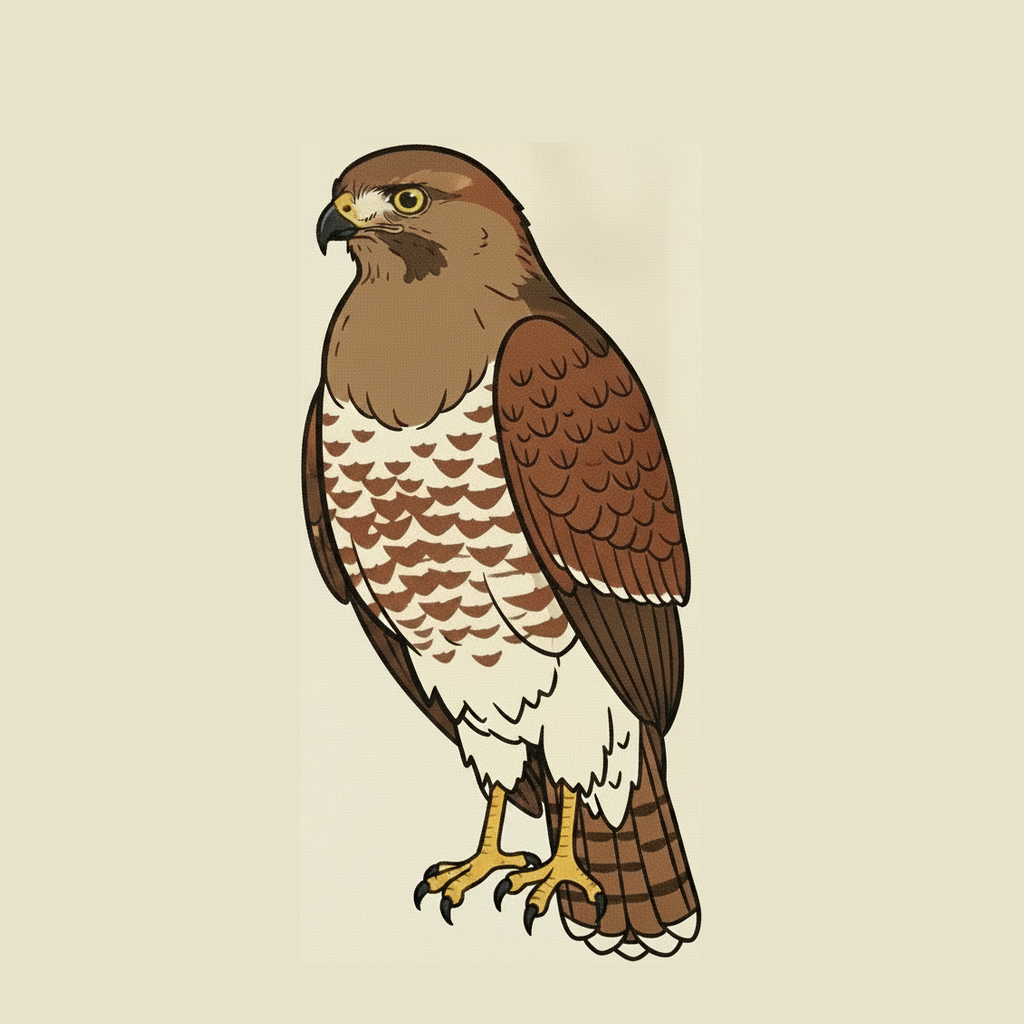
Photographs
what it really looks like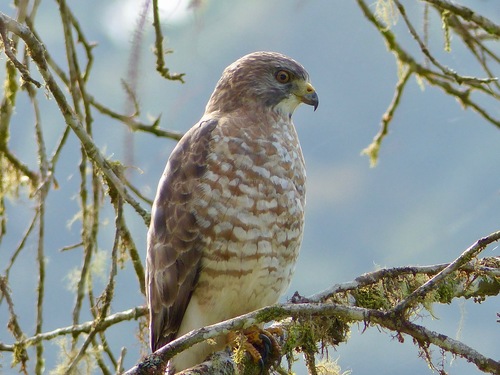
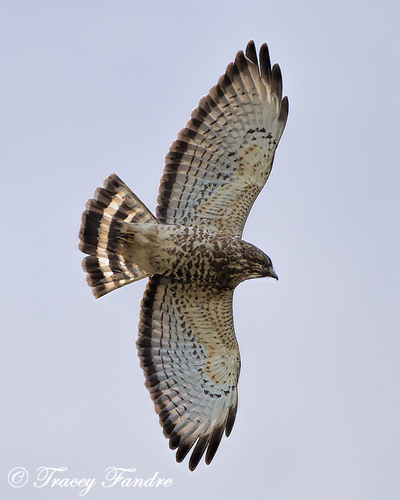
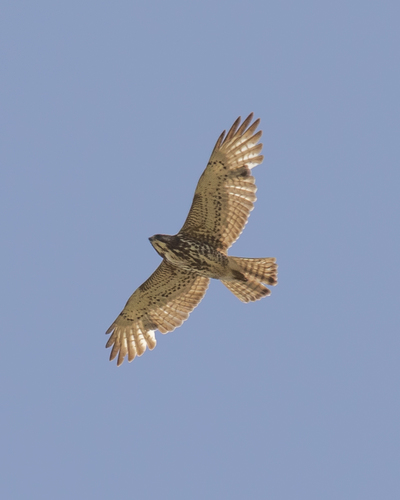
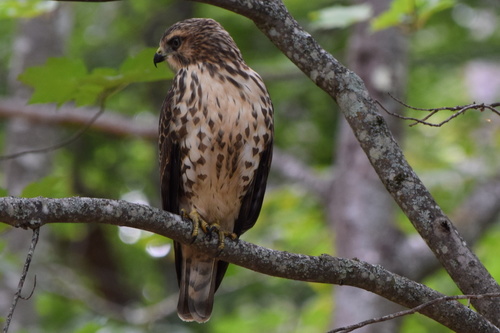
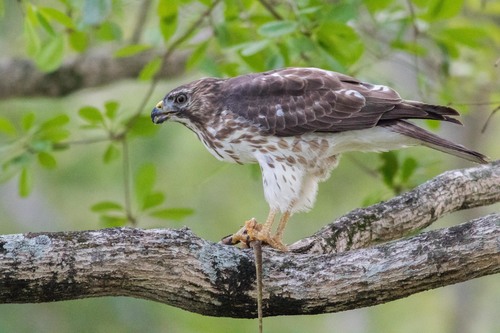
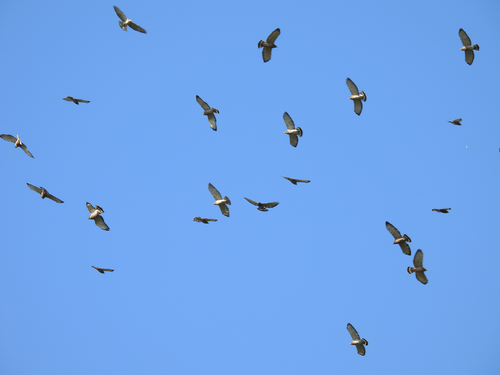
Photographs from iNaturalist · photographer credits
About from Wikipedia
Description
The broad-winged hawk is a relatively small Buteo, with a body size from 32 to 44 cm (13 to 17 in) in length and weighing 265 to 560 g (9.3 to 19.8 oz). The tail is relatively short, measuring 14.5–19.0 cm (5.7–7.5 in) in length. The tarsus measures from 5.6 to 6.6 cm (2.2 to 2.6 in). As in most raptors, females are slightly larger than males. Broad-winged hawks have relatively short and broad wings, pointed at the end, which have a tapered appearance unique to the species. The wingspan can range from 74 to 100 cm (29 to 39 in), with the extended wing bone (standard measurement) measuring 22.7–30 cm (8.9–11.8 in). An adult's body is a dark brown with a white belly and chest containing horizontal barring. Its tail can be a dark grey-black with white lines along the middle, base, and tip. The young hawks have a slightly different coloring with more white and longitudinal barring instead of horizontal barring. The two types of coloration are a dark morph with fewer white areas and a light morph that is more pale overall. The light morph of this bird is most likely to be confused with the red-shouldered hawk, which has a longer, more heavily barred tail and wings with a solid rufous color in the adult, which are usually distinctive. Rare dark morphs are a darker brown on both upperparts and underparts. Dark-morph short-tailed hawks are similar, but are whitish under the tail with a single subterminal band.
Range & habitat
Broad-winged hawks have a wide range in North America and South America, from southern Canada to southern Brazil. Their breeding range is in the northern and eastern parts of North America, and some migrate in the winter to Florida, southern Mexico, and northern South America. Five subspecies are endemic to the Caribbean and do not migrate. Those subspecies that do migrate fly in flocks of more than 40 up to several thousand at heights from 550 to 1,300 m (1,800 to 4,270 ft). They soar using thermals to carry them through their journey of 3,000–6,000 km (1,900–3,700 mi). Fall migration lasts for 70 days as birds migrate about 100 km (62 mi) per day from North America, through Central America to South America without crossing salt water. The enormous flocks of soaring broad-winged hawks are termed kettles and are characteristic of many hawk migration spectacles in North America, such as at Hawk Cliff in Ontario, Hawk Ridge in Minnesota, Hawk Mountain in Pennsylvania, and the River of Raptors in Veracruz. Broad-winged hawks stay in areas up to an elevation around 2,000 m (6,600 ft). They breed in deciduous forests good for nesting and forage primarily in wetlands and meadows. While some birds have acclimatized themselves to living near humans, even those birds avoid human settlements and interactions. In the winter, the migrating subspecies of the hawks seek out similar conditions to their overwintering home, so they settle in deciduous and mixed forests. Although it is declining in some areas because of forest fragmentation, its overall population is increasing and is assessed as least concern on the IUCN Red List.
Adapted from Broad-winged hawk on Wikipedia, used under CC BY-SA 4.0.