Photographs
what it really looks like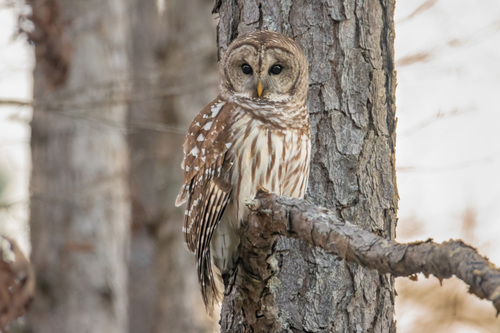
Photographs from iNaturalist · photographer credits
About from Wikipedia
Description
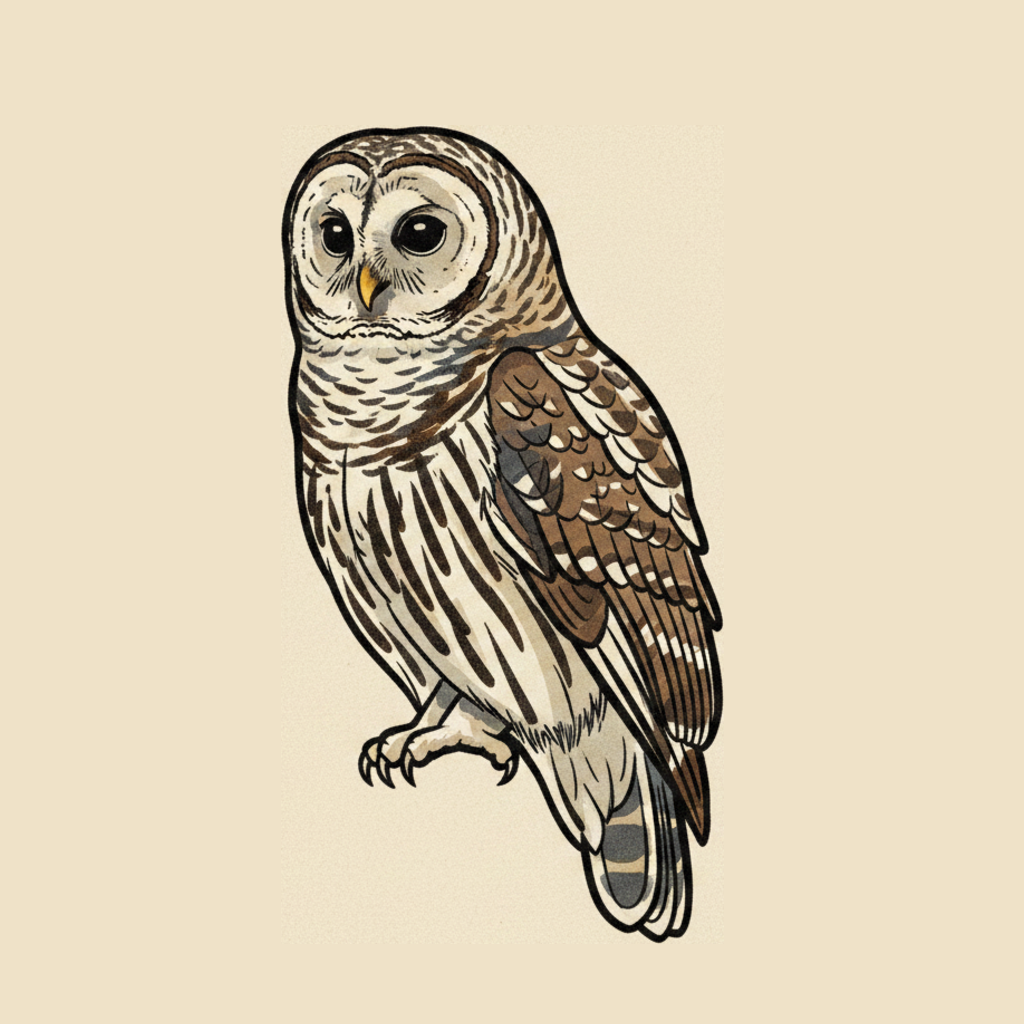
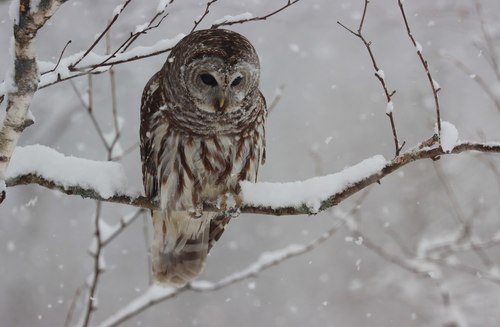
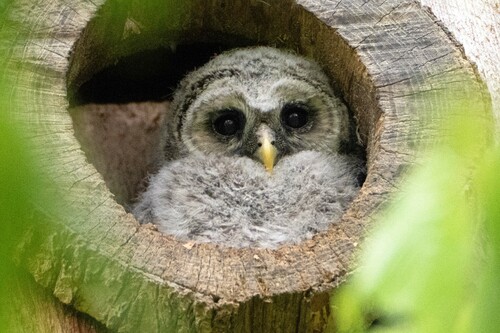
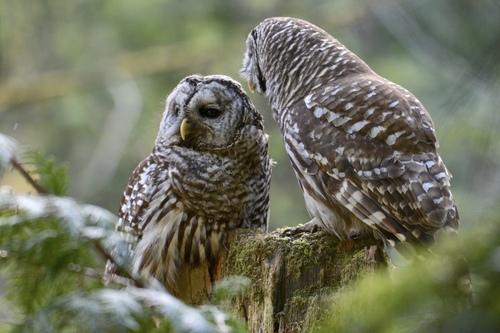
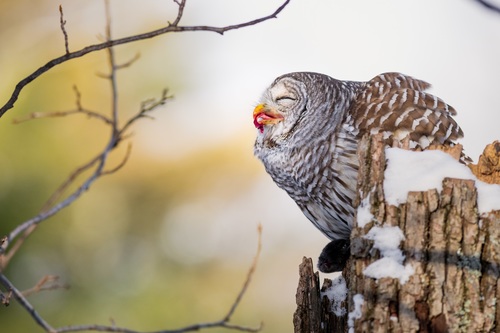
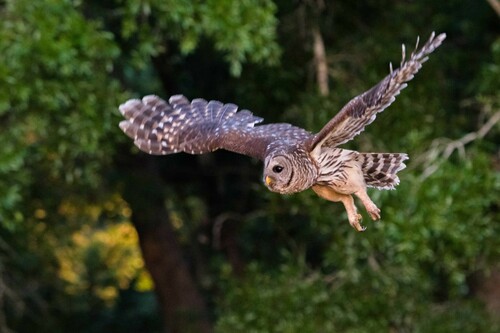
The barred owl is considered somewhat subdued and drab in coloration compared to the sometimes rich coloring of other sympatric owls. Overall, this owl is greyish-brown or brown. The brownish color extends from the head to the back. Barred owls are scalloped with white bars on the mantle and the back, bearing as well some whitish spotting on the wing coverts. The underside has a pale creamy gray-brown base color (ranging into dirty white in the palest individuals) overlaid about the throat and upper chest with horizontal, slightly crescent-shaped barring (hence its common name), while the belly is boldly streaked in a vertical pattern. The streaking is usually blackish, dusky brown, or sometimes rufescent- (reddish-) brown. The head is fairly large (although not especially so for a species in Strix) and rounded with no ear tufts. The facial disc is pale grayish-brown with darker yet subtle concentric lines. The bill is pale straw-yellow (occasionally showing a mild greenish tint) while the cere (a bare structure at the base of the beak) is "horn-colored". Its eyes are a dark brown color; the eyes may appear intensely black in the field and, although large, are fairly closely set. The barred owl has well-developed eye anatomy. As is typical of owls, their ocular anatomy is quite distinct from diurnal raptors especially in terms of their photoreceptor cells, as they have a very large number of rod cells in their quite sensitive retina. However, their pecten oculi is smaller relative to the size of their large ocular globe (other large owls are known to have similar pecten proportions). The vision in limited or almost no light during a laboratory study of a barred owl was found to be similar to that of other owls, including the long-eared owl (Asio otus) and the American barn owl (Tyto furcata). The tarsi and toes are feathered up to the dark gray, black-tipped talons. These feathers are more sparse and bristled in the southern races. On individuals with bare sections of their toes, the toes are yellowish-gray in color. The flight feathers are barred with whitish buff and brown while the tail is brown or grayish-brown with 4–5 whitish bars. Young barred owls with their second set of down feathers are fluffy brownish-white, with indistinct darker barring on their head, back and mantle. They quickly become juveniles which resemble adults but have less distinct markings (especially about the head and neck), more buff coloring overall, often some remnant down, pinkish skin and a pale, blue-green cere. Also the tail at this age may have as many as seven bands (though sometimes have four, like adults). Full adult plumage is obtained via molt after about a year as well as adult bare part characteristics. A study of tail molt in Washington showed that molt tends to occur relatively quickly, and that young individuals are difficult to age by state of molt alone. Southern barred owls tend to be darker and slightly smaller than northerly ones. Rare captive and wild barred owls with albinism have been described and are pure white but tend to retain their brown eyes. The barred owl is a large species. The adult measures anywhere from 40 to 63 cm (16 to 25 in) in length while the wingspan may range from 96 to 125 cm (38 to 49 in). The wing area (measured by square centimeter relative to the body mass) is quite intermediate among American owls, with the wing loading being lower than larger, but proportionately small-winged larger owls and even than some smaller owls. The barred has high wing-loading. Wing-loading is related to hunting technique, with higher wing-loading owls typically hunting from a perch, with only a brief flight necessary to obtain food, whilst lower wing-loading owls often hunt their prey from active flight. As is the case in most owls, the various wing feathers of barred owls are uncharacteristically soft and bear a comb-like shape, which in turn renders their flight functionally silent during their hunts. Like most birds of prey, the female is larger than the male barred owl, sometimes described as reverse sexual dimorphism (due to the fact that males average larger than females in most non-raptorial birds). Among standard measurements, the wing chord of grown males varies from 303 to 340 mm (11.9 to 13.4 in), with an average from three sources of 326.2 mm (12.84 in), the tail may measure from 182 to 250 mm (7.2 to 9.8 in), with an average of 219.6 mm (8.65 in) and the culmen from the cere may measure from 22 to 27 mm (0.87 to 1.06 in), with an average of 24.3 mm (0.96 in). Meanwhile, for the female, the wing chord may range from 318 to 357 mm (12.5 to 14.1 in), averaging 335.8 mm (13.22 in), the tail from 204 to 257 mm (8.0 to 10.1 in), averaging 223.3 mm (8.79 in) and the culmen from the cere 20 to 30.7 mm (0.79 to 1.21 in), averaging 25.1 mm (0.99 in). Sexual dimorphism is particularly pronounced in barred owls by body mass as males within a population are sometimes a third lighter in weight. In the nominate subspecies (S. v. varia), average weights for males have been reported as 621.9 g (1.371 lb) (sample size 12), 632 g (1.393 lb) (sample size 20) and 681 g (1.501 lb) (sample size unknown) in three samples. The weight range for adult males is known to vary from 468 to 812 g (1.032 to 1.790 lb). The considerably larger female of the nominate subspecies has been reported to average 801 g (1.766 lb) (sample size 24), 872.6 g (1.924 lb) (sample size 14) and 909.5 g (2.005 lb) (sample size unknown). Altogether, fully-grown female barred owls may weigh from 610 to 1,150 g (1.34 to 2.54 lb).
Range & habitat
The barred owl is distributed throughout most of the eastern United States, as well as much of southern Canada. They are found as far northeast as much of Nova Scotia (western two-thirds), New Brunswick and Sept-Îles, in much of Quebec, up to Lake Mistassini, and Ontario, up to Moosonee. The barred owl has been recorded as far north as central Labrador, though the species is not yet confirmed to breed in the province. The barred owl ranges in every part of the eastern United States continuously from northernmost Maine down throughout New England, the Mid-Atlantic states, much of the Midwest, the Southeast United States and all of Florida. Their range extends without substantial gaps to the limits of western Minnesota, easternmost South Dakota, the southeastern corner of Nebraska, the eastern half roughly of Kansas, most of Oklahoma and east Texas to as far west as Cisco and Burnet. Arguably and discontinuously from Texas, the species may range into central and southern Mexico but these populations are now often considered a separate species. These initial parts of the range in the eastern and central stretches would be considered as where the species is "native". A wandering barred owl was once seen flying over Lake Michigan 48 km (30 mi) from the nearest land.
Behaviour
The barred owl, like most owls, is largely adapted to nocturnality. Between 5:00 am and 8:00 pm, juvenile barred owls were recorded to sleep an average of 28% of each hour. Peak times in Minnesota were found to be right after sunset and just before dawn. Nonetheless, they are not as fully nocturnal as many owls and rank around 6th amongst 19 regular North American owl species for the regularity of their activity outside of nightfall, especially in particular circumstances such as when a rival or a human impersonator is emitting barred owls calls or whilst hunting. Often daytime activity tends to be early in the morning or around dusk but potentially at any time (overcast days being preferred). This species often spends the daytime hidden away in the dense foliage of a tree, often at minimum 5 m (16 ft) above the ground, but sometimes also roosts in a branch close to a broad trunk or in a natural tree hollow. Roost tree heights in Minnesota was typically 8 to 12 m (26 to 39 ft) while, in Illinois, they were up to 9 m (30 ft). Recently fledged owls sometimes roost in tall grass, usually after falling from the nest tree. Roost site selection may be partially dictated by thermoregulation, as in spotted owls, with shadier roosts likely to mitigate heat stress. They seldom rely on camouflage, instead often flying at the least disturbance and not allowing close approaches, making them potentially difficult to observe. Yet, on the other hand, they can be surprisingly tame and seemingly curious of people in the wild; further they are considered "as mild and engaging" as a predator can be. Barred owls are regularly subject to mobbing by small birds, from several small passerines to corvids and woodpeckers, and mammals when discovered by them during the daytime, and such situations may lead to them being attacked by diurnal birds of prey. There are some records of barred owls engaging in allopreening, presumably between pairs, with each other in the wild. They are skilled and silent fliers and frequently use routine forest flyways with open understory and low branch densities. Like most species of owl in the Strix genus, the barred owl tends to be highly territorial regardless of the time of year. The territories are claimed by singing from different perches, often near the perimeter of its perceived home range. The boundaries are almost always well-maintained by barred owls and are generally stable from year to year and even generation to generation. Territory sizes have been determined via radio telemetry. The average territory size of 13 in Minnesota was 273 ha (670 acres), of 7 in Michigan it was 282 ha (700 acres) and of 10 in Wisconsin was 337.9 ha (835 acres). Another Minnesota study found pairs to occupy a mean of about 226 ha (560 acres) in mixed hardwood-conifer woods. Pairs in an Oklahoma study were reportedly found every 110 to 165 ha (270 to 410 acres). The mean territory size from 10 studies was estimated from throughout the range. In this study, the breeding season mean area was calculated at 256.7 ha (634 acres) in males and 297.8 ha (736 acres) in females; whereas the means in nonbreeding season were 900.4 ha (2,225 acres) in males and 536.2 ha (1,325 acres) in females. Overall, the annual mean home range for males was 782 ha (1,930 acres) and for females was 538.7 ha (1,331 acres). The breeding range's mean home size in Washington was 321 ha (790 acres), while it was 971 ha (2,400 acres) in the non-breeding season. The ranges of pairs overlaps in the breeding season, at 87–95% range overlap, but decreases down to 45% after hatching. In a Florida study of barred owls, territorial responses, including several duets, by a pair were found to be provoked by researchers playing calls of both "stranger" owls and recordings of owls that were neighbors to the pair being tested. The aggressive response even to known neighbors in this study is unusual. In tawny owls in a study from Italy, for instance, they responded mildly or not at all to the calls of neighboring tawny owls known to them but with great aggression to the calls of "stranger" owls. Due to its rather stolidly territorial nature, the barred owl is not normally a migratory species. Claims in the past of "rather impressive" flights in New England in the past were lacking in verifiable details. Of 158 banded recoveries in the northern part of the range, movements during winter were found to cover no further than 10 km (6.2 mi), while all those recovered in Saskatchewan and Alberta scarcely moved at all. There is little to no evidence of nomadic behavior as has been recorded in several other owls in the north.
Adapted from Barred owl on Wikipedia, used under CC BY-SA 4.0.